UAE Positioned to Capture AI Trade Wave as AI Goods Now Drive 43% of Global Trade Growth, DMCC Report Finds
DMCC's Future of Trade 2026 report finds that AI-related goods now account for 43 percent of global trade growth despite representing only 15 percent of volume, and identifies the UAE as one of the best-positioned economies to capture the next phase of AI-enabled trade and supply chain flows.
Key Takeaways
- ▸AI-related goods accounted for 43 percent of global trade growth in the first half of 2025 despite representing only 15 percent of trade volume, with trade across 100 AI-related product lines reaching 1.92 trillion US dollars.
- ▸The UAE retains second place globally in DMCC's Commodity Trade Index and is identified as a key connector economy for the next phase of AI-enabled trade.
- ▸South-South trade now accounts for 35 percent of global flows, surpassing North-North flows at 25 percent, favouring the corridors where the UAE sits.
- ▸AI-enabled trade depends on physical infrastructure including data centres, power grids, and logistics networks, areas where the UAE's investment strategy is directly aligned.
DMCC, Dubai's international business district, has published its Future of Trade 2026 report, finding that AI has crossed the operational threshold in global trade and that the UAE is positioned to play an outsized role in the next phase of AI-enabled commerce, supply chain restructuring, and next-generation trade finance.
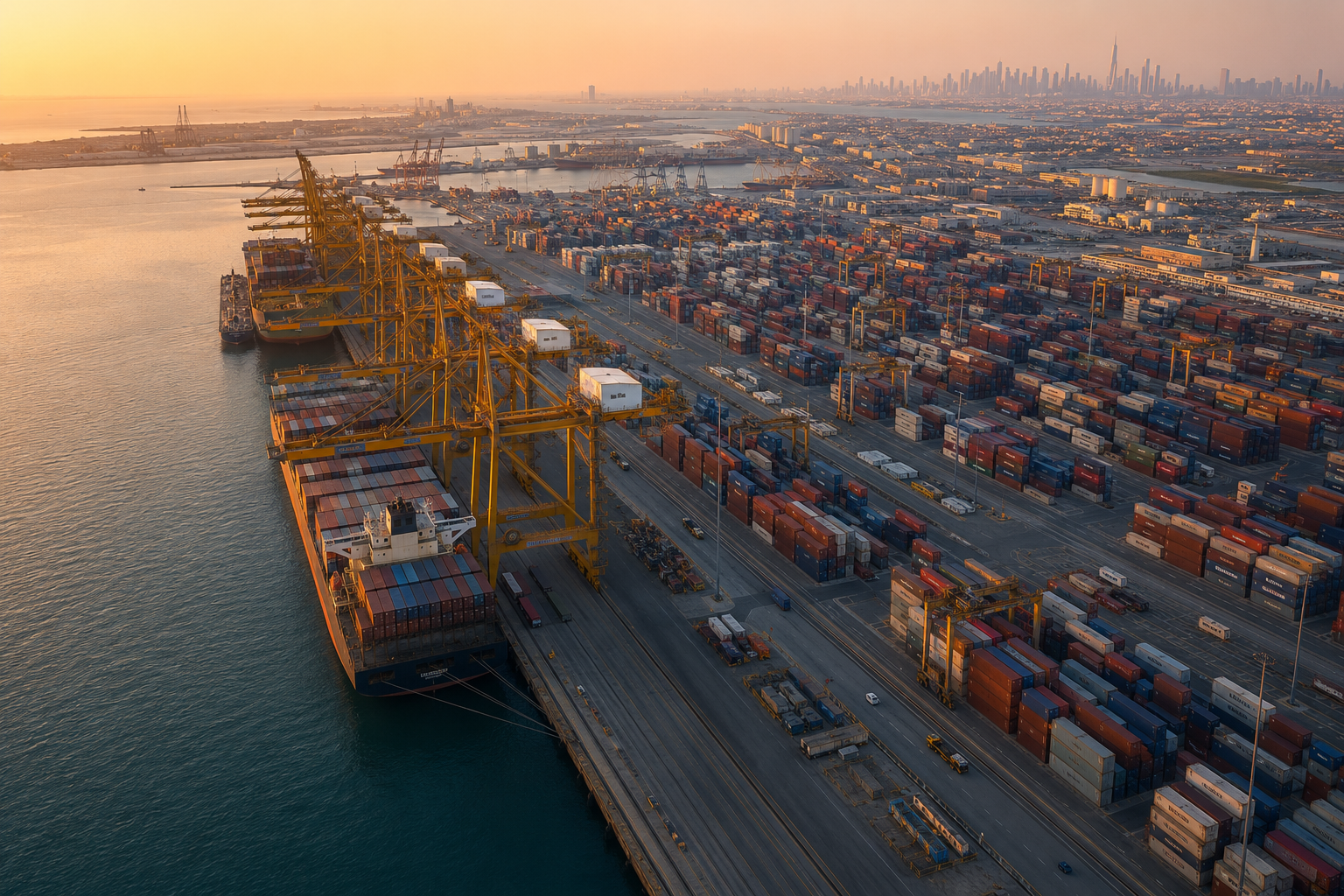
The headline data point on AI trade is striking. AI-related goods represented approximately 15 percent of global trade by volume in the first half of 2025 but accounted for 43 percent of global trade growth over the same period. Trade across 100 AI-related product lines reached 1.92 trillion US dollars, up more than 20 percent year on year, compared with less than 4 percent growth in non-AI goods. The report is explicit that AI-enabled trade will depend on physical infrastructure as much as software adoption. Semiconductors, data centres, power grids, cooling systems, water, critical minerals, ports, and logistics networks are identified as the decisive factors in where AI capability can scale. This framing maps directly onto the Gulf's sovereign AI infrastructure investment strategy, where capital is being directed precisely at this physical layer.
The report positions the UAE as a key connector economy in the new geography of global trade. South-South trade now accounts for approximately 35 percent of global flows, surpassing North-North flows at 25 percent, and the UAE sits at the intersection of the corridors linking Asia, the Middle East, Africa, and Latin America that are driving that growth. The UAE ranked among the top five recipients of greenfield investment globally in 2024, reinforcing the report's finding that investment is following economies that can operate credibly across multiple trading blocs simultaneously.
For the AI trade wave specifically, the report notes that the UAE combines energy security, advanced logistics infrastructure, capital access, commodities expertise, and diversified trade relationships in a configuration that is directly relevant to AI supply chain requirements. Data centres require stable, competitive power. AI hardware requires reliable logistics and low-tariff transit. AI services require sophisticated financial infrastructure and regulatory clarity. The UAE scores strongly on all four dimensions.
On trade finance and digital payments, the report identifies the UAE as one of a small group of jurisdictions, alongside Singapore, Hong Kong, and the UK, that have introduced or are actively developing stablecoin regulatory frameworks providing the certainty institutions need to adopt digital settlement at scale. The UAE is also a core participant in mBridge, the most significant wholesale central bank digital currency initiative currently operational. The report notes the UAE's trade finance gap is negligible at a time when the global gap remains at 2.5 trillion US dollars, a structural advantage for enterprises using Dubai as a base for AI-related trade flows. This connects directly to the GCC financial services AI adoption data AWM has tracked throughout 2026, where AI deployment in trade finance, compliance, and fraud detection is moving from pilot to production at Gulf banks.
The report's scenario analysis finds that more than 80 percent of respondents expect slow, uneven trade growth over the next one to three years, with businesses treating disruption as the baseline operating assumption. Only 4 percent expect a best-case scenario. In that environment, the connector economy model the UAE has built, offering predictability and the ability to operate across multiple markets simultaneously, becomes more rather than less valuable to enterprises navigating AI supply chain complexity.
Frequently Asked Questions
What share of global trade growth do AI goods represent?
According to DMCC's Future of Trade 2026 report, AI-related goods accounted for 43 percent of global trade growth in the first half of 2025, despite representing only 15 percent of trade volume. Trade across 100 AI-related product lines reached 1.92 trillion US dollars.
Why is the UAE well positioned for AI-enabled trade?
The UAE combines energy security, advanced logistics, capital access, commodities expertise, and diversified trade relationships. The report also identifies the UAE as a frontrunner in next-generation financial infrastructure including stablecoins and CBDC participation through mBridge.
What is the South-South trade shift?
South-South trade now accounts for approximately 35 percent of global flows, surpassing North-North flows at 25 percent, shifting trade growth toward corridors linking Asia, the Middle East, Africa, and Latin America where the UAE is centrally positioned.
What does AI-enabled trade depend on physically?
The report identifies semiconductors, data centres, power grids, cooling systems, water, critical minerals, ports, and logistics networks as the decisive physical infrastructure factors in where AI capability can scale.
Related Articles
Everyone Expects Two AI Blocs. The Gulf Is Betting It Doesn't Have to Choose
Saudi Arabia is simultaneously the deepest US AI partner in the Gulf and the home of a sovereign AI company that just built its flagship Arabic model on Chinese architecture, and according to a new analysis, that isn't a contradiction, it's the point.
Sep 16, 2026
AnalysisHumain and G42 Look to Raise Outside Capital as Gulf AI Giants Weigh IPOs
Saudi Arabia's Humain and Abu Dhabi's G42 are both exploring outside capital and potential IPOs as their AI ambitions scale beyond sovereign funding alone.
Sep 8, 2026
AnalysisDubai Police Deploy 36 AI Robots, Complete 104 Technology Projects
Dubai Police has deployed 36 RPA robots and completed 104 technology projects over the past year as it expands AI across policing and administrative operations.
Sep 7, 2026
AnalysisDubai Chambers Launches Agentic AI Training for 14,000 Member Companies
Dubai Chambers has launched specialised Agentic AI training tracks through a new e-learning platform, aiming to equip more than 14,000 member companies with the skills to adopt the technology across their operations.
Sep 2, 2026
AnalysisHumain and DataVolt Partner for 100MW AI Data Centre on Saudi Arabia's Red Sea Coast
Saudi AI firm Humain has partnered with DataVolt to build a 100MW data centre at Oxagon, NEOM, the first phase of a larger 1.5 gigawatt AI campus.
Sep 2, 2026