The Quiet Revolution in the Clinic: How AI-Driven Medical Search Is Reshaping Healthcare Decision-Making Across the MENA Region
A generation of physicians across the Gulf, Levant, and North Africa is quietly adopting AI-powered clinical decision support — often without institutional oversight, regulatory frameworks, or validated safety data. Drawing on the global rise of OpenEvidence and the specific pressures facing MENA’s healthcare systems, this analysis examines the promise, the peril, and the policy gap at the heart of AI medicine in the Arab world.
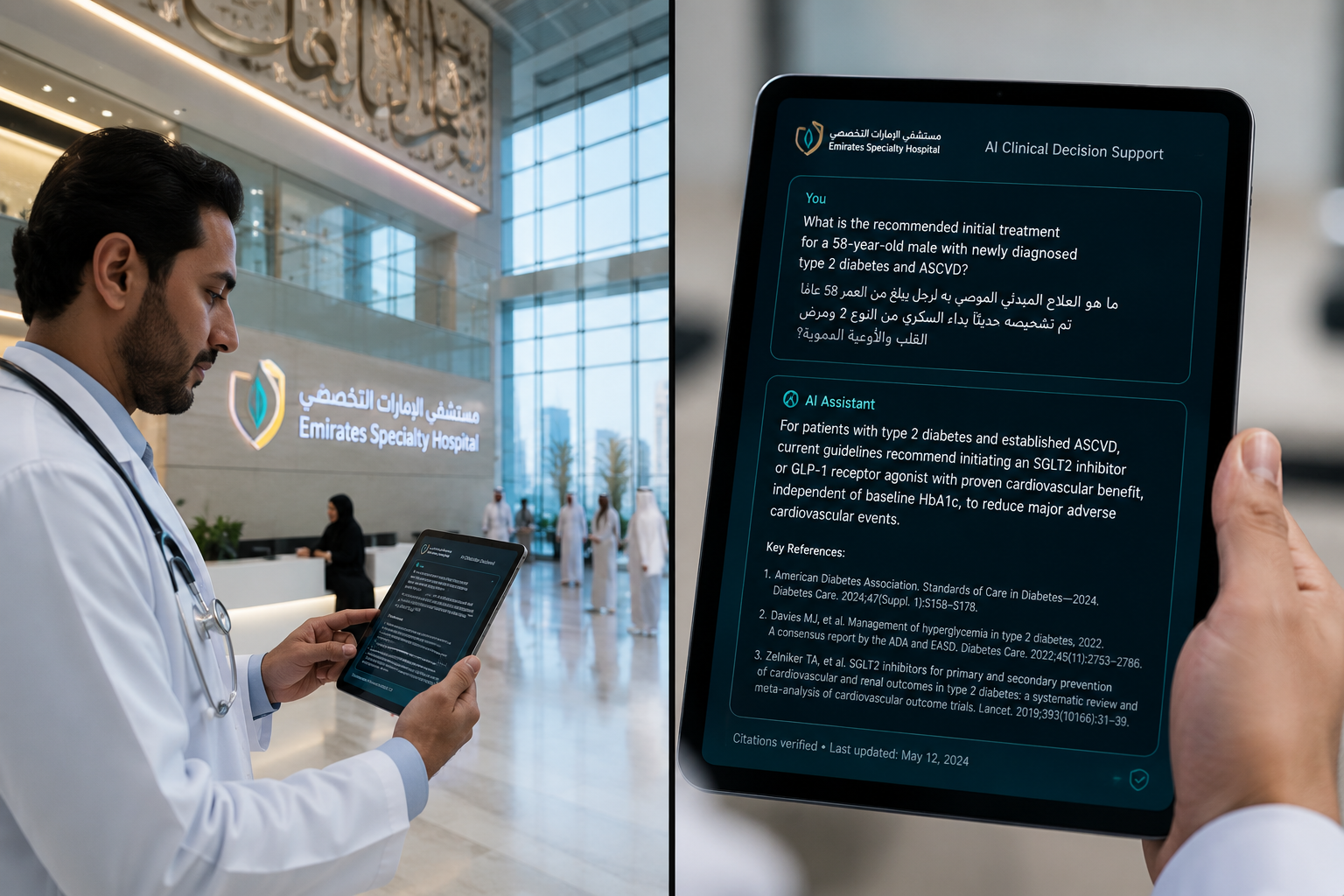
Key Takeaways
- ▸AI medical tools are in active use — without regulation
- ▸Global tools carry MENA-specific accuracy risks
- ▸Shadow AI is a patient safety issue
- ▸The evidence base does not match the adoption curve
- ▸MENA has a strategic window — and it is closing
- ▸Medical education reform is urgent
The Physician’s Dilemma: Why Traditional Resources Are Failing MENA Clinicians
For decades, point-of-care clinical information was dominated by static, long-form repositories of peer-reviewed summaries. These tools were designed for an era of deliberate, desktop-based research. They reflect the workflow of a physician with time — a commodity that is vanishing across MENA’s healthcare systems.
The MENA Context: Systemic Pressure Points
• Workforce Gaps: The Gulf’s rapid healthcare expansion has dramatically outpaced the supply of specialist physicians. Saudi Arabia, for example, has a physician density below the OECD average despite substantial infrastructure investment. Overextended clinicians have less time per patient encounter to consult traditional research tools.
• Multilingual Clinical Environments: MENA’s hospitals are among the world’s most linguistically diverse. A physician in Abu Dhabi may be Filipino-trained, consulting a tool in English, for a patient whose chart is partially in Arabic. AI tools that process natural language queries regardless of rigid keyword structure offer a meaningful practical advantage.
• Cross-Specialty Demand: In regions where specialist density is low, general practitioners and non-specialist surgeons regularly manage conditions outside their primary training. AI clinical decision support fills a critical knowledge gap in these settings — though not without risk.
• Medical Tourism and International Patient Profiles: The UAE and Jordan are major medical tourism destinations. Physicians managing international patients may encounter medication regimens, genetic predispositions, or epidemiological backgrounds unfamiliar from local training. AI tools calibrated to global literature offer rapid orientation.
The Technology: What AI Clinical Decision Support Actually Does
Understanding the technology is essential to evaluating both its promise and its limitations. The most sophisticated AI medical search platforms — of which OpenEvidence is the most widely adopted globally — operate on a fundamentally different architecture from general-purpose AI chatbots such as ChatGPT or Gemini.
Retrieval-Augmented Generation (RAG): The ‘Search Glue’ Model
Rather than generating answers from a statistical model of text, RAG-based systems work as follows:
• Primary Source Licensing: The platform holds direct licensing agreements with high-impact journals (New England Journal of Medicine, JAMA, The Lancet) and clinical guideline bodies (NCCN, WHO, specialty societies).
• Contextual Retrieval: When a physician submits a query, the system identifies specific passages, data points, and figures from licensed full-text articles relevant to that query.
• Synthesis with Citation: The AI synthesises these retrieved passages into a coherent answer — and every claim is linked to a traceable, peer-reviewed source.
This architecture makes RAG-based medical AI categorically different from general AI: it is not fabricating — it is curating. However, as this article’s risk section will address, curation is not the same as correctness.
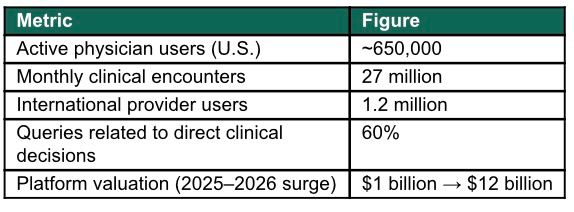
Key Performance Metrics (Global, April 2026)
Clinical Utility: Where AI Decision Support Delivers in MENA Settings
Research identifies three primary domains where AI clinical decision support offers meaningful advantages over traditional search. Each has specific resonance in MENA healthcare contexts.
3.1 Medication Verification and Pharmacovigilance
MENA’s pharmaceutical markets are characterised by high rates of polypharmacy, a significant parallel import sector, and varying availability of originator versus generic medications. Physicians managing complex drug regimens — particularly in elderly patients with multiple comorbidities — can use AI tools to rapidly verify rare side effects, drug interactions, and contraindications against the most current literature.
This is particularly relevant in the Gulf, where lifestyle-related conditions (type 2 diabetes, hypertension, dyslipidaemia) create complex multi-drug patient profiles managed across fragmented care settings.
3.2 Diagnostic Pathway Optimisation
Choosing the correct diagnostic modality — CT versus MRI, ultrasound versus plain film — requires synthesis of clinical presentation, radiation risk, cost, and current evidence. In MENA healthcare systems where imaging resources may be unevenly distributed (abundance in private Gulf hospitals, scarcity in public North African facilities), AI decision support can help clinicians optimise their choices within available resources.
3.3 Cross-Specialty Support in Low-Density Settings
Across North Africa and the Levant, where specialist physician density is far below GCC levels, AI clinical decision support enables generalist physicians to manage conditions at the boundary of their expertise — a surgeon managing antihypertensive therapy, a general practitioner interpreting a haematology result. This is not a replacement for specialist referral, but in settings where referral pathways are slow or inaccessible, it represents a meaningful clinical scaffold.
Risks and Critical Limitations: The Evidence Gap Behind the Adoption Curve
The global adoption of AI clinical decision support has significantly outpaced the production of rigorous, peer-reviewed evidence on its accuracy, safety, and outcome effects. This gap is more acute in MENA, where the technology is being adopted into healthcare systems with limited existing infrastructure for evaluating health technology.
4.1 The Hallucination and Synthesis Error Problem
Even RAG-based systems — which retrieve from licensed sources rather than generating from statistical patterns — are not immune to synthesis errors. Documented failure modes include:
• Drawing strong conclusions from studies with small sample sizes or underpowered methodology.• Misrepresenting risk levels or effect sizes when synthesising across multiple conflicting studies.• Presenting provisional or contested findings with a confidence that the underlying literature does not support.
A December 2025 study found that AI medical search tools accurately answered complex clinical queries less than 45% of the time in controlled evaluation. The discrepancy between this objective performance and physician perception of accuracy is one of the most concerning findings in the field.
4.2 The MENA-Specific Evidence Deficit
The training data and source licensing of global AI medical platforms is overwhelmingly drawn from Western journals and clinical guidelines calibrated to Western patient populations. This creates specific risks in MENA contexts:
• Epidemiological Mismatch: Disease prevalence, genetic predispositions (e.g., familial hypercholesterolaemia rates in Gulf populations, haemoglobinopathy burden in Egypt), and drug metabolism variations relevant to MENA populations are underrepresented in the source literature.• Guideline Relevance: Many AI tools default to FDA or EMA guidance. In MENA, clinicians operate under Saudi FDA, UAE Ministry of Health, Egyptian Drug Authority, or WHO frameworks — which may differ materially on approved indications, dosing, and contraindications.• Arabic Language Interface Limitations: Most platforms are optimised for English-language queries. The cognitive load of formulating clinical questions in a second language — and interpreting answers in it — is a genuine safety consideration in high-stakes clinical moments.
4.3 Skill Atrophy and Medical Education
Experienced MENA clinicians and medical educators are raising concerns that parallel those heard globally: the risk that the next generation of physicians, trained in environments where AI decision support is ambient and immediate, may develop impaired capacity to interrogate primary sources, identify study methodology flaws, or reason through diagnostic uncertainty without algorithmic assistance.
This is not a theoretical concern in a region that has invested heavily in medical education — through institutions such as King Saud University College of Medicine, UAE University, and the American University of Beirut Medical Center — and is currently reforming curricula to meet Vision 2030 and National Agenda targets.
The Regulatory and Governance Landscape: A Region Still Catching Up
Perhaps the most urgent concern is the governance gap. In most MENA jurisdictions, specific regulatory frameworks for AI clinical decision support tools do not yet exist. The technology is being used in clinical settings under general digital health or medical device regulations not designed for generative AI.
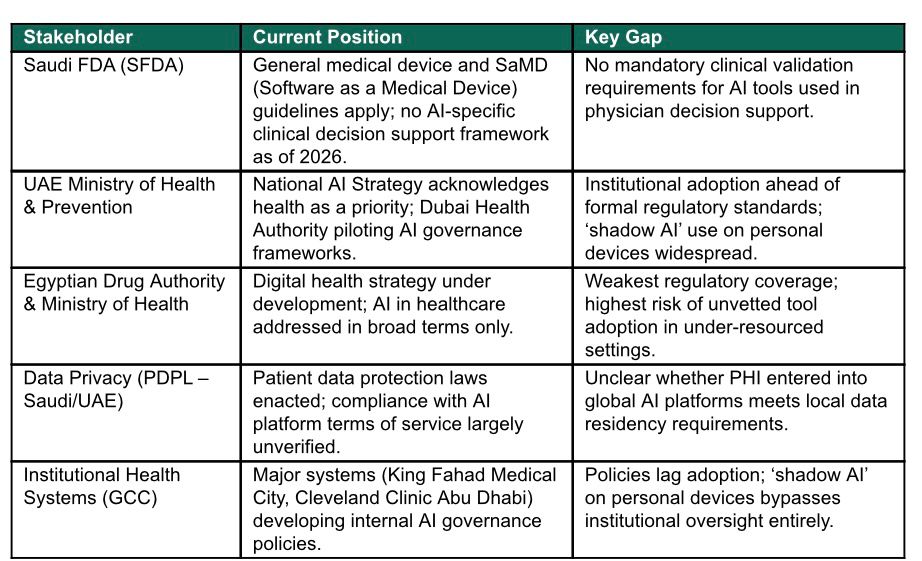
The Shadow AI Problem
A significant proportion of AI clinical decision support use in MENA — as globally — occurs on personal physician devices, outside any institutional oversight framework. A clinician consulting an AI tool on a personal smartphone between patient consultations leaves no institutional audit trail, no record of the query or response, and no mechanism for clinical governance review if the advice contributed to an adverse outcome.
This ‘shadow AI’ dynamic is particularly acute in MENA, where institutional digital governance maturity varies enormously between a fully digitalised Gulf tertiary centre and a district hospital in rural Egypt or Morocco.
The Competitive and Investment Landscape: Capital’s Bet on AI Medicine
The financial trajectory of AI clinical decision support is a signal of structural, not cyclical, change. The surge in valuation of leading platforms from approximately $1 billion to $12 billion in a single year reflects capital markets’ conviction that AI will become the primary infrastructure layer of medical knowledge globally.
For MENA, this has specific implications:
• Incumbent Disruption: Traditional clinical reference tools — many of which are widely used in MENA’s academic and teaching hospitals — are pivoting to AI-enhanced interfaces. The window for MENA health systems to shape their relationship with these platforms (through procurement policy, data agreements, and localisation requirements) is narrowing.• Regional Investment Opportunity: Gulf sovereign wealth funds and healthcare holding companies are well-positioned to invest in or partner with AI clinical decision support platforms that commit to MENA-specific dataset development, Arabic-language interfaces, and regional guideline integration.• Talent and Development: Saudi Aramco’s medical services, Mubadala Health, and IHC (International Holding Company) are among the regional entities with both the capital and the clinical scale to pilot and validate AI clinical decision support tools against MENA patient populations — generating the evidence base the field currently lacks.
Recommendations: A MENA Framework for Responsible AI in Clinical Practice
The adoption of AI clinical decision support in MENA is not a question of whether — it is already happening. The question is whether it happens with or without the governance, validation, and educational frameworks that patient safety requires.
For Regulators
• Develop AI-specific SaMD (Software as a Medical Device) sub-frameworks within existing health technology assessment structures, incorporating mandatory clinical validation for tools used in direct physician decision support.• Establish data residency requirements clarifying whether PHI entered into global AI platforms must be processed on servers within national or GCC-wide boundaries.• Create a GCC-wide mutual recognition framework for AI health tool validation, reducing duplication and establishing a regional evidence standard.
For Health Systems and Hospital Leadership
• Formalise AI governance policies that bring shadow AI usage to the surface — integrating approved tools into EHR workflows with audit trails, rather than driving use to personal devices.• Commission MENA-specific accuracy audits of AI clinical decision support tools, with particular attention to epidemiological relevance, guideline applicability, and Arabic-language performance.• Establish ‘human-in-the-loop’ protocols for AI-assisted decisions in high-risk clinical domains (oncology, critical care, paediatrics), requiring physician verification of AI outputs against primary sources.
For Medical Educators
• Integrate AI literacy into undergraduate and postgraduate medical curricula across MENA institutions — teaching not just how to use AI tools but how to critically evaluate their outputs, identify their failure modes, and maintain primary source reasoning skills.• Develop MENA-specific case libraries for AI decision support training, drawing on the region’s distinctive disease epidemiology and clinical presentation patterns.
Conclusion: Efficiency Without Evidence Is Not Progress
AI-powered clinical decision support has achieved something rare in medicine: truly voluntary, rapid, mass adoption. Physicians are not being mandated to use these tools — they are choosing them because they work, or appear to. The gulf between perception and validated performance is precisely where the patient safety risk lives.
For the MENA region — home to some of the world’s most ambitious healthcare transformation programmes, some of its most resource-constrained public health systems, and one of the fastest-growing physician workforces globally — the stakes of getting this right are unusually high.
The technology is here. The adoption is happening. What MENA’s health systems, regulators, and medical educators have not yet built are the frameworks to ensure that ‘fast’ answers are also ‘safe’ answers — and that the quiet revolution in the clinic does not quietly erode the clinical judgment it was designed to support.
Related Articles
Everyone Expects Two AI Blocs. The Gulf Is Betting It Doesn't Have to Choose
Saudi Arabia is simultaneously the deepest US AI partner in the Gulf and the home of a sovereign AI company that just built its flagship Arabic model on Chinese architecture, and according to a new analysis, that isn't a contradiction, it's the point.
Sep 16, 2026
AnalysisHumain and G42 Look to Raise Outside Capital as Gulf AI Giants Weigh IPOs
Saudi Arabia's Humain and Abu Dhabi's G42 are both exploring outside capital and potential IPOs as their AI ambitions scale beyond sovereign funding alone.
Sep 8, 2026
AnalysisDubai Police Deploy 36 AI Robots, Complete 104 Technology Projects
Dubai Police has deployed 36 RPA robots and completed 104 technology projects over the past year as it expands AI across policing and administrative operations.
Sep 7, 2026
AnalysisDubai Chambers Launches Agentic AI Training for 14,000 Member Companies
Dubai Chambers has launched specialised Agentic AI training tracks through a new e-learning platform, aiming to equip more than 14,000 member companies with the skills to adopt the technology across their operations.
Sep 2, 2026
AnalysisHumain and DataVolt Partner for 100MW AI Data Centre on Saudi Arabia's Red Sea Coast
Saudi AI firm Humain has partnered with DataVolt to build a 100MW data centre at Oxagon, NEOM, the first phase of a larger 1.5 gigawatt AI campus.
Sep 2, 2026