Robotics and Automation in the GCC 2026: The Industries Being Transformed and What Comes Next
Saudi Arabia's robotics market reaches USD 554.9M in 2025, growing at 15.96% CAGR to 2034. GCC warehouse robotics is already a USD 1.2B market. This report covers every industry being transformed and what enterprise leaders must do next.
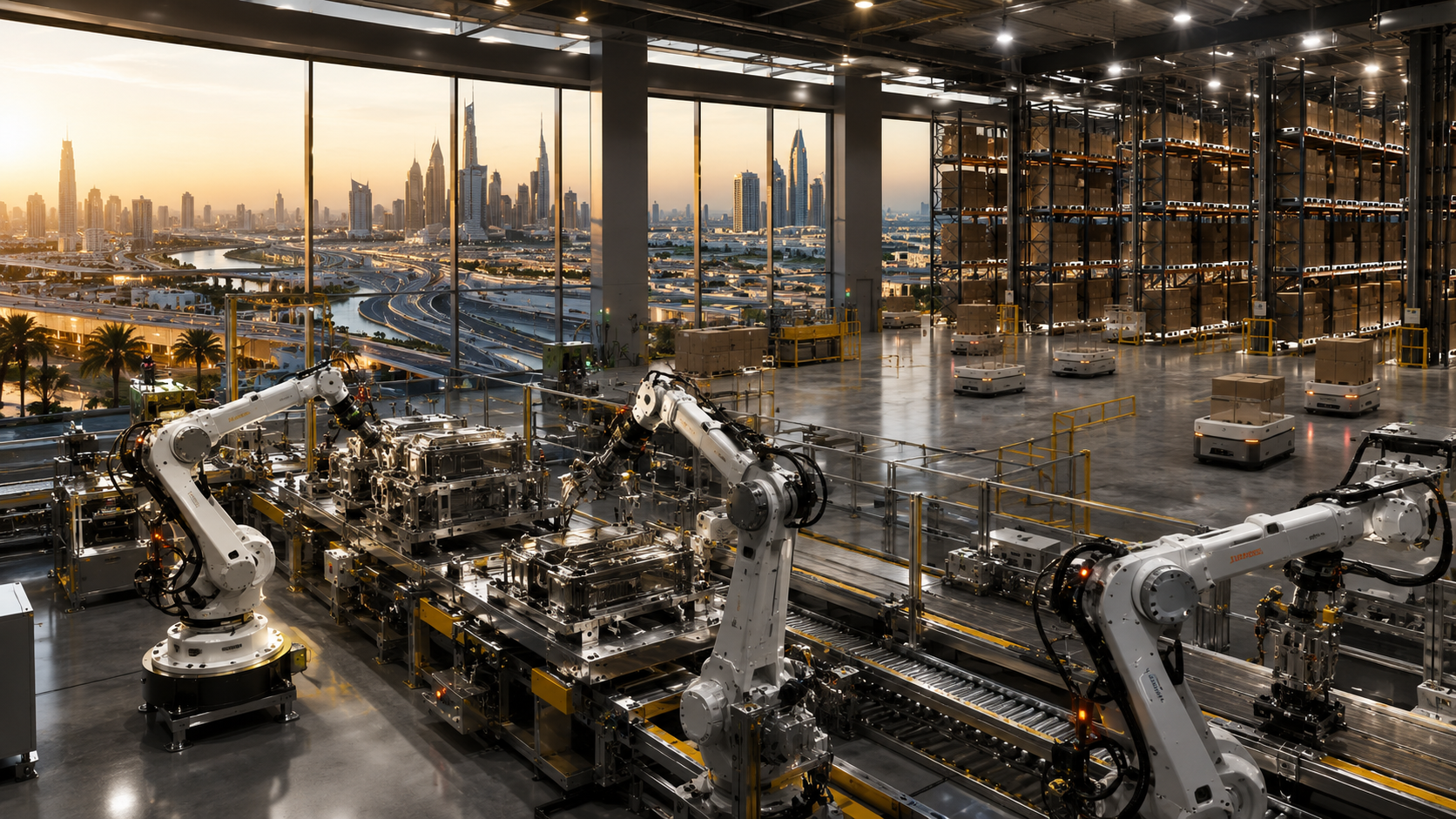
The GCC's robotics and automation market is no longer a forward-looking ambition sitting inside a national strategy document. It is a capital allocation decision being made in boardrooms across Riyadh, Abu Dhabi, and Dubai every quarter, backed by sovereign wealth funds, Vision 2030 implementation mandates, and a structural labour shortage that has made automation not merely desirable but operationally necessary.
Saudi Arabia's robotics market reached USD 554.9 million in 2025 and is projected to hit USD 2.1 billion by 2034 at a CAGR of 15.96%, driven by industrial automation, smart manufacturing, and Vision 2030 initiatives. The GCC AI-powered warehouse robotics and automation segment is already valued at USD 1.2 billion. Saudi Arabia holds the highest market share in GCC robotic process automation at more than 33%, followed by the UAE, driven by the expansion of manufacturing and logistics units and the rising adoption of automation across financial institutions.
For enterprise technology and operations leaders, 2026 is the year when the robotics question shifts from whether to deploy to which sector to prioritise first, what deployment model satisfies GCC regulatory and data requirements, and how to build the governance architecture that agentic automation increasingly demands.
The Market: Size, Growth, and Investment Drivers
| Market segment | Value | Growth |
|---|---|---|
| Saudi Arabia robotics market | USD 554.9M (2025) | 15.96% CAGR to 2034, projected USD 2.1B |
| GCC AI-powered warehouse robotics | USD 1.2B | Driven by e-commerce and logistics efficiency demand |
| GCC agricultural robots | USD 261.7M (2025) | 13.18% CAGR to 2034, projected USD 823.7M |
| Saudi Arabia RPA market share (GCC) | 33%+ | Highest share in the region |
| MEA RPA market share (global) | 6.0% (2025) | Saudi Arabia expected to register highest CAGR 2026 to 2033 |
Three structural forces are compounding growth across every segment simultaneously.
- Vision 2030 mandate: Saudi Arabia's Ministry of Industry and Mineral Resources launched the Future Factories Programme to build a robust technology ecosystem targeting 36,000 factories by 2035, with cutting-edge robotics and AI at the centre of that ambition. PwC assesses that AI and robotics could contribute more than USD 135.2 billion, or 12.4% of Saudi GDP, by 2030.
- Labour economics: Strict regulations on foreign labour and persistent shortages in skilled technical roles are pushing GCC businesses toward automation in manufacturing, logistics, and healthcare at a pace that pure technology-led demand alone would not have generated.
- Infrastructure readiness: The UAE's focus on becoming a global logistics hub, combined with Saudi Arabia's port and freight expansion programmes, has built the physical infrastructure that makes large-scale warehouse and logistics robotics commercially viable at a scale that was not available even three years ago.
Manufacturing: Robotic Arms, Quality Control, and Industry 4.0
Manufacturing is the highest-volume deployment sector for physical robotics across the GCC, and 2026 represents an acceleration point rather than a new beginning.
The Saudi government's focus on integrating the Internet of Things, AI, machine learning, cloud computing, and robotic process automation into the manufacturing sector to strengthen its capabilities is now in active implementation phase. Robotic arms installed in manufacturing plants are handling repetitive, high-risk tasks including welding, painting, and precision assembly, reducing injuries to labour while maintaining quality consistency that manual processes cannot sustain at the volumes Vision 2030's manufacturing targets require.
In the UAE, the Fourth Industrial Revolution strategy is driving manufacturers to deploy automated systems as a route to increased productivity and more innovative product development. The Middle East and Africa industrial robotics market, valued at USD 429.59 million in 2022, is projected to reach USD 871.73 million by 2030, with the UAE and Saudi Arabia holding the primary growth positions within that regional total.
The key players operating across GCC manufacturing robotics deployments include ABB, Fanuc, Kuka, Kawasaki Heavy Industries, Mitsubishi Electric, Universal Robots, and Yaskawa Electric, all of which have established regional partnerships and local implementation capability in the UAE and Saudi Arabia specifically.
Warehousing and Logistics: The USD 1.2 Billion Transformation
Aramex revealed the opening of an automated robotic sorting facility at Jeddah Islamic Port in January 2025, increasing logistics efficiency with a capacity of 4,000 shipments per hour.
Warehousing and logistics is the GCC robotics sector with the most clearly measurable and immediate commercial ROI, and it is where the largest deployments are occurring in 2026.
The e-commerce sector is the dominant driver, driven by the need for rapid order fulfilment and efficient inventory management. Retailers are adopting AI-powered warehouse robotics to enhance customer experience and streamline operations, with autonomous mobile robots navigating warehouse floors, optimising pick paths, and managing inventory in real time.
Key deployment patterns in 2026 across GCC logistics:
- Autonomous mobile robots for inventory navigation and pick-and-place in fulfilment centres
- AI-powered robotic sorting systems at port facilities, including the Jeddah Islamic Port Aramex deployment at 4,000 shipments per hour
- Drone delivery programmes for last-mile logistics in Saudi Arabia, reducing carbon emissions and labour dependency
- Predictive inventory management systems combining warehouse robotics with demand forecasting AI
For enterprises evaluating warehouse robotics investment, the integration of IoT with warehouse robotics, the shift toward autonomous mobile robots over fixed-conveyor systems, and the customisation of robotic solutions for sector-specific requirements are the three trends that define the 2026 deployment standard. Leading platforms operating in the GCC warehouse robotics space include GreyOrange, Locus Robotics, Swisslog, Dematic, and Honeywell Intelligrated, alongside regional implementations from Siemens and Zebra Technologies.
Healthcare: Dispensing, Disinfection, and Patient Monitoring
Healthcare robotics in the GCC is following a dual track: administrative automation handling prescription dispensing, patient monitoring, and clinical documentation, and clinical robotics in surgical and diagnostic support roles.
Robotic medication dispensing systems, disinfection robots, and patient monitoring automation are reducing manual labour and human error in hospital operations across Saudi Arabia and the UAE, with healthcare facilities investing in robotics specifically to enhance efficiency and quality of service within environments where precision requirements are among the highest of any deployment context.
Saudi Arabia's healthcare robotics trajectory is particularly notable. The sector is identified by IMARC as one of the key drivers of future Saudi robotics market demand, with healthcare facilities deploying systems specifically to address clinical accuracy requirements and labour availability challenges that are structurally persistent in a healthcare market growing at the pace that Saudi Arabia's population and economic development require.
For the UAE, the Malaffi platform, connecting 59 hospitals with 3.5 billion clinical records, creates the data infrastructure that makes AI-driven clinical robotics and patient monitoring automation viable at a national scale, and healthcare robotics vendors entering the UAE market should treat Malaffi integration capability as a procurement evaluation criterion rather than an optional feature.
Construction and Infrastructure: NEOM and the Frontier Deployments
Construction robotics represents the highest-profile and most capital-intensive segment of GCC robotics investment in 2026, anchored by NEOM's December 2024 investment in Danish startup GMT Robotics to enhance robotics in construction.
GMT's systems can reduce the onsite construction workforce by 90%, a statistic that carries particular strategic significance for NEOM, which is constructing at a pace and scale that no conventional construction workforce could sustain. NEOM's ambition is to localise the GMT technology to promote sustainable development and create high-skilled jobs while replacing the manual construction labour dependency that has historically characterised Gulf megaprojects.
Beyond NEOM, construction drone deployment for surveying and monitoring across Saudi Arabia's Vision 2030 infrastructure pipeline is accelerating, with drones now standard across major infrastructure projects for site inspection, progress monitoring, and topographic surveying. The construction robotics investment pattern reflects a broader principle visible across the GCC's robotics market: the highest-value automation targets are the most labour-intensive, highest-risk, or most precision-dependent operations, not the most technologically straightforward ones.
Agriculture: Food Security and the USD 823 Million Opportunity
The GCC agricultural robots market, reaching USD 261.7 million in 2025 and projected to hit USD 823.7 million by 2034, addresses one of the region's most structurally persistent vulnerabilities: food security in a climate and geographic context that makes conventional agriculture uniquely challenging.
Autonomous tractors, robotic harvesters, automated irrigation systems, and unmanned field equipment are being deployed across controlled-environment agriculture, vertical farming projects, and hydroponic farming systems that the UAE and Saudi Arabia are building specifically to reduce import dependency. Agritech startups, research programmes, and digital farming infrastructure investments are creating an ecosystem that did not exist in any meaningful form five years ago and is now supporting commercial-scale deployment.
For enterprise technology leaders evaluating agricultural robotics, the GCC's unique requirements, including extreme heat management, water scarcity constraints, and the priority of precision over volume in controlled environment agriculture, create a specification set that generic agricultural robotics solutions designed for temperate-climate field farming do not address well. Regional calibration and vendor GCC deployment experience are procurement prerequisites, not optional considerations.
Robotic Process Automation: The Invisible Transformation
While physical robotics attracts the most visible investment, robotic process automation is transforming GCC enterprises at a scale and pace that physical robotics deployments have not yet matched.
The UAE Ministry of Finance has automated 63 processes and sub-processes, reducing errors by 95% and average handling time by 65%, and has executed 1.8 million automated transactions with 98% accuracy, saving 39,000 labour hours. These numbers represent a single government department. The RPA deployment across UAE government entities, Saudi public sector functions, and the financial institutions of both markets is substantially broader.
Saudi Arabia is expected to register the highest CAGR in MEA robotic process automation from 2026 to 2033, driven by the expansion of manufacturing and logistics units and the rising adoption across financial institutions specifically. For GCC financial services technology leaders, BFSI represents 56.23% of MEA RPA market revenue in 2025, the dominant sector, and the compliance and efficiency case for expanded RPA deployment within financial institutions grows stronger with every quarter of regulatory documentation volume increase.
What Comes Next: Agentic Automation and the Governance Imperative
The robotics and automation landscape in 2026 is converging with agentic AI in ways that create both significant opportunity and significant governance complexity for GCC enterprises.
AD Ports Group's Guinness World Record deployment of 205 AI agents across its logistics operations, combined with WeRide's Level-4 autonomous Robotaxi operating on Saudi roads, signals the direction of the market: the convergence of physical robotics, AI perception, and agentic decision-making into systems that operate continuously, autonomously, and at a scale that human-supervised automation cannot match.
For GCC enterprise leaders, three actions define the 2026 strategic priority:
- Define the automation hierarchy for your operations, identifying which processes benefit from RPA, which require physical robotics, and which are candidates for agentic AI coordination across both.
- Build governance architecture before deployment scale, treating agentic automation oversight, audit trails, and exception escalation design as infrastructure requirements equivalent in importance to the robotics hardware or software platform selected.
- Treat the GCC regulatory environment as a design input, because Saudi PDPL, UAE PDPL, NDMO data classification, and NCA cybersecurity controls all apply to automated systems processing data, operating in regulated contexts, or connected to critical infrastructure, regardless of whether the automation is executed by software bots, physical robots, or AI agents.
The GCC robotics and automation market is past the question of whether these technologies will transform the region's industries. The evidence across manufacturing, logistics, healthcare, construction, and agriculture demonstrates that the transformation is active and accelerating. The enterprise question in 2026 is how fast your organisation is moving relative to the competitive and regulatory environment around it.
Related Articles
Everyone Expects Two AI Blocs. The Gulf Is Betting It Doesn't Have to Choose
Saudi Arabia is simultaneously the deepest US AI partner in the Gulf and the home of a sovereign AI company that just built its flagship Arabic model on Chinese architecture, and according to a new analysis, that isn't a contradiction, it's the point.
Sep 16, 2026
AnalysisHumain and G42 Look to Raise Outside Capital as Gulf AI Giants Weigh IPOs
Saudi Arabia's Humain and Abu Dhabi's G42 are both exploring outside capital and potential IPOs as their AI ambitions scale beyond sovereign funding alone.
Sep 8, 2026
AnalysisDubai Police Deploy 36 AI Robots, Complete 104 Technology Projects
Dubai Police has deployed 36 RPA robots and completed 104 technology projects over the past year as it expands AI across policing and administrative operations.
Sep 7, 2026
AnalysisDubai Chambers Launches Agentic AI Training for 14,000 Member Companies
Dubai Chambers has launched specialised Agentic AI training tracks through a new e-learning platform, aiming to equip more than 14,000 member companies with the skills to adopt the technology across their operations.
Sep 2, 2026
AnalysisHumain and DataVolt Partner for 100MW AI Data Centre on Saudi Arabia's Red Sea Coast
Saudi AI firm Humain has partnered with DataVolt to build a 100MW data centre at Oxagon, NEOM, the first phase of a larger 1.5 gigawatt AI campus.
Sep 2, 2026