Computer Vision in the GCC 2026: Manufacturing, Retail, and Smart City Applications
Saudi Arabia's AI vision market grows at 28.6% CAGR. The UAE's reaches USD 2.65 billion by 2033. This data-verified report covers how GCC manufacturing, retail, and smart city programmes are deploying computer vision in 2026, and the compliance architecture each requires.
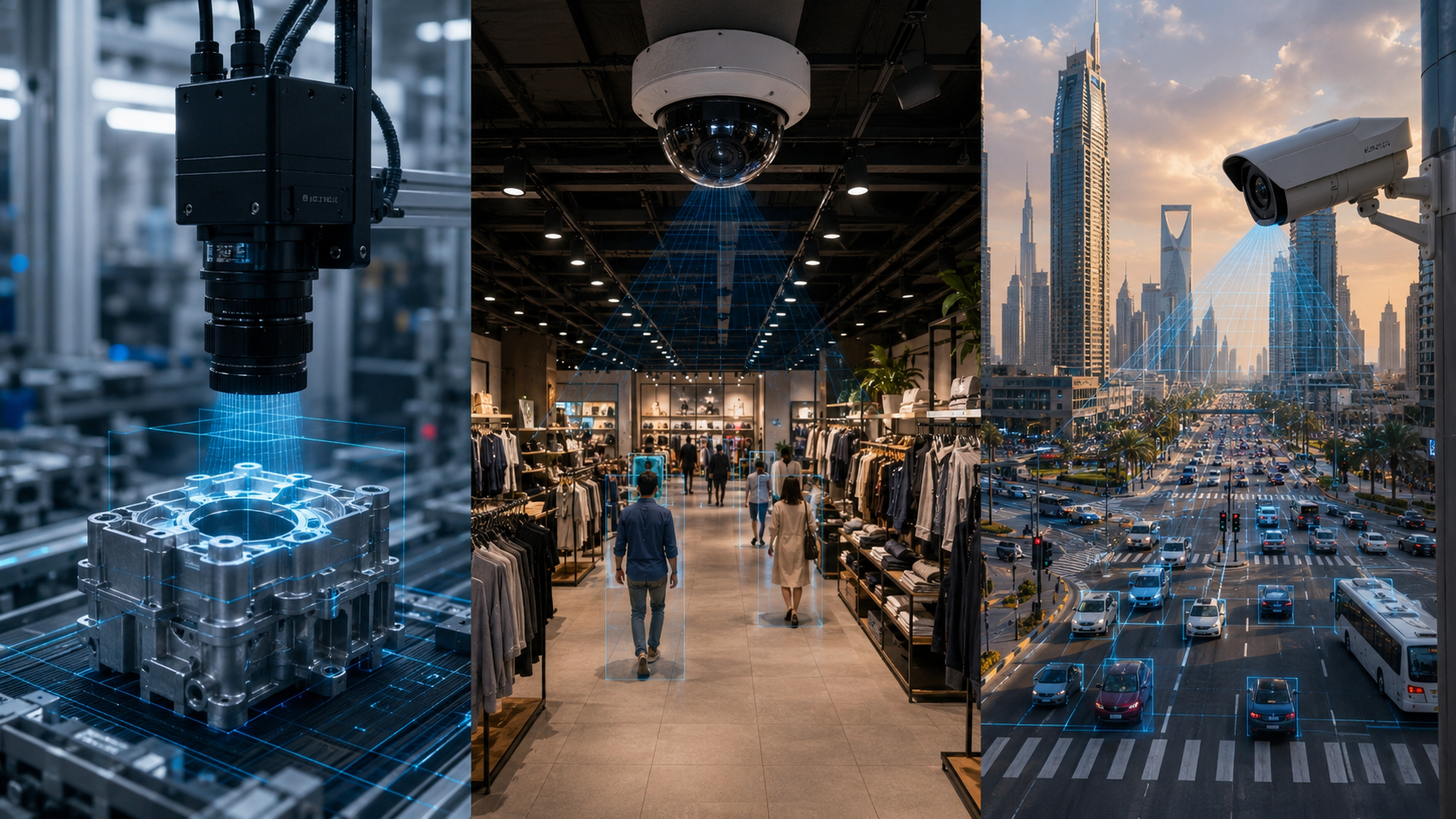
A data-verified market report on how UAE and Saudi Arabia enterprises and governments are deploying AI-powered visual intelligence in 2026.
Why Computer Vision Has Become Strategic Infrastructure in the Gulf
Computer vision, the AI discipline that enables machines to analyse visual data through cameras, sensors, and deep learning algorithms, has moved from pilot deployment to embedded infrastructure across the GCC's three highest-priority sectors. The Saudi Arabia AI Vision Market is expected to grow at a CAGR of 28.60% through 2032, while the UAE AI Computer Vision Market is projected to reach USD 2.65 billion by 2033 at a CAGR of 22.6%. Across the broader Middle East and Africa region, the computer vision market is anticipated to add more than USD 1.31 billion in value between 2025 and 2030.
The growth is not generic global momentum applied to a regional market. It is the direct output of two specific national programmes. Saudi Arabia's Vision 2030 has 66 of the Kingdom's 96 direct and indirect objectives directly linked to data and AI technologies, and the UAE's National AI Strategy 2031 explicitly integrates computer vision into public services and national development. Government spending on emerging technologies in Saudi Arabia surged 56% in 2024, with AI companies securing USD 9.1 billion in funding.
For enterprise technology leaders, the practical question in 2026 is not whether to deploy computer vision. It is which of the three primary application categories, manufacturing quality control, retail loss prevention and customer analytics, or smart city infrastructure, deliver the clearest return for their specific operating context, and what governance and compliance architecture each requires under UAE PDPL and Saudi data protection frameworks.
Manufacturing: Defect Detection and Industry 4.0
Manufacturing is where computer vision delivers the most immediately quantifiable return in the GCC, driven by Saudi Arabia's explicit Industry 4.0 push under Vision 2030.
Real-time defect detection systems use machine learning algorithms to enable instantaneous quality inspection on manufacturing floors, detecting micro-defects invisible to human eyes and reducing production waste by 30 to 40% while ensuring consistent output across automotive, electronics, and precision industries. Vision-based AI systems are widely used in Saudi manufacturing for quality inspection, defect detection, and robotic automation, with factories equipped with this technology able to automatically identify defects, monitor assembly lines, and optimise production processes without the inconsistency that manual visual inspection introduces at scale.
The financial logic for GCC manufacturers is direct. Computer vision systems work continuously without slowing production, detecting product defects, reducing waste through early fault detection, and monitoring safety gear and restricted areas simultaneously. For a manufacturer running multiple shifts across a production line, the labour cost of equivalent manual quality assurance coverage, combined with the inconsistency that fatigue introduces into human visual inspection, makes the computer vision business case calculable from the first production cycle.
Beyond quality control, computer vision is powering autonomous navigation systems processing multi-camera feeds for obstacle detection, lane recognition, and real-time decision-making, enabling Level-4 autonomous vehicles such as WeRide's Robotaxi operating on Saudi roads. This signals the direction Saudi industrial and transport policy is heading: computer vision is not a discrete manufacturing tool, it is the perception layer for the Kingdom's broader autonomous systems strategy.
Retail: From Loss Prevention to Checkout-Free Shopping
Retailers across Saudi Arabia and the UAE are increasingly adopting computer vision to improve customer experience and operational efficiency simultaneously, and 2026 has produced the clearest evidence yet that this is delivering measurable commercial return rather than experimental novelty.
The loss prevention case is the most immediately quantifiable. Self-checkout has become the highest-risk transaction point in modern retail. Stores where 50% or more of transactions pass through self-checkout experience 30 to 60% higher losses than comparable stores, and scan-and-go mobile checkout under full random audit showed a 43.4% error rate, meaning nearly half of all baskets contained some form of scanning discrepancy. IDC Retail Insights predicts that large retailers deploying computer vision at scale can achieve a 40% reduction in shrinkage by 2028, with 50% of large retailers expected to expand computer vision for store monitoring by that date.
For GCC retailers specifically, the compliance architecture of the chosen approach matters as much as the technology itself. Behaviour-based detection, which flags repeat visitors using body shape, gait patterns, and clothing characteristics across sessions without storing facial biometric data, sidesteps the regulatory threshold that facial recognition for identification purposes triggers under most data protection frameworks. The UAE supports AI proliferation while adhering to strict data protection rules under its Personal Data Protection Law, which mandates responsible data handling and opt-in consent mechanisms for biometric processing specifically. Retailers deploying facial recognition for loss prevention in the UAE or Saudi Arabia should treat a documented Data Protection Impact Assessment as an infrastructure cost built into the deployment from day one, not a legal formality addressed retrospectively.
Beyond loss prevention, computer vision is automating stock level monitoring as the leading inventory use case, with AI-powered cameras identifying and counting products on shelves, detecting empty spaces, verifying planogram compliance, and confirming that shelf price tags match POS system records. Virtual try-on solutions combining computer vision and augmented reality, allowing customers to digitally try on clothes and cosmetics via smart mirrors or mobile devices, are an increasingly common deployment in the GCC's luxury and beauty retail segment, where customer experience differentiation drives a disproportionate share of revenue.
Smart Cities: NEOM, Smart Dubai, and the National Data Infrastructure
Smart city deployment is where GCC computer vision investment reaches its largest scale and its highest strategic visibility. The UAE's National AI Strategy 2031 and Saudi Arabia's Vision 2030 are landmark government initiatives underscoring the integration of computer vision into public services, with applications spanning facial recognition systems at airports, AI-based traffic monitoring, and predictive maintenance in oil rigs, all functioning as critical tools for operational efficiency and public safety.
Saudi Arabia's NEOM project and the UAE's Smart Dubai initiative represent the two flagship deployments anchoring regional smart city computer vision investment. These programmes integrate computer vision for surveillance, traffic management, public safety, and intelligent infrastructure, with government-led initiatives and public-private partnerships accelerating adoption across both public administration and private enterprise simultaneously. Smart cameras have emerged as the dominant product type in the broader Middle East and Africa computer vision industry specifically because they integrate image sensing, processing, and communication within a single autonomous unit, a design well suited to a region where technical expertise and supporting IT infrastructure vary considerably across deployment sites.
The national data infrastructure underpinning these systems is substantial. The UAE's Dubai Data Law mandates open, standardised, and interoperable government data, and through Smart Dubai Pulse, over 2,000 datasets are available to businesses and citizens, forming the analytics foundation for city planning and infrastructure analytics. Saudi Arabia's SDAIA operates the National Data Bank, combining hundreds of public datasets, alongside the Tawakkalna platform, which evolved from a COVID-19 tool into a full-scale citizen data gateway used by 30 million users.
The governance dimension of smart city computer vision deployment is becoming a defining procurement requirement in 2026 rather than a secondary consideration. In 2026, buyers in Saudi Arabia, the UAE, and Qatar are focusing on platforms that support compliance, Arabic user experience, interoperability, and trusted regional hosting for real public-sector use, with data residency treated as an early-stage architectural decision rather than a late procurement checkbox, because in practice it directly affects trust, technical design, vendor selection, and long-term scalability of the deployment.
The Compliance Layer: What Every GCC Deployment Must Build In
Across manufacturing, retail, and smart city applications, one compliance pattern recurs consistently and deserves explicit attention from technology and risk leaders evaluating computer vision investment in 2026.
Article 9 equivalent provisions under UAE PDPL and Saudi data protection law treat facial recognition used for individual identification as a sensitive data processing activity requiring explicit consent, distinct from systematic monitoring obligations that apply more broadly to any large-scale visual surveillance deployment. Saudi Arabia has begun implementing AI regulatory frameworks in line with global best practice, though enforcement consistency and interpretive clarity continue to develop across the region. For any organisation deploying computer vision involving facial recognition, biometric identification, or systematic monitoring of public or semi-public spaces, a documented compliance review aligned to UAE PDPL or Saudi PDPL requirements should be treated as a deployment prerequisite, not a parallel workstream that can be completed after go-live.
For GCC enterprises building or procuring computer vision systems, the practical sequencing that protects both deployment timeline and compliance posture is to classify the specific visual data being processed, determine whether biometric identification or merely behavioural pattern detection is required for the use case, and select the technical architecture, behaviour-based versus identification-based, that satisfies the business requirement at the lowest compliance exposure level achievable. This sequencing applies equally whether the deployment is a manufacturing defect detection camera, a retail loss prevention system, or a municipal smart city surveillance network.
What This Means for Enterprise and Government Technology Leaders
The growth trajectory across all three sectors points toward the same structural conclusion. Computer vision in the GCC is no longer evaluated as an emerging technology pilot. It is being procured, budgeted, and governed as core infrastructure, with national data platforms, sovereign cloud architecture, and Vision 2030 and National AI Strategy 2031 alignment shaping vendor selection criteria as directly as the technical capability comparison itself.
For manufacturing leaders, the near-term opportunity is defect detection deployment at the production line level, where the 30 to 40% waste reduction figure provides a calculable ROI case that does not depend on broader digital transformation timelines. For retail leaders, the opportunity is twofold: loss prevention systems architected on behaviour-based rather than facial-identification detection to minimise compliance exposure, combined with inventory and planogram automation that delivers operational efficiency independent of the loss prevention business case. For government and smart city technology leaders, the strategic imperative is building computer vision deployments on the national data infrastructure, Smart Dubai Pulse, SDAIA's National Data Bank, and sector-specific sovereign cloud platforms, that GCC governments have already established, rather than architecting parallel systems that fragment the data interoperability these national programmes are explicitly designed to deliver.
The enterprises and government entities that align their 2026 computer vision investment to this infrastructure, rather than treating it as a standalone technology purchase, are the ones building deployments that will scale cleanly as Vision 2030 and National AI Strategy 2031 implementation accelerates through the remainder of the decade.
Related Articles
Everyone Expects Two AI Blocs. The Gulf Is Betting It Doesn't Have to Choose
Saudi Arabia is simultaneously the deepest US AI partner in the Gulf and the home of a sovereign AI company that just built its flagship Arabic model on Chinese architecture, and according to a new analysis, that isn't a contradiction, it's the point.
Sep 16, 2026
AnalysisHumain and G42 Look to Raise Outside Capital as Gulf AI Giants Weigh IPOs
Saudi Arabia's Humain and Abu Dhabi's G42 are both exploring outside capital and potential IPOs as their AI ambitions scale beyond sovereign funding alone.
Sep 8, 2026
AnalysisDubai Police Deploy 36 AI Robots, Complete 104 Technology Projects
Dubai Police has deployed 36 RPA robots and completed 104 technology projects over the past year as it expands AI across policing and administrative operations.
Sep 7, 2026
AnalysisDubai Chambers Launches Agentic AI Training for 14,000 Member Companies
Dubai Chambers has launched specialised Agentic AI training tracks through a new e-learning platform, aiming to equip more than 14,000 member companies with the skills to adopt the technology across their operations.
Sep 2, 2026
AnalysisHumain and DataVolt Partner for 100MW AI Data Centre on Saudi Arabia's Red Sea Coast
Saudi AI firm Humain has partnered with DataVolt to build a 100MW data centre at Oxagon, NEOM, the first phase of a larger 1.5 gigawatt AI campus.
Sep 2, 2026