Anthropic Forms $200 Million Partnership with the Gates Foundation
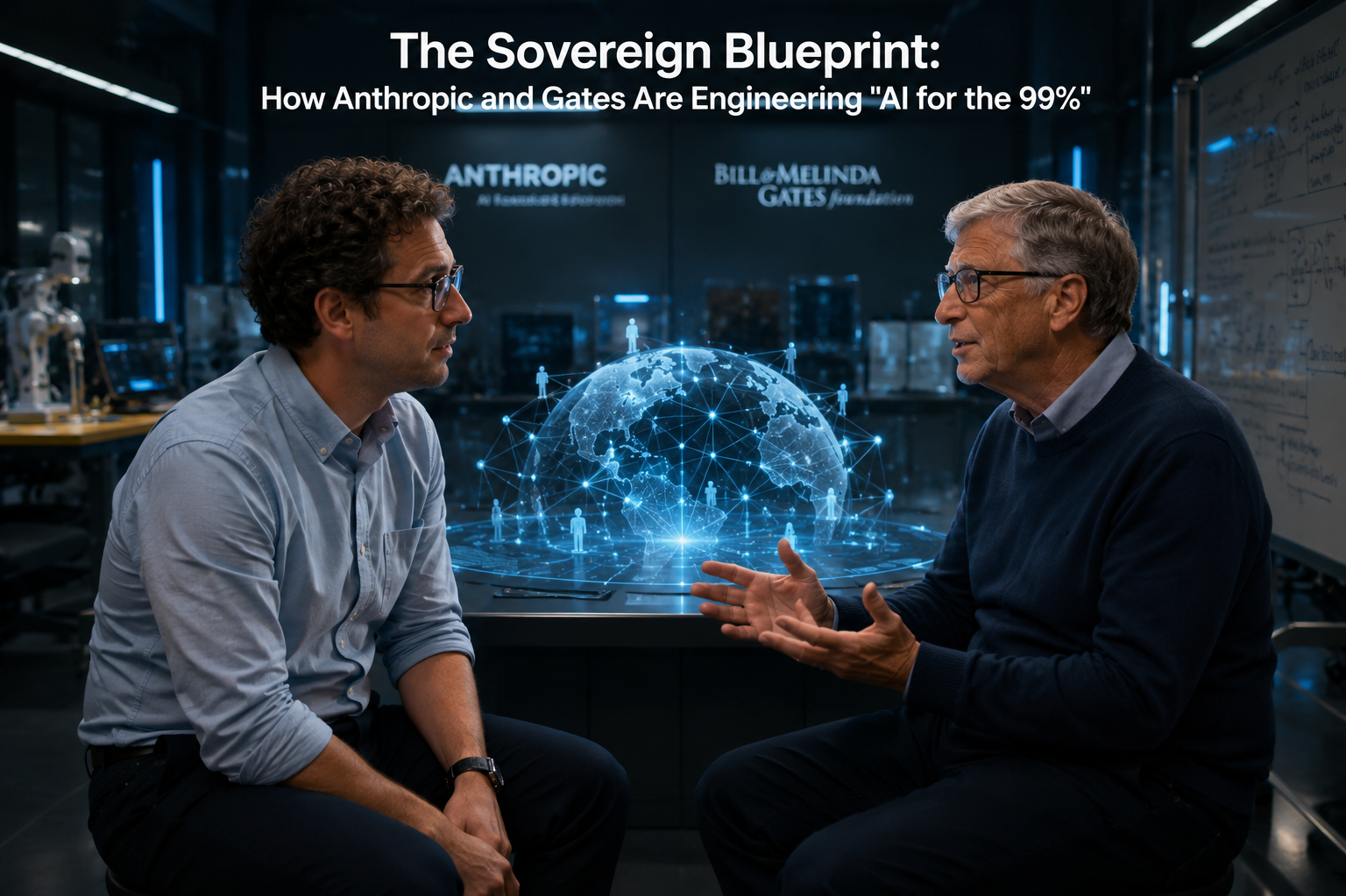
Anthropic and the Bill & Melinda Gates Foundation have announced a $200 million, four-year partnership to deploy Claude AI for vaccine discovery, foundational education, and smallholder agriculture across the Global South.
Key Takeaways
- ▸Anthropic and the Bill & Melinda Gates Foundation announced a $200 million, four-year partnership in May 2026
- ▸Claude will be deployed to computationally screen vaccine candidates for Polio, HPV, and Eclampsia, shortening the pre-clinical development cycle
- ▸The Global AI for Learning Alliance (GAILA) will build knowledge graphs, localized literacy tools, and career mobility infrastructure for the US, India, and sub-Saharan Africa
- ▸Anthropic is developing agriculture-specific Claude improvements trained on local crop and soil datasets to support two billion smallholder farmers
- ▸The partnership introduces Claude Credits, allowing nonprofits to access frontier AI without high compute costs
The Sovereign Blueprint: How Anthropic and Gates Are Engineering AI for the 99%
For years, the critique of Silicon Valley has been consistent: artificial intelligence is a tool built by the elite, for the elite. While multi-billion dollar LLMs optimise ad revenue and corporate spreadsheets, the market gap in global health and subsistence farming has widened.
The newly announced $200 million partnership between Anthropic and the Bill and Melinda Gates Foundation represents a fundamental pivot. By combining Anthropic's Constitutional AI approach with the Gates Foundation's decades of field data, the partnership aims to move AI from a luxury enterprise tool to a foundational public utility for the Global South.
1. Global Health: Transforming Claude into a Molecular Architect
The most resource-intensive pillar of this partnership is the application of AI to neglected tropical diseases and maternal health - areas often ignored by traditional pharmaceutical R&D due to low profit margins.
Computational Vaccine and Therapy Discovery
Anthropic is deploying Claude as a front-end catalyst for the Institute for Disease Modeling (IDM), with the goal of shortening the pre-clinical valley of death for vaccines.
Initial efforts target high-burden diseases including Polio, HPV, and Eclampsia. Claude is being used to computationally screen potential vaccine candidates before they ever reach a physical lab, potentially saving years in the development cycle. Integrating Claude into IDM's transmission models also allows local health officials - who may not be data scientists - to query complex epidemiological forecasts using natural language.
2. The Intelligence Gap in Education
In the US, sub-Saharan Africa, and India, the partnership is addressing the divergence in educational outcomes. Rather than deploying chatbots, the initiative focuses on creating public goods - infrastructure that other developers can build on.
The GAILA Framework
As part of the Global AI for Learning Alliance (GAILA), the partnership is building three foundational capabilities.
Knowledge graphs map curriculum standards to AI logic, ensuring that math tutoring is pedagogically sound rather than generically responsive.
Localised literacy tools develop AI-powered applications that support foundational literacy and numeracy in regional dialects, specifically tailored for Indian and African contexts.
In the US, the focus shifts to economic mobility - creating portable digital records of skills that allow workers to prove their certifications across different employers seamlessly.
3. Agricultural Intelligence for Smallholder Farmers
Nearly two billion people rely on smallholder farming for survival. These farmers are on the front lines of climate change but have the least access to precision agriculture tools.
Anthropic is committed to making agriculture-specific improvements to Claude, training the model on datasets of local crops and regional soil conditions. The goal is to provide farmers with practical, trustworthy guidance grounded in their specific context.
Predictive crop management will help farmers anticipate pest outbreaks and weather shifts before they cause losses. Supply chain optimisation will use AI to link agricultural training programmes directly to employment outcomes and market access.
4. Why This Partnership Matters for AI Safety
This is not a charitable donation. It is a strategic deployment of beneficial AI. Anthropic's Constitutional AI - a method of training models to follow a set of ethical principles - is being tested in high-stakes environments where the consequences of error are significant.
Claude Credits allow nonprofits to bypass the high compute costs of frontier models.
Direct Connectors grant AI access to specialised health platforms without compromising data privacy.
Evaluation Benchmarks create a gold standard for measuring how AI performs in healthcare versus general conversational use.
5. The Infrastructure of Opportunity
The partnership's $200 million commitment is structured over four years. By treating AI access as a matter of equity in health and education, Anthropic and the Gates Foundation are attempting to prevent a Digital Divide 2.0.
As these programmes roll out, the Beneficial Deployments team at Anthropic will face a difficult challenge: ensuring that an AI trained predominantly on Western data can truly understand and solve the nuanced, localised problems of a farmer in Uttar Pradesh or a health worker in Ethiopia.
"We are extending the benefits of AI in areas where markets alone will not." - Anthropic Beneficial Deployments Team
Summary
The Anthropic-Gates partnership is the first large-scale attempt to build a non-market infrastructure for AI. If successful, it will prove that the same intelligence used to write code in San Francisco can be used to eradicate cervical cancer in low-income nations.
Related Articles
Everyone Expects Two AI Blocs. The Gulf Is Betting It Doesn't Have to Choose
Saudi Arabia is simultaneously the deepest US AI partner in the Gulf and the home of a sovereign AI company that just built its flagship Arabic model on Chinese architecture, and according to a new analysis, that isn't a contradiction, it's the point.
Sep 16, 2026
AnalysisHumain and G42 Look to Raise Outside Capital as Gulf AI Giants Weigh IPOs
Saudi Arabia's Humain and Abu Dhabi's G42 are both exploring outside capital and potential IPOs as their AI ambitions scale beyond sovereign funding alone.
Sep 8, 2026
AnalysisDubai Police Deploy 36 AI Robots, Complete 104 Technology Projects
Dubai Police has deployed 36 RPA robots and completed 104 technology projects over the past year as it expands AI across policing and administrative operations.
Sep 7, 2026
AnalysisDubai Chambers Launches Agentic AI Training for 14,000 Member Companies
Dubai Chambers has launched specialised Agentic AI training tracks through a new e-learning platform, aiming to equip more than 14,000 member companies with the skills to adopt the technology across their operations.
Sep 2, 2026
AnalysisHumain and DataVolt Partner for 100MW AI Data Centre on Saudi Arabia's Red Sea Coast
Saudi AI firm Humain has partnered with DataVolt to build a 100MW data centre at Oxagon, NEOM, the first phase of a larger 1.5 gigawatt AI campus.
Sep 2, 2026