UAE's $30B Stargate AI Campus Gets a Wartime Redesign
The UAE is restructuring its flagship $30 billion Stargate AI campus from a single 26-square-kilometre site into a distributed network of hardened facilities, after drone and missile strikes damaged AWS data centres in the UAE and Bahrain during the regional conflict.
Key Takeaways
- ▸The UAE is redesigning its $30 billion Stargate AI campus from a single consolidated site into a distributed network of hardened facilities.
- ▸The redesign follows drone and missile strikes that damaged AWS data centres in the UAE and Bahrain in March, and an Iranian military video naming Stargate as a potential target in April.
- ▸G42, OpenAI, Nvidia, Oracle, Cisco and SoftBank are the project's core partners.
- ▸Neither G42 nor OpenAI disputed Reuters' reporting on the redesign.
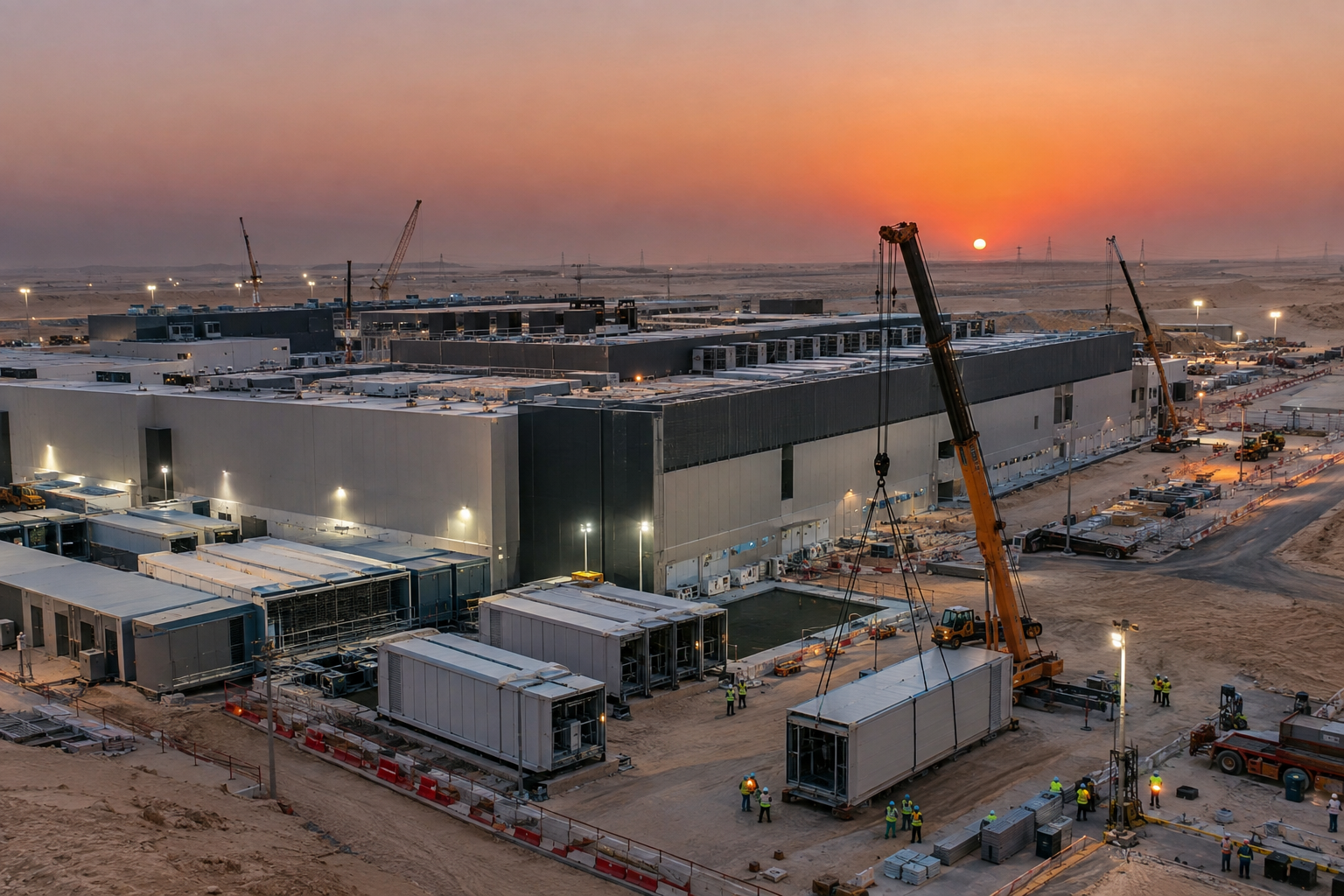
The UAE's most significant AI infrastructure bet is being rebuilt while under construction. According to a Reuters report citing six sources, including a US official, a Western diplomat and industry executives, the UAE is revising the master plan for Stargate UAE, its flagship AI campus, moving from a single consolidated 26-square-kilometre site near Abu Dhabi toward a distributed network of smaller, hardened facilities. The new design under consideration includes underground or mountain-based construction, air defence systems, blast-resistant concrete, and duplicated power and cooling, changes driven by drone and missile strikes that damaged two AWS data centres in the UAE and a third facility in Bahrain in March, followed by an April video from Iran's armed forces explicitly naming the Stargate site, near Al Dhafra Air Base, as a potential military target.
Stargate UAE sits at the centre of the country's ambition to become a global AI hub as it diversifies away from oil. The project is led by G42, the Abu Dhabi AI company controlled by Sheikh Tahnoun bin Zayed al Nahyan, in partnership with Nvidia, OpenAI, Oracle, Cisco and SoftBank, and was announced during a US presidential visit to the UAE last year. The first phase, a $30 billion, one-gigawatt compute cluster, began construction last year, with the first 200 megawatts expected online this year, en route to a planned five-gigawatt full build-out that Larry Ellison, Oracle's chairman and CTO, has said would have enough capacity to connect every UAE government agency and commercial institution to the world's most advanced AI models.
Neither G42 nor OpenAI disputed the substance of Reuters' reporting. G42 said the project's specifics are "subject to continuous review in line with the security, resilience and operational standards expected of critical infrastructure at this scale," language that confirms an active reassessment without detailing its scope. OpenAI said it continues making "good progress on the infrastructure and adoption priorities needed to deliver it." Reuters could not determine how close Emirati authorities are to finalising the new masterplan, or the extent to which the changes will affect cost and timeline, and four of the six sources specifically confirmed the shift toward distributed, hardened architecture.
This is not the first sign that the region's AI infrastructure buildout has had to account for the conflict rather than pause for it. When the US-UAE AI Acceleration Partnership Working Group held its first meeting in April, this site noted the timing coincided directly with reports that military strikes involving Iran had already disrupted UAE and Bahrain data centre infrastructure, and read the meeting's public disclosure as a deliberate signal of continuity rather than retreat. The Stargate redesign is the concrete follow-through on that signal: rather than relocating the project or slowing its timeline, the UAE appears to be absorbing the cost of hardening a live construction project against an active physical threat.
The redesign also reframes how enterprises and investors should read G42's broader strategic moves this year. The company's reported exploration of a majority US ownership stake, and its parallel efforts to expand data centre capacity abroad, including in Minneapolis, now look less like pure market expansion and more like a deliberate diversification of both ownership structure and physical footprint against the same category of geopolitical and physical risk driving the Stargate redesign itself. G42's broader ambition to deploy over a billion AI agents across UAE industries depends entirely on the underlying compute infrastructure surviving exactly the kind of disruption this redesign is meant to withstand, making Stargate's physical resilience a prerequisite for, not a side issue to, the UAE's wider AI strategy.
For enterprises and investors tracking Gulf AI infrastructure specifically, the practical signal is that a $30 billion flagship project being restructured mid-build, rather than paused, cancelled or relocated, indicates the UAE's AI ambitions are proceeding on the explicit assumption that active conflict is now a standing design constraint, not a temporary disruption to wait out. Whether that assumption holds, and whether the added cost and construction time of a hardened, distributed campus changes the economics enough to affect the project's five-gigawatt end goal, will become clearer as Emirati authorities finalise the new masterplan.
Frequently Asked Questions
Why is the UAE redesigning Stargate UAE?
After drone and missile strikes damaged two AWS data centres in the UAE and one in Bahrain in March, and Iran's armed forces named the Stargate site as a potential military target in April.
What does the new design look like?
A distributed network of smaller, hardened facilities instead of a single consolidated site, potentially including underground or mountain-based construction, air defences, blast-resistant concrete and duplicated power and cooling.
Who is leading Stargate UAE?
G42, in partnership with Nvidia, OpenAI, Oracle, Cisco and SoftBank.
How big is the project?
A $30 billion first phase delivering one gigawatt of compute capacity, en route to a planned five-gigawatt full build-out.
Related Articles
Saudi Arabia Sets Out 14GW AI Computing Ambition, Using Groq as the Model to Scale
Saudi Arabia is working with the private sector to build more than 14 gigawatts of AI computing capacity, Communications Minister Abdullah Al Swaha said in Silicon Valley, framing the Kingdom's pitch to global AI companies around compute, capital and customer access, with Groq held up as proof the model already works.
Sep 14, 2026
IntelligenceDubai Police's New AI Shift Management System Is Built to Scale Across All of Dubai Government
Dubai Police and Digital Dubai have launched an AI-Assisted Shift Management System that matches staff skills to operational needs in real time, built on the government's shared GRP infrastructure and designed from the outset to expand across all of Dubai's government entities.
Sep 11, 2026
IntelligenceVodafone, Cassava and Elsewedy Electric to Build Egypt's First Sovereign AI Data Centre
Vodafone Business, Cassava Technologies and Elsewedy Electric have signed an agreement to build Africa Data Centers Egypt, including the country's first sovereign AI data centre powered by Nvidia GPUs, targeting up to $1 billion in investment upon completion.
Sep 10, 2026
IntelligenceHP's Four-Front Bet on Saudi Arabia: Manufacturing, R&D, Talent and Startups
HP's Riyadh plant is now shipping devices commercially, while its AI R&D centre, AgentOne, FlowMaster, and Garage 2.0 push the company from vendor to builder inside Saudi Arabia's Vision 2030 economy.
Sep 9, 2026
IntelligenceDEWA Showcases AI-Powered Asset Management Strengthening Dubai's Power Network
DEWA CEO Saeed Mohammed Al Tayer toured the authority's Al Ruwayyah complex to review a cluster of AI-driven initiatives, including an Asset Health Centre that predicts equipment failures before they happen, as Dubai's power network shifts from reactive to predictive maintenance.
Sep 4, 2026