The US-UAE AI Acceleration Partnership Working Group: What the First Meeting Means for Enterprise AI in the Gulf
Overview
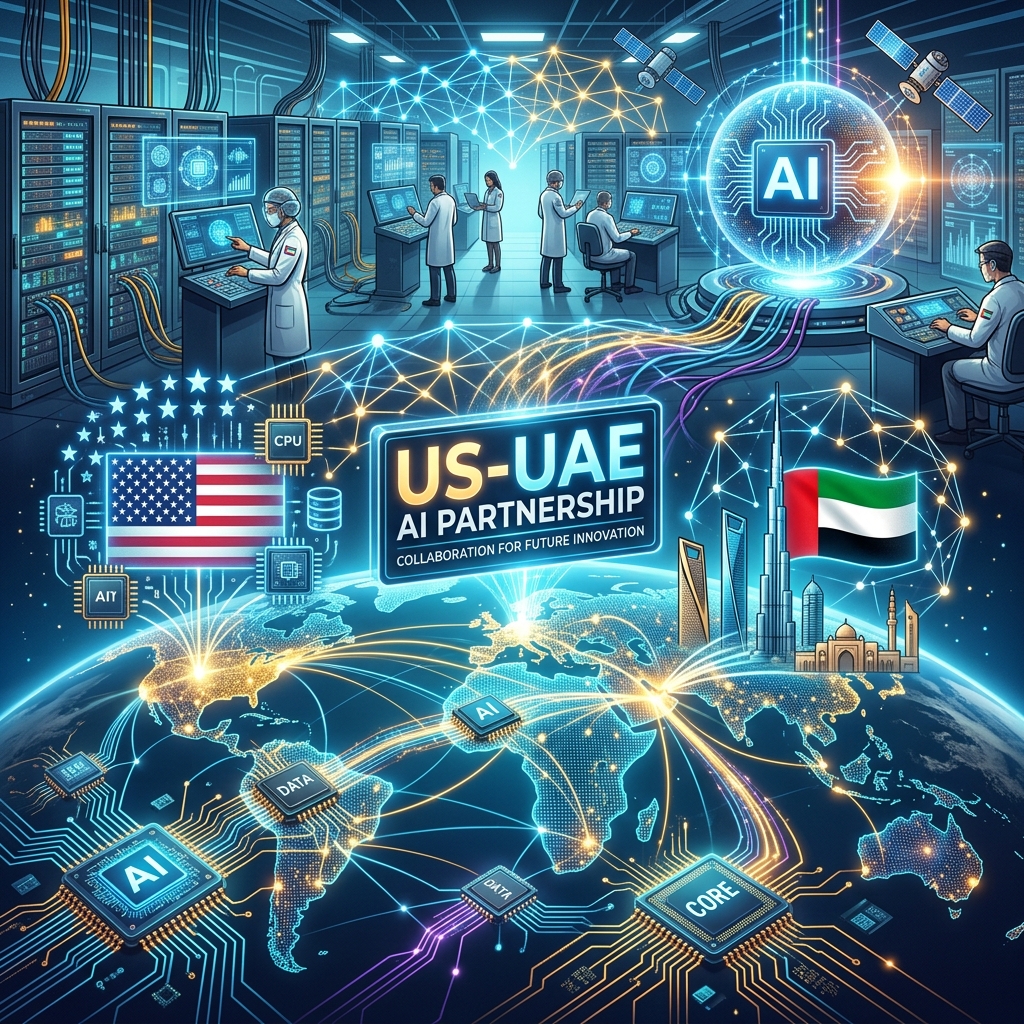
On March 26, 2026, a quiet but consequential meeting took place in Washington D.C. According to the US Department of State, Under Secretary of State for Economic Affairs Jacob Helberg and UAE Minister of Investment Mohamed Al Suwaidi co-chaired the first interagency meeting of the US-UAE AI Acceleration Partnership Working Group, bringing together senior representatives from the Departments of State, Commerce, Energy, War, and Treasury, as well as the White House Office of Science and Technology Policy, alongside UAE government officials and companies.
The State Department publicly disclosed details on April 6 — three days ago. For enterprises operating across the UAE and wider GCC, the implications are significant and immediate.
This is not a ceremonial handshake. It is the first formal governance structure built to operationalise one of the most ambitious bilateral AI frameworks in history — and its outcomes will directly shape AI infrastructure access, chip availability, data sovereignty rules, and enterprise compliance requirements across the region for years to come.
What Was Agreed — The Three Headline Outcomes
Reporting by The National confirmed three headline outcomes from the meeting: chip agreements described as "ironclad," a reaffirmation of the UAE's $1.4 trillion US investment commitment made last May, and formal recognition of G42's security and governance safeguards as a gold standard — with the UAE Embassy in Washington summarising all three publicly on the same day.
Each of these carries direct weight for enterprise AI leaders in the GCC.
- Chip access confirmed. The UAE's approval to import US-made advanced AI chips — including NVIDIA's latest Blackwell GPU architecture — remains in force. According to Geo.tv, Washington reaffirmed that the terms of the AI agreement remain firm, including UAE access to advanced US-origin AI chips, subject to security rules. For enterprises building or procuring AI infrastructure in the UAE, this removes a key uncertainty that had hung over procurement planning since 2024.
- $1.4 trillion investment reaffirmed — despite regional conflict. The UAE reiterated its $1.4 trillion US investment commitment, with The National reporting the pledge stands despite regional instability. This is a pointed signal given the active conflict involving Iran that has disrupted shipping lanes and struck infrastructure across the Gulf this week. The partnership is being stress-tested in real time — and holding.
- Pax Silica Investor Consortium launched. As reported by The National, Jacob Helberg announced the "next major milestone" — the Pax Silica Investor Consortium, with founding members including Mubadala, SoftBank and Temasek. The coalition of sovereign wealth funds and institutional investors will focus on ensuring that minerals, ports, factories and energy assets powering global semiconductor supply chains stay in trusted hands.
For GCC enterprises, the Pax Silica Consortium is the most consequential announcement. It signals that the UAE — through Mubadala — now sits inside the most exclusive tier of global AI supply chain governance. Saudi Arabia is moving in the same direction: SDAIA is simultaneously co-leading a parallel global AI governance framework with the World Bank this week in Washington — a striking sign that both Gulf states are actively shaping the rules of the AI era, not merely following them.
Why This Meeting Happened Now — The Geopolitical Backdrop
The timing is not coincidental. The US State Department reflected on the meeting in the context of the current conflict in Iran, noting it "highlighted the importance both governments attach to their AI partnership," adding: "The US is proud to stand shoulder to shoulder with the UAE in building the future together."
The regional security environment is live and escalating. Saudi Arabia has been directly in the line of fire — intercepting over 400 Iranian drones and missiles across a sustained three-week campaign in March, and neutralising seven ballistic missiles over Riyadh as recently as March 31. The cyber dimension is escalating in parallel: Google Cloud's Cybersecurity Forecast 2026 specifically warns of AI-powered attacks and rising nation-state threats targeting the Middle East and GCC, and Russian APT28 has been actively exploiting network infrastructure to target military and critical installations across the region.
As IndexBox reported this week, military strikes involving Iran have included attacks on data centres in the UAE and Bahrain, disrupting cloud infrastructure and raising questions about regional AI ambitions. The working group meeting was publicly disclosed in exactly this window — a deliberate signal of continuity and commitment.
For enterprise CIOs and CTOs in the UAE, this dual message — geopolitical solidarity plus locked-in chip supply — provides a degree of confidence for long-term infrastructure planning that would otherwise be impossible in the current environment.
The Stargate UAE Connection — What It Means on the Ground
The working group sits atop a very large and very real infrastructure programme. As detailed by the UAE Embassy, at the centre is Stargate UAE — a 5 GW AI campus developed by G42 with leading American partners including OpenAI, Oracle, NVIDIA, Cisco and SoftBank, planned across 10 square miles in Abu Dhabi, with an initial 200 MW cluster launching in 2026. It represents the largest AI campus outside the United States.
This is the physical infrastructure the working group governs. The 200 MW first phase, currently under construction, will provide enterprise-grade AI compute capacity to businesses in the UAE at a scale not previously available in the region.
For enterprises that have been waiting on sovereign cloud capacity before committing to large-scale AI deployments, Stargate UAE's 2026 operational timeline is a material unlock. Businesses in financial services, government technology, healthcare and energy — sectors identified by GCC regulators as requiring data residency — now have a domestic compute option aligned with US security standards. Notably, Commvault and Microsoft have already moved to close the detection-to-recovery gap for GCC enterprises, directly targeting the UAE and Saudi Arabia's tightening cyber resilience mandates — a sign that the enterprise security layer around this infrastructure is maturing in step with the infrastructure itself.
G42's Role — From Vendor to Governance Standard
One of the most significant outcomes of the working group meeting was the formal recognition of G42's security framework. According to the UAE Embassy statement, through the implementation of a "Regulated Technology Environment," approved UAE organisations acquiring regulated US technologies are required to adhere to extensive physical and cybersecurity protocols, involving regular audits, third-party validations and active oversight by both governments.
The UAE Embassy's official summary explicitly described G42's security and governance safeguards as a gold standard recognised at the working group meeting.
This matters beyond G42 itself. Any enterprise in the UAE seeking to build AI systems on US-origin technology — whether NVIDIA chips, AWS infrastructure or Microsoft Azure — will operate within a compliance environment shaped by these standards. The urgency of getting this right is underscored by the threat landscape: UAE cyber threats are intensifying, with ransomware up 32% and shadow AI emerging as a new attack surface for enterprises across the Emirates. The Regulated Technology Environment is not optional — it is the governance layer through which chip access flows, and increasingly the layer that separates enterprises with defensible AI infrastructure from those that are exposed.
What This Means for Saudi Arabia and the Wider GCC
The US-UAE partnership does not operate in isolation. Saudi Arabia is running a parallel track through HUMAIN, the PIF-backed AI company building 500 MW of NVIDIA infrastructure under its own bilateral framework with Washington. As CNBC reported, HUMAIN is aiming to position Saudi Arabia as the third biggest global AI hub after the US and China.
On the governance front, Saudi Arabia is not waiting either. This week in Washington, SDAIA and the World Bank launched a five-day international workshop on AI governance and international cooperation — running almost simultaneously with the US-UAE working group meeting. The two events together signal a coordinated Gulf push to embed both countries inside the global AI regulatory architecture, not just its infrastructure.
Saudi Arabia's broader technology ambitions extend well beyond AI software and data centres. The Kingdom's successful deployment of the Shams satellite aboard NASA's Artemis II mission this month is the clearest signal yet that sovereign technology capability — from space to compute to governance — is the defining theme of the Vision 2030 era.
The working group model established by the UAE is likely to be replicated across the GCC. Qatar, which launched its own national AI firm late last year, and other Gulf states are watching this structure closely. The Pax Silica Consortium, with Mubadala as a founding member, creates a template for how sovereign wealth capital can be positioned inside global AI supply chain governance.
Key Takeaways for Enterprise AI Leaders
- Infrastructure timeline is locked in. The 200 MW first phase of Stargate UAE remains on track for 2026. Advanced US chips are flowing. Supply chain uncertainty that delayed enterprise AI planning across the region since 2024 is materially reduced.
- Compliance is non-negotiable — and the threat landscape makes it urgent. G42's Regulated Technology Environment is now the formal standard for enterprise access to US-origin AI technology in the UAE. IT, legal and procurement teams need to understand its requirements before finalising AI vendor contracts. With eight distinct cybersecurity risks now directly targeting GCC organisations across financial services, healthcare, energy and government, the compliance framework is not bureaucratic overhead — it is active risk management.
- Sovereign AI governance is accelerating on both sides of the Gulf. With the UAE locking in its chip and infrastructure agreements and Saudi Arabia simultaneously leading global AI governance talks through SDAIA, the GCC is establishing itself as a rule-maker in the AI era — not just a market for it.
- The conflict variable is real but the partnership is designed to hold. With Saudi Arabia actively defending its airspace against ballistic threats and nation-state cyber actors escalating operations across GCC infrastructure, enterprise resilience planning and data centre redundancy are no longer optional considerations for businesses operating in the Gulf. The US-UAE working group's public reaffirmation this week was a direct signal that the AI infrastructure agenda will not be paused by regional instability.
Sources: US Department of State · The National · UAE Embassy Washington · NVIDIA Newsroom · CNBC · Geo.tv · IndexBox · Saudi Future Tech · MENA Cyber Wire