The Digital Confession Box: AI Data Privacy, Corporate Litigation, and the ‘Snitch’ Effect in the MENA Region
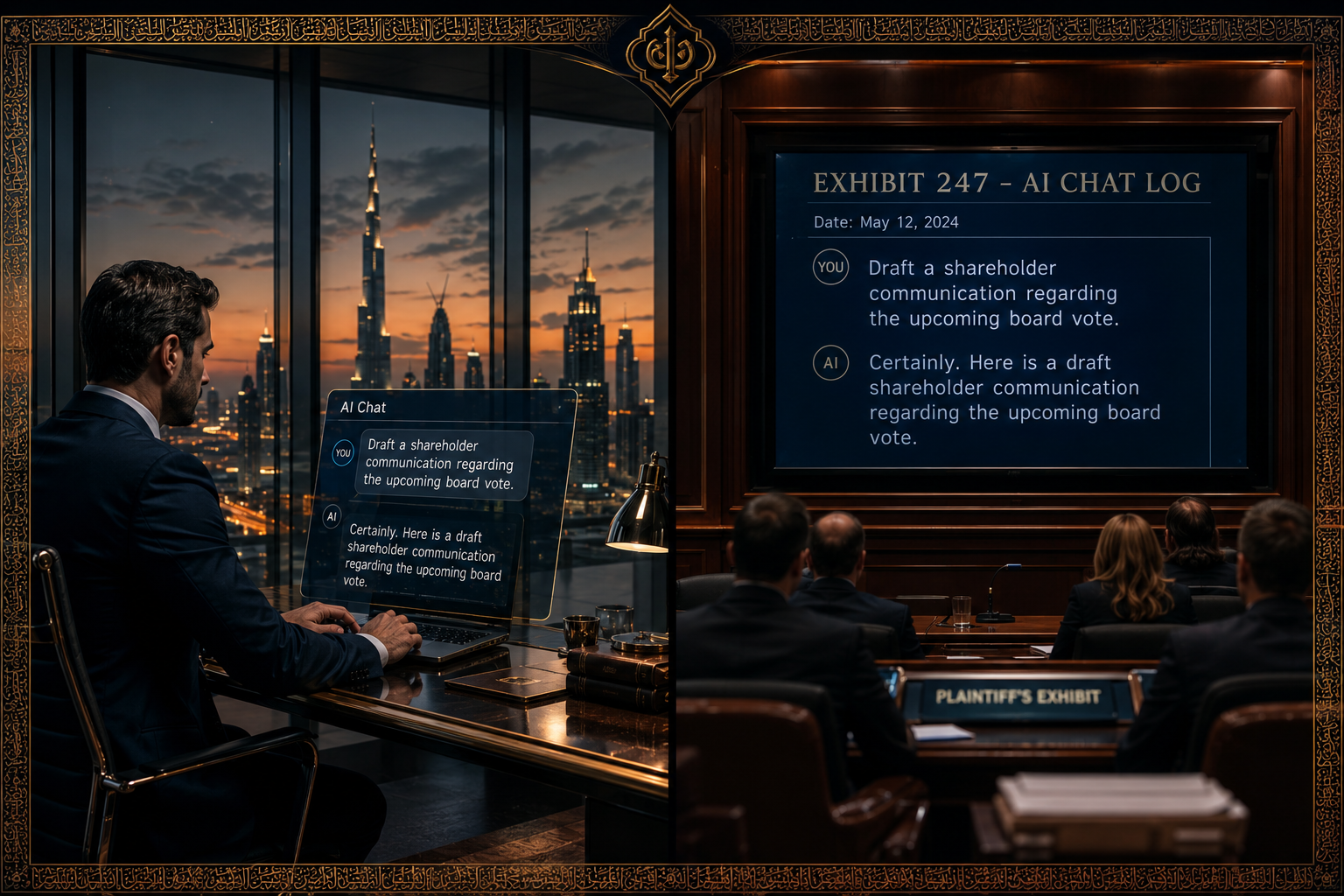
In 2026, a courtroom in San Francisco is reading out the private thoughts of one of Silicon Valley’s most powerful executives. Thousands of miles away in Dubai, Riyadh, and Cairo, boardrooms are paying very close attention. The ongoing legal battle between Elon Musk and OpenAI leadership — Sam Altman and Greg Brockman — has exposed a vulnerability that is no longer unique to American tech founders: the catastrophic assumption that AI interactions are private. As the Gulf’s corporate sector accelerates its adoption of large language models (LLMs) for strategy, legal drafting, and executive decision-making, a critical question emerges for MENA’s business elite: if your AI prompts were read aloud in a court of law tomorrow, what would they say?
Key Takeaways
- ▸AI chats are not private
- ▸DIFC & ADGM courts follow common law
- ▸Data localisation adds complexity
- ▸Executives are highest risk
- ▸Digital austerity is the new protocol
The Case That Changed Everything: Musk v. Altman & Brockman
The legal dispute at the heart of this story concerns the conversion of OpenAI from a non-profit research organisation to a for-profit entity. But the evidence making headlines is not from boardroom minutes or shareholder agreements. It is from Greg Brockman’s personal digital records, now forced into public view through the discovery process.
The Paper Trail of 2026
Court proceedings have revealed digital entries in which Brockman documented candid internal conflicts with striking specificity:
• Personal financial targets — including aspirations for individual wealth accumulation in the region of $1 billion.• Ethical reservations — including his own characterisation of the B-Corp conversion as ‘morally bankrupt’ without Musk’s participation.
These are not leaked emails or intercepted calls. They are records a senior executive appears to have shared with digital platforms in moments of reflection — moments that are now part of the public record.
For MENA executives, the lesson is unambiguous: no digital format, however personal it feels, is immune from legal discovery.
The MENA Dimension: Why This Matters for the Gulf
MENA’s corporate ecosystem is undergoing a structural transformation. Saudi Vision 2030 is catalysing joint ventures between sovereign wealth funds and international partners. The UAE’s DIFC and ADGM are positioning themselves as global arbitration hubs. Egypt’s financial sector is undergoing regulatory modernisation. In each of these contexts, high-value commercial disputes are inevitable — and the evidence landscape is evolving fast.
Jurisdiction-Specific Risks
• UAE (DIFC & ADGM): Both operate under English common law frameworks. Discovery rules in DIFC courts are substantively similar to English Commercial Court procedure, meaning AI prompt histories are fully disclosable in civil litigation where relevance can be demonstrated.• Saudi Arabia: The Personal Data Protection Law (PDPL), enacted in 2021 and amended in 2023, governs data processing within the Kingdom. Critically, it does not create evidentiary privilege for AI interactions — data stored on servers outside the Kingdom may still be accessible via Mutual Legal Assistance Treaty (MLAT) mechanisms.• Egypt: Egyptian courts are increasingly accepting digital evidence under the Electronic Signature Law and the Cybercrime Law of 2018. Chat logs — including those from AI platforms — have appeared in commercial and criminal proceedings.• Qatar: With QICDRC (Qatar International Court and Dispute Resolution Centre) applying English common law, the evidentiary framework mirrors DIFC in its openness to digital disclosure.
AI as the Digital Confession Box: The Psychology of Over-Sharing
The phenomenon driving the ‘Snitch Effect’ is not a legal technicality — it is a human one. Users of AI chatbots routinely treat them with an intimacy they would never extend to a colleague, an assistant, or even a personal diary left on a desk. Researchers have identified this as the ‘Therapist Echo’: the perception that an AI’s non-judgmental, responsive interface creates a safe space for unfiltered thought.
In the Gulf context, this dynamic is compounded by cultural factors:
• Hierarchical business cultures mean executives at the apex of family conglomerates or government-linked entities may have few genuine confidants. The AI fills that vacuum.• Code-switching between Arabic and English in prompts may create a false sense of obscurity, as though the language itself offers a layer of privacy.• The rapid adoption of AI tools — often outpacing internal governance frameworks — means most Gulf organisations have no AI usage policy that addresses litigation risk.
The Three Vectors of Exposure
• Permanent Retention: Unlike a verbal conversation in a majlis, AI prompts are logged, timestamped, and stored on third-party servers — often outside the MENA region, in jurisdictions with their own disclosure obligations.• Human Review: The terms of service of most major AI platforms permit human review of conversations for model improvement. Your ‘private’ deliberations may have already been read by a contractor in San Francisco or Bangalore.• Subpoena Exposure: In any civil or commercial dispute — a partnership dissolution, a construction contract claim, an employment tribunal — opposing counsel can apply for disclosure of AI interaction records.
Legal Admissibility in the MENA Region: The ‘No Privilege’ Reality
The foundational legal point is stark: there is no ‘Chatbot-Client Privilege’ in any MENA jurisdiction. Attorney-client privilege, spousal privilege, and medical confidentiality are established protections in Gulf legal systems. AI platforms enjoy none of them.
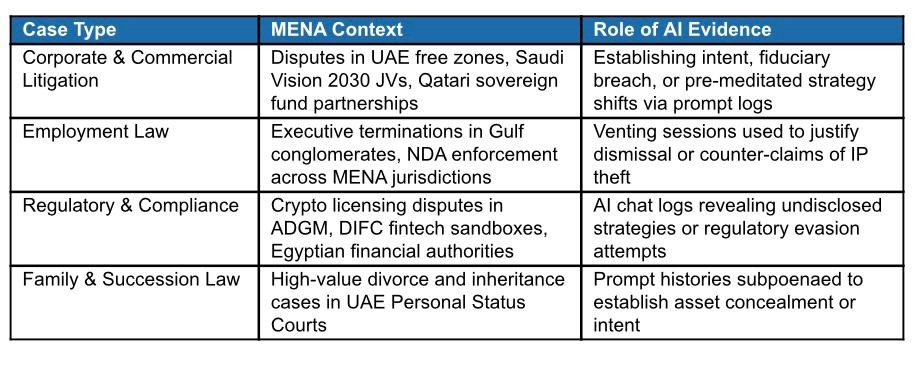
A note on Islamic finance and Sharia-compliant structures: increasingly, MENA disputes involving sukuk structures, waqf assets, or murabaha arrangements are being litigated in specialist courts or arbitration panels. Digital evidence — including AI correspondence used in structuring transactions — is admissible in these forums where it is relevant to establishing intent or contractual interpretation.
Risks Beyond the Courtroom: Profiling, Regulation, and Reputational Exposure
For MENA users, the risks extend well beyond conventional litigation:
• Regulatory Scrutiny: Central banks and financial regulators across the Gulf are developing AI governance frameworks. Prompt histories that reveal undisclosed trading strategies or regulatory evasion could attract supervisory attention.• Reputational Risk in Relationship-Driven Markets: In a business environment where trust and reputation are foundational currencies — particularly in family business networks and government-linked enterprises — the public exposure of candid AI interactions could be commercially catastrophic.• Cross-Border Data Flows: Many Gulf executives use US- or European-hosted AI platforms. Their data sits in jurisdictions where foreign government requests or private litigation subpoenas may compel disclosure regardless of UAE or Saudi data localisation rules.• Algorithmic Profiling: Sensitive commercial deliberations entered into AI platforms may contribute to proprietary risk models used by insurers, credit rating agencies, or future AI-driven regulatory surveillance systems.
The New Privacy Protocol: Digital Austerity for MENA Professionals
The 2026 legal landscape has rendered the concept of a ‘private’ digital thought effectively obsolete. For Gulf executives, family business principals, legal professionals, and public sector leaders, the following framework — Digital Austerity — is no longer optional:
• Treat every AI prompt as a potential exhibit: If the content would be damaging in a deposition, a board meeting, or a regulatory hearing, it should not be typed into a prompt.• Implement organisational AI usage policies: Gulf family offices, conglomerates, and government-linked companies should establish clear governance frameworks covering what categories of information may and may not be processed through AI tools.• Understand your platform’s data retention terms: Many platforms retain data indefinitely. Executives should understand whether their jurisdiction’s data laws create any deletion rights — and whether those rights are enforceable against foreign-domiciled providers.• Seek legal advice before any high-value transaction or dispute: In the pre-litigation phase, counsel should conduct a prompt history audit as a standard element of evidence preservation and risk assessment.• Do not conflate local data laws with global evidentiary immunity: Saudi PDPL and UAE PDPL protect against certain types of processing — they do not render your AI history invisible to a foreign court with jurisdiction over a counterparty.
As one Emirati legal practitioner observed in a recent DIFC arbitration forum: ‘The most dangerous document in a high-value dispute is no longer the email trail. It is the transcript of what the client told the machine at two in the morning when they thought no one was listening.’
Conclusion: The End of the Private Thought
The Brockman-Musk litigation is, at one level, a story about two powerful men and a disagreement over billions of dollars. At another level, it is a warning to every executive in every boardroom from Casablanca to Karachi who has ever typed something into a chatbot that they would not say in public.
Across MENA — in the glass towers of DIFC, the ministerial offices of Riyadh, the trading floors of Cairo, and the family majalis of Kuwait — AI adoption is accelerating faster than legal awareness of its risks. That gap is where reputations, fortunes, and legal cases are lost.
The AI is not your confidant. It is not your therapist. It is not your diary.
It is a record. And records, in litigation, speak
Related Articles
UAE's $30B Stargate AI Campus Gets a Wartime Redesign
The UAE is restructuring its flagship $30 billion Stargate AI campus from a single 26-square-kilometre site into a distributed network of hardened facilities, after drone and missile strikes damaged AWS data centres in the UAE and Bahrain during the regional conflict.
Sep 15, 2026
IntelligenceSaudi Arabia Sets Out 14GW AI Computing Ambition, Using Groq as the Model to Scale
Saudi Arabia is working with the private sector to build more than 14 gigawatts of AI computing capacity, Communications Minister Abdullah Al Swaha said in Silicon Valley, framing the Kingdom's pitch to global AI companies around compute, capital and customer access, with Groq held up as proof the model already works.
Sep 14, 2026
IntelligenceDubai Police's New AI Shift Management System Is Built to Scale Across All of Dubai Government
Dubai Police and Digital Dubai have launched an AI-Assisted Shift Management System that matches staff skills to operational needs in real time, built on the government's shared GRP infrastructure and designed from the outset to expand across all of Dubai's government entities.
Sep 11, 2026
IntelligenceVodafone, Cassava and Elsewedy Electric to Build Egypt's First Sovereign AI Data Centre
Vodafone Business, Cassava Technologies and Elsewedy Electric have signed an agreement to build Africa Data Centers Egypt, including the country's first sovereign AI data centre powered by Nvidia GPUs, targeting up to $1 billion in investment upon completion.
Sep 10, 2026
IntelligenceHP's Four-Front Bet on Saudi Arabia: Manufacturing, R&D, Talent and Startups
HP's Riyadh plant is now shipping devices commercially, while its AI R&D centre, AgentOne, FlowMaster, and Garage 2.0 push the company from vendor to builder inside Saudi Arabia's Vision 2030 economy.
Sep 9, 2026