Innovo and FieldAI Deploy General-Purpose Robots at Dubai's AED 1.7 Billion Ghaf Woods Project
Innovo Group and FieldAI have launched the first production deployment of general-purpose construction robots in the Middle East at Ghaf Woods in Dubai, a AED 1.7 billion Majid Al Futtaim development, advancing the UAE's AI Strategy 2031 objectives for non-oil sector transformation.
Key Takeaways
- ▸Innovo Group and FieldAI have launched the first production deployment of general-purpose robots at a live Middle East construction site, operating at Ghaf Woods in Dubai under extreme UAE summer conditions.
- ▸The robots initially perform autonomous site progress monitoring and real-time documentation, with the platform designed to expand to logistics and multi-robot coordination.
- ▸Construction is one of the least digitised major industries globally, making the GCC an economically significant testing ground for physical AI at scale.
- ▸The deployment advances the UAE AI Strategy 2031's objective of deploying AI across physical industries, not solely digital economy applications.
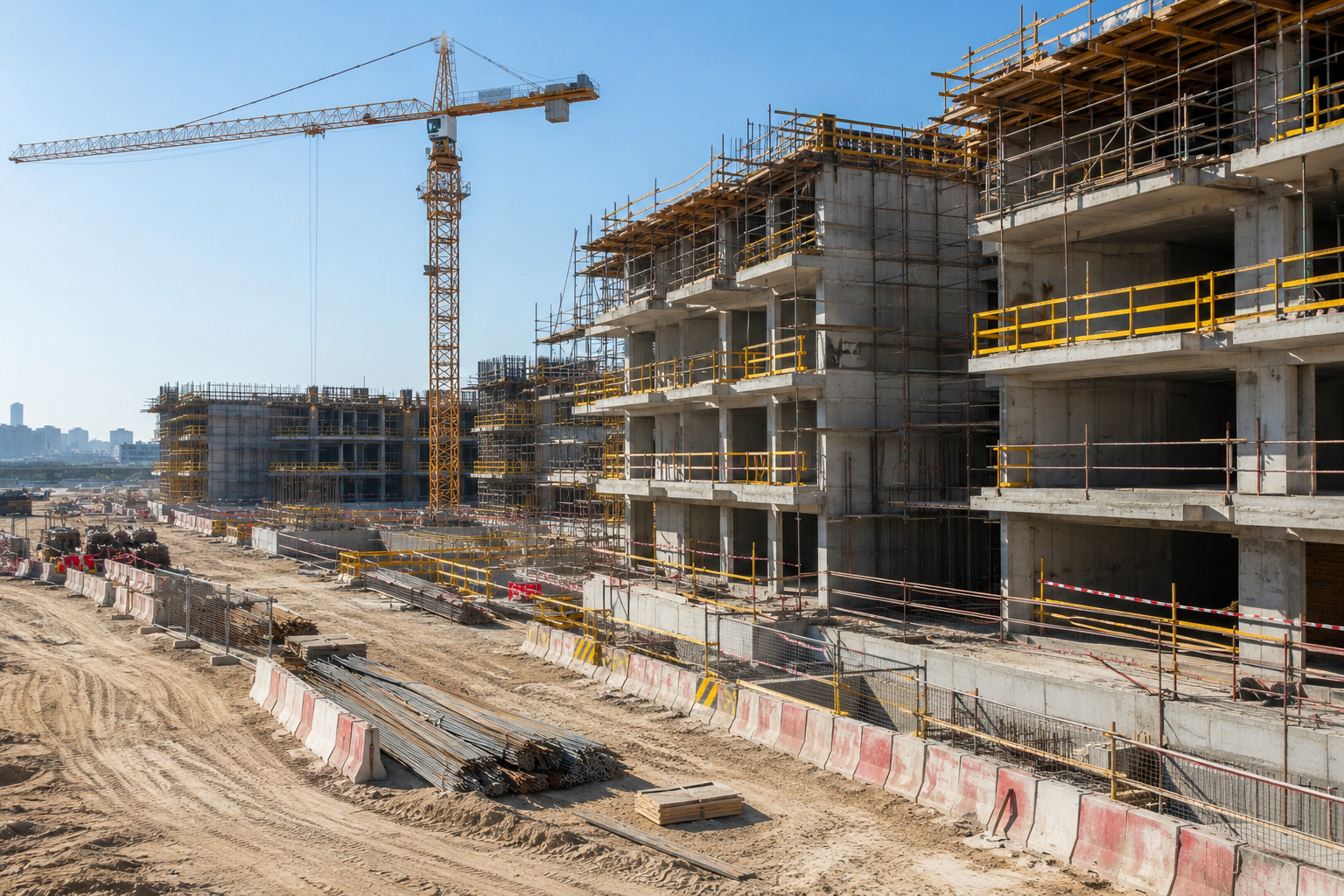
Innovo Group, one of the UAE's leading construction companies, has partnered with FieldAI to deploy general-purpose robots at Ghaf Woods, a landmark AED 1.7 billion biophilic residential development by Majid Al Futtaim in Dubai. The deployment marks the first production-scale use of general-purpose robots in a live construction environment in the Middle East, extending physical AI from laboratory and structured-environment pilots into one of the most demanding real-world settings: an active, large-scale construction site operating under extreme summer heat.
FieldAI specialises in deploying general-purpose robots in unstructured environments, settings too unpredictable and dynamically changing for conventional industrial robots that require pre-mapped, controlled conditions. Construction sites represent the most complex category of unstructured environment: safety-critical, constantly evolving, defined by the proximity of heavy machinery, variable terrain, and human workers operating under pressure. The UAE's climate adds a further constraint. Ghaf Woods is operating in conditions where outdoor temperatures regularly exceed 40 degrees Celsius, a factor that eliminates many robot platforms from consideration and makes reliable autonomous operation substantially harder to achieve.
What the Robots Are Doing On Site
The initial production deployment at Ghaf Woods focuses on autonomous site progress monitoring, real-time documentation, environmental understanding, and data capture in areas that are either difficult for human teams to access consistently, repetitive in nature, or operationally hazardous. Progress monitoring on a development of this scale requires continuous data collection across a site that is changing daily. Manual survey processes introduce delays, inconsistencies, and exposure risk for workers operating in extreme heat.
FieldAI's platform uses a universal robot brain that works across multiple robot types and task categories. The architecture is designed to start with monitoring and modelling missions and expand progressively across a broader range of physical tasks, including site logistics, dexterous manipulation, and multi-robot coordination. Each additional capability is built on the operational data generated by the preceding phase, creating compounding value as the deployment scales.
The practical output for Innovo is more accurate, more frequent, and safer site documentation, feeding directly into project management, quality control, and client reporting workflows. For a development of Ghaf Woods' complexity, combining biophilic design principles with the scale and timeline pressures of a major residential community in Dubai's competitive property market, the ability to maintain real-time visibility across the entire site has direct implications for delivery certainty and cost control.
Why This Matters Beyond a Single Project
The significance of the Ghaf Woods deployment extends well beyond a single construction project. Construction is one of the least digitised major industries globally, despite its economic scale. In the GCC, where the construction sector is absorbing enormous capital flows across giga-projects in Saudi Arabia, major mixed-use developments in the UAE, and infrastructure programmes across Qatar, Bahrain, and Oman, the productivity, safety, and data quality limitations of conventional construction management are consequential at a national economic level.
The scale of AI infrastructure investment entering the Gulf has until recently focused heavily on data centres, compute capacity, and software platforms. Physical AI, the deployment of intelligent autonomous systems in real-world environments, has been a second-order priority. The Innovo and FieldAI partnership begins to close that gap in a sector where the economic case for autonomous operation is clear and the deployment environment is genuinely challenging enough to provide meaningful validation data.
If a general-purpose robot system can operate reliably on an active Dubai construction site in June and July, the operational case for deployment across a much wider range of Gulf construction and infrastructure projects is substantially strengthened. Developers, contractors, and project management firms across the region will be watching the Ghaf Woods deployment as a proof of concept that is directly applicable to their own pipeline.
The UAE AI Strategy 2031 Connection
Both Innovo and FieldAI framed the partnership explicitly within the context of the UAE's National Strategy for Artificial Intelligence 2031, which targets the country's position as a global AI leader by the end of the decade. The strategy is not limited to software, data, and compute. It identifies the deployment of AI across physical industries, including construction, logistics, and manufacturing, as a core pillar of the economic diversification and productivity growth objectives that underpin the broader ambition.
The Ghaf Woods deployment sits directly within that strategic frame. It is a UAE construction firm, a US physical AI company, and a landmark Dubai development combining to demonstrate that the country's AI strategy is advancing in sectors that account for a substantial portion of national economic activity, not solely in the digital economy applications that typically dominate AI strategy discussions.
The Gulf's position as a frontrunner in enterprise AI deployment has been confirmed in software and data contexts. Physical AI in construction, logistics, and infrastructure represents the next validation layer, and Ghaf Woods is a credible first step toward that validation in the UAE. The alliance between Innovo's construction domain knowledge and FieldAI's autonomous platform capability mirrors the kind of partnership structure that the UAE AI strategy's emphasis on local-international collaboration is designed to produce.
For construction and real estate developers across Dubai and Abu Dhabi assessing their own technology roadmaps, the Ghaf Woods partnership provides a live reference point that is operating in their climate, on a project type most of them will recognise, with a timeline and scale that is commercially comparable to their own pipeline.
Frequently Asked Questions
What makes the Innovo and FieldAI deployment at Ghaf Woods significant?
It is the first production deployment of general-purpose robots in a live construction environment in the Middle East, operating in extreme UAE summer heat on one of Dubai's largest active residential developments. It validates physical AI in an unstructured, safety-critical environment rather than a controlled pilot setting.
What tasks are the robots performing at Ghaf Woods?
The initial phase covers autonomous site progress monitoring, real-time documentation, environmental understanding, and data capture in areas that are difficult, repetitive, or hazardous for human teams. The platform is designed to expand to logistics, manipulation, and multi-robot coordination as the deployment matures.
How does this deployment relate to the UAE AI Strategy 2031?
The UAE's national AI strategy explicitly includes physical AI deployment across construction, logistics, and manufacturing as a core element of its economic diversification and productivity objectives, not solely digital economy applications. The Ghaf Woods partnership demonstrates progress against that physical AI dimension of the strategy.
Related Articles
UAE's $30B Stargate AI Campus Gets a Wartime Redesign
The UAE is restructuring its flagship $30 billion Stargate AI campus from a single 26-square-kilometre site into a distributed network of hardened facilities, after drone and missile strikes damaged AWS data centres in the UAE and Bahrain during the regional conflict.
Sep 15, 2026
IntelligenceSaudi Arabia Sets Out 14GW AI Computing Ambition, Using Groq as the Model to Scale
Saudi Arabia is working with the private sector to build more than 14 gigawatts of AI computing capacity, Communications Minister Abdullah Al Swaha said in Silicon Valley, framing the Kingdom's pitch to global AI companies around compute, capital and customer access, with Groq held up as proof the model already works.
Sep 14, 2026
IntelligenceDubai Police's New AI Shift Management System Is Built to Scale Across All of Dubai Government
Dubai Police and Digital Dubai have launched an AI-Assisted Shift Management System that matches staff skills to operational needs in real time, built on the government's shared GRP infrastructure and designed from the outset to expand across all of Dubai's government entities.
Sep 11, 2026
IntelligenceVodafone, Cassava and Elsewedy Electric to Build Egypt's First Sovereign AI Data Centre
Vodafone Business, Cassava Technologies and Elsewedy Electric have signed an agreement to build Africa Data Centers Egypt, including the country's first sovereign AI data centre powered by Nvidia GPUs, targeting up to $1 billion in investment upon completion.
Sep 10, 2026
IntelligenceHP's Four-Front Bet on Saudi Arabia: Manufacturing, R&D, Talent and Startups
HP's Riyadh plant is now shipping devices commercially, while its AI R&D centre, AgentOne, FlowMaster, and Garage 2.0 push the company from vendor to builder inside Saudi Arabia's Vision 2030 economy.
Sep 9, 2026