The AI Skills Gap Is Here — And Power Users Are Pulling Dangerously Far Ahead
WASHINGTON D.C. — Anthropic's fifth economic impact report delivers a nuanced but sobering message to the global workforce: mass AI-driven unemployment has not arrived yet — but the conditions for profound inequality are already being set.
The report, released Tuesday and discussed by Anthropic's Head of Economics Peter McCrory at the Axios AI Summit in Washington D.C., finds no material difference in unemployment rates between workers in AI-exposed roles — technical writers, data entry clerks, software engineers — and those whose work requires physical interaction with the real world. The labour market, McCrory says, remains "still healthy."
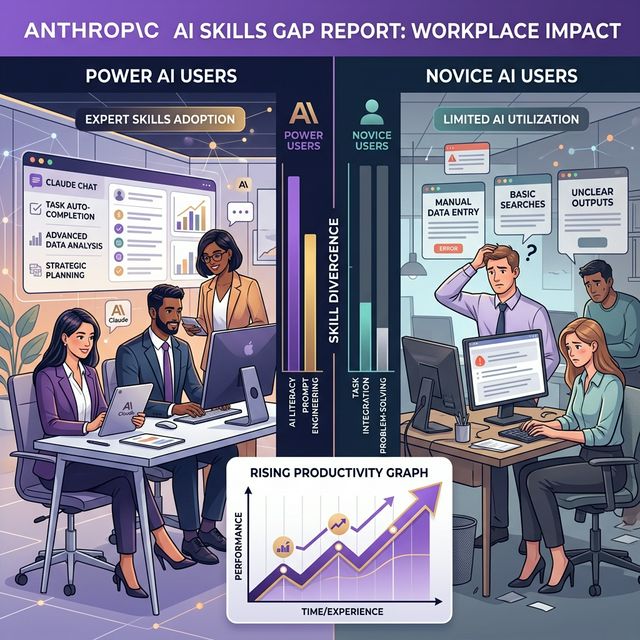
But beneath that headline stability lies an increasingly urgent divergence: early AI adopters are extracting dramatically more value from tools like Claude than newcomers, and the gap is growing.
How Power Users Are Pulling Away
Anthropic's analysis of Claude usage patterns reveals a consistent pattern: workers who adopted AI tools early are more likely to use them for complex, work-centric tasks — strategic iteration, thought partnership, and multi-step problem solving — rather than casual or one-off queries.
Newcomers, by contrast, tend to use AI for simpler, isolated tasks. They're using the same tool but getting a fraction of the productivity leverage. The result is an emerging "AI return gap" — where the same technology, in different hands, produces wildly different outcomes.
"AI is becoming a technology that rewards those who already know how to use it — and workers who can effectively incorporate it into their work will increasingly have an edge." — Peter McCrory, Head of Economics, Anthropic
The report also found that Claude usage is heavily concentrated geographically — more intense in high-income countries, within the US in areas with greater concentrations of knowledge workers, and for a relatively small set of specialised tasks. The promise of AI as an equaliser is, at least for now, not materialising.
The Displacement Clock Is Ticking
The absence of displacement today should not be read as a guarantee of stability tomorrow. Anthropic CEO Dario Amodei has predicted that AI could eliminate half of all entry-level white-collar jobs and push unemployment as high as 20% within five years — a statement that has reverberated across policy circles globally.
McCrory's framing is more cautious but equally urgent:
"Displacement effects could materialise very quickly, so you want to establish a monitoring framework to understand that before it materialises — so that we can catch it as it's happening and identify the appropriate policy response."
The call for real-time monitoring frameworks reflects a broader recognition: by the time traditional economic statistics flag structural unemployment from AI, the damage may already be entrenched.
Younger Workers at Greatest Risk
Anthropic's report highlights early evidence of uneven impacts on younger workers entering the workforce. Entry-level white-collar roles — the traditional on-ramp to career development — are among the most AI-exposed categories. These are precisely the roles where AI can automate the highest share of tasks at the lowest cost.
For young professionals in the MENA region entering the workforce today, this creates a paradox: they are encountering AI tools earlier in their careers than any previous generation, but the entry-level roles that would have given them foundational experience are under the greatest pressure. The UAE's lead in AI adoption makes this tension especially acute locally.
The Embedded Tweet Context
New Anthropic economic impact report out today. The AI skills gap is real. Early adopters are using Claude as a thought partner. Newcomers are using it for one-off tasks. The productivity gap is widening. 🧵
— Rebecca Bellan (@RebeccaBellan) March 25, 2026
What the MENA Region Should Do Now
The Anthropic report's findings have direct implications for Gulf enterprises and governments investing in AI workforce programmes. The data suggests that simply providing AI tool access is insufficient — the quality of AI training and the sophistication of use cases matters enormously.
- Invest in depth, not breadth. Generic AI training programmes that teach basic prompting produce novice-level users. Enterprises need deep, job-specific AI integration programmes.
- Track the skills gap locally. UAE and Saudi companies should be measuring AI usage sophistication — not just adoption rates — across their teams right now.
- Prioritise entry-level roles. The workers most at risk from displacement are often the youngest and least equipped to self-advocate. Proactive reskilling for white-collar entry-level roles is urgent.
McCrory's call for monitoring frameworks is well-founded. But in the Gulf, where 80% of organisations have an AI strategy but data readiness still lags, the foundational work of measuring the AI skills gap has barely begun.
The productivity gap between AI power users and beginners is not an inevitable fact of human nature — it's a trainable, closeable gap. The question is whether organisations will close it proactively, or wait for the market to punish them for allowing it to widen.