Elon Musk's "Terafab": Inside the Plan to Build Chips for SpaceX, Tesla — and Space
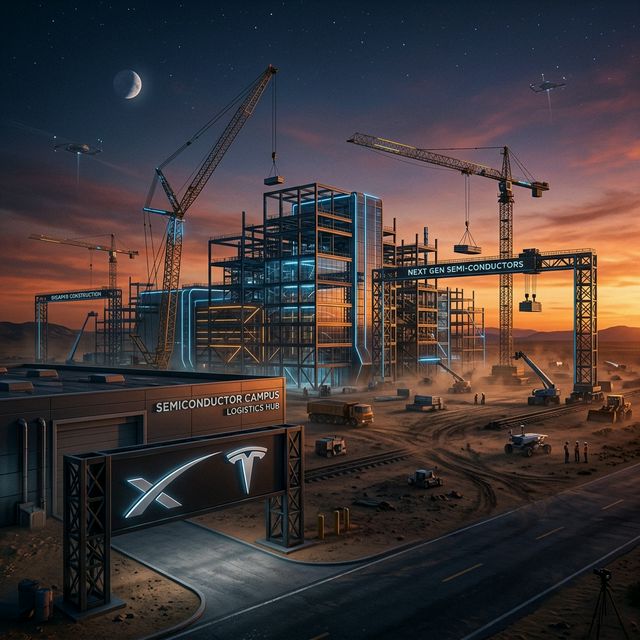
Elon Musk has unveiled plans for a chip manufacturing facility he is calling "Terafab" — a joint project between Tesla and SpaceX that would be built near Tesla's Austin headquarters. The goal: produce the semiconductors his companies need for AI and robotics, at a scale no existing fab can match.
The announcement came on Saturday night at an event in downtown Austin, Texas. A photo shared from the gathering suggested the Terafab is planned for a site adjacent to Tesla's "gigafactory" in the city. Musk framed the decision not as an act of ambition but of necessity:
"We either build the Terafab or we don't have the chips, and we need the chips, so we build the Terafab."
— Elon Musk, Austin, Texas
The complaint is one that has echoed across the AI industry for the past two years: demand for advanced semiconductors has dramatically outpaced supply. What sets this announcement apart is the scale Musk is targeting — and his willingness to vertically integrate into one of the most capital-intensive industries on earth.
The Numbers: What "Terafab" Would Need to Produce
Musk laid out two distinct targets for the facility's output:
🌍 On Earth
Support 100 to 200 gigawatts of AI computing power per year — enough to run the data centres required for Tesla's Full Self-Driving systems, Optimus robotics, and SpaceX's constellation management AI.
🚀 In Space
Deliver chips capable of sustaining a terawatt of computing power operating in orbit — a figure that would represent an entirely new class of space-based infrastructure.
To put these ambitions in context: the entire global data centre industry today consumes an estimated 200–250 gigawatts of power. Musk is describing a facility whose chips would, in effect, double the world's AI compute capacity — and then add orbital infrastructure on top.
No timeline was offered for any of these milestones.
Why Musk Is Entering Chip Manufacturing
The move follows a familiar Musk playbook: when a critical input is constrained, build it yourself. SpaceX did it with rocket engines. Tesla did it with batteries, then with its own AI training chip, the Dojo D1. Neuralink has built bespoke electrodes in-house. The through-line is vertical integration as a competitive moat.
The specific trigger here is the accelerating demand from his AI and robotics programmes. Tesla's Optimus humanoid robot — now in production at the Fremont factory — requires dense, real-time inference compute at the edge. SpaceX's Starlink constellation, now serving over 100 countries, requires ever-more sophisticated routing and signal processing. And both companies have ambitious plans for autonomous systems that will only escalate those requirements.
Musk's argument is straightforward: the largest chip manufacturers — TSMC, Samsung, Intel Foundry — are prioritising their existing clients (Apple, Nvidia, AMD) and cannot accommodate the custom schedules and volumes his companies require. Building Terafab would give him a dedicated, sovereign supply chain.
MENA Context: The GCC's Own Semiconductor Ambitions
The Gulf is not a passive observer of this trend. The UAE recently unveiled a 4-trillion transistor AI chip at World Government Summit 2026, signalling sovereign hardware ambitions. Saudi Arabia's Public Investment Fund has backed semiconductor initiatives as part of Vision 2030. Meanwhile, Samsung and AMD's HBM4 partnership is reshaping how the region plans its AI data centre supply chains. Musk's Terafab — if it materialises — would represent yet another private-sector alternative to the existing TSMC-dominated order.
The Hard Reality of Building a Chip Fab
Musk's critics are quick to note that he has no background in semiconductor manufacturing — and that the gap between announcing a fab and operating one is measured in years and tens of billions of dollars. Building a leading-edge fabrication plant requires:
- Extreme ultraviolet (EUV) lithography machines — manufactured exclusively by ASML, with wait times of 18 months or more per unit, and prices exceeding $350 million each.
- Specialised cleanroom facilities — requiring years to construct and commission, with contamination tolerances measured in parts per trillion.
- A workforce that doesn't yet exist at the required scale — semiconductor process engineers are among the most scarce technical professionals on earth.
- Regulatory approvals and export controls — particularly complex given that advanced chip manufacturing equipment is subject to strict US and allied export regimes.
Bloomberg, which first reported on the event, noted that Musk "has a history of overpromising on goals and timelines." His track record on this is mixed: Starship eventually flew after repeated delays; Full Self-Driving has been "almost ready" for the better part of a decade. Whether Terafab follows the Starship or the FSD trajectory remains to be seen.
Part of a Larger AI Hardware Race
The announcement arrives at a moment of intense jockeying among the world's largest technology companies over AI compute. Nvidia's order backlog continues to expand — Jensen Huang has publicly discussed a $1 trillion backlog — and every hyperscaler from Microsoft to Google to Amazon is designing custom silicon to reduce dependence on third-party chip suppliers.
Jeff Bezos is also reportedly exploring adjacent territory: a $100 billion fund targeting AI-driven acquisition of old manufacturing firms, including chipmakers, has been attributed to him in recent months. The pattern is clear: the billionaire class is converging on the physical layer of AI as the next frontier of competitive moats.
What distinguishes Musk's approach is its sheer scale and the dual-use nature of the ambition — chips optimised for space are a genuinely novel category, with potential military and commercial implications far beyond running a language model.
Related Coverage
-
Nvidia's $1 Trillion Backlog: The 'Inference Inflection' and its Impact on MENA's AI Strategy
The chip shortage driving Musk's Terafab plans, examined through a Gulf lens.
-
UAE's 4-Trillion Transistor AI Chip: What It Signals for the Gulf Tech Race
The MENA region's own sovereign chip ambitions, unveiled at World Government Summit 2026.
-
Samsung and AMD Sign HBM4 Supply MOU — A Semiconductor Alliance That Reshapes Gulf AI Infrastructure Plans
How the semiconductor partnership landscape is shifting across the GCC.
-
Jeff Bezos Reportedly Seeks $100 Billion to Buy and Transform Old Manufacturing Firms with AI
The Musk playbook isn't unique — Bezos is pursuing a parallel vertical integration strategy.
What to Watch
The Terafab announcement raises more questions than it answers. Key signals to track in the coming months:
- ASML engagement — If Musk places EUV orders, that would be the first concrete proof of commitment. ASML's order book is the real forcing function.
- Partnership announcements — Building a fab alone would be unprecedented. Expect licensing agreements or minority partnerships with existing foundry players if the project is serious.
- US government involvement — The CHIPS Act has already disbursed funds to TSMC (Arizona), Samsung (Texas), and Intel. A Musk-led fab near Austin would be a credible applicant — and a politically complex one.
- SpaceX's orbital compute ambitions — The "terawatt in space" target is the most speculative piece. Watch for payload manifests or Starship mission profiles that hint at data centre satellites.
The Bottom Line
Elon Musk is betting that the bottleneck to his companies' AI ambitions is not software, not talent, and not capital — it is silicon. The Terafab announcement is the most direct public statement yet that he intends to control his own semiconductor supply chain, much as he controls his own rocket engines and battery cells.
Whether it succeeds or not, the announcement matters: it reflects a growing consensus among the world's largest AI builders that depending on TSMC and Nvidia for the physical foundation of intelligence is an unacceptable strategic vulnerability. For the MENA region — where Saudi Arabia and the UAE are both building sovereign AI infrastructure — it is a reminder that chips are the new oil, and the race to control the supply chain is accelerating.
Source: Bloomberg; event remarks by Elon Musk at Austin, Texas event, March 2026.