Samsung and AMD Sign HBM4 Supply MOU — A Semiconductor Alliance That Reshapes Gulf AI Infrastructure Plans
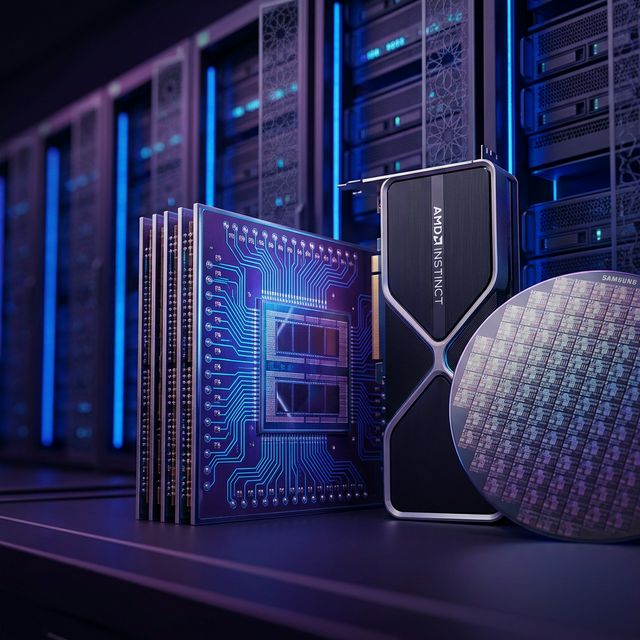
Samsung Electronics and Advanced Micro Devices have formalised a strategic memory partnership centred on next-generation HBM4 chips for AMD's upcoming AI accelerators. The deal, signed during Nvidia's GTC week, has direct implications for the data centre buildout underway across the UAE and Saudi Arabia.
Samsung Electronics and Advanced Micro Devices signed a memorandum of understanding on Wednesday to deepen their strategic partnership across AI memory and potentially chip manufacturing. The agreement, formalised during AMD CEO Lisa Su's first visit to South Korea in over a decade, positions Samsung as the primary HBM4 supplier for AMD's next-generation Instinct MI455X AI accelerators — the chips designed to power large-scale AI training and inference clusters in 2026 and beyond.
The MOU also covers optimised DDR5 memory for AMD's sixth-generation EPYC server processors, codenamed Venice, and opens the door to a foundry partnership under which Samsung could manufacture future AMD chips on its advanced process nodes. That foundry element, while not yet formalised, would be a significant development: it would give AMD a credible alternative to TSMC for cutting-edge production and give Samsung's foundry business a high-profile anchor customer at a time when it is working to close the gap with the Taiwanese firm.
Why This Deal Happened This Week
The timing is deliberate. The signing took place during Nvidia's annual GTC developer conference in San Jose, where Nvidia CEO Jensen Huang separately announced a foundry partnership with Samsung and publicly praised the company's HBM4 technology. AMD and Samsung used the same news cycle to signal that the Nvidia-Samsung relationship is not exclusive — and that AMD is building its own integrated silicon-to-system stack capable of challenging Nvidia's dominance in AI accelerator market share.
Samsung holds approximately 22% of the global HBM market, compared to SK Hynix's 57% leadership. HBM4 represents the memory generation most critical to the next wave of AI infrastructure, offering substantially higher bandwidth and energy efficiency than HBM3E — the chips currently used in AMD's MI350X and MI355X accelerators, which Samsung already supplies. The new agreement locks in Samsung as AMD's preferred partner for the generational step-up.
The Competitive Context: AMD vs. Nvidia in 2026
Last month, AMD signed a deal with Meta Platforms to supply up to $60 billion worth of AI chips over five years. A similar arrangement exists with OpenAI. These deals — combined with the Samsung HBM4 supply commitment and the Helios rack-scale platform developed with Celestica — represent AMD's most coordinated challenge to Nvidia's AI infrastructure dominance to date.
AMD CEO Lisa Su also met with Naver leadership during the Seoul visit, signing a separate MOU to build a high-performance GPU computing environment optimised for Naver's HyperClova X AI model — further evidence that AMD is building an ecosystem of strategic anchor customers rather than competing on individual chip specifications alone.
GCC Relevance
This deal matters directly to the Gulf's AI infrastructure buildout. Both the UAE's Stargate project — a 5-gigawatt AI data centre campus in Abu Dhabi anchored by G42, OpenAI, Nvidia, Oracle, and Cisco — and Saudi Arabia's HUMAIN compute programme are currently dominated by Nvidia GPU infrastructure. The Samsung-AMD MOU signals that a credible, fully integrated alternative supply chain is forming. As Gulf sovereign infrastructure planners model out 2027 and 2028 procurement, the availability of AMD's Instinct MI455X backed by Samsung HBM4 represents a meaningful second-source option that reduces concentration risk on Nvidia's supply chain. For GCC cloud providers and AI platform operators evaluating next-generation hardware, the AMD roadmap is now worth including in procurement planning conversations.
Sources: Reuters / Korea Herald / Samsung Electronics / AMD — March 18, 2026