Clinical Cognition: Evaluating the Efficacy of Generative AI in Emergency Diagnostics
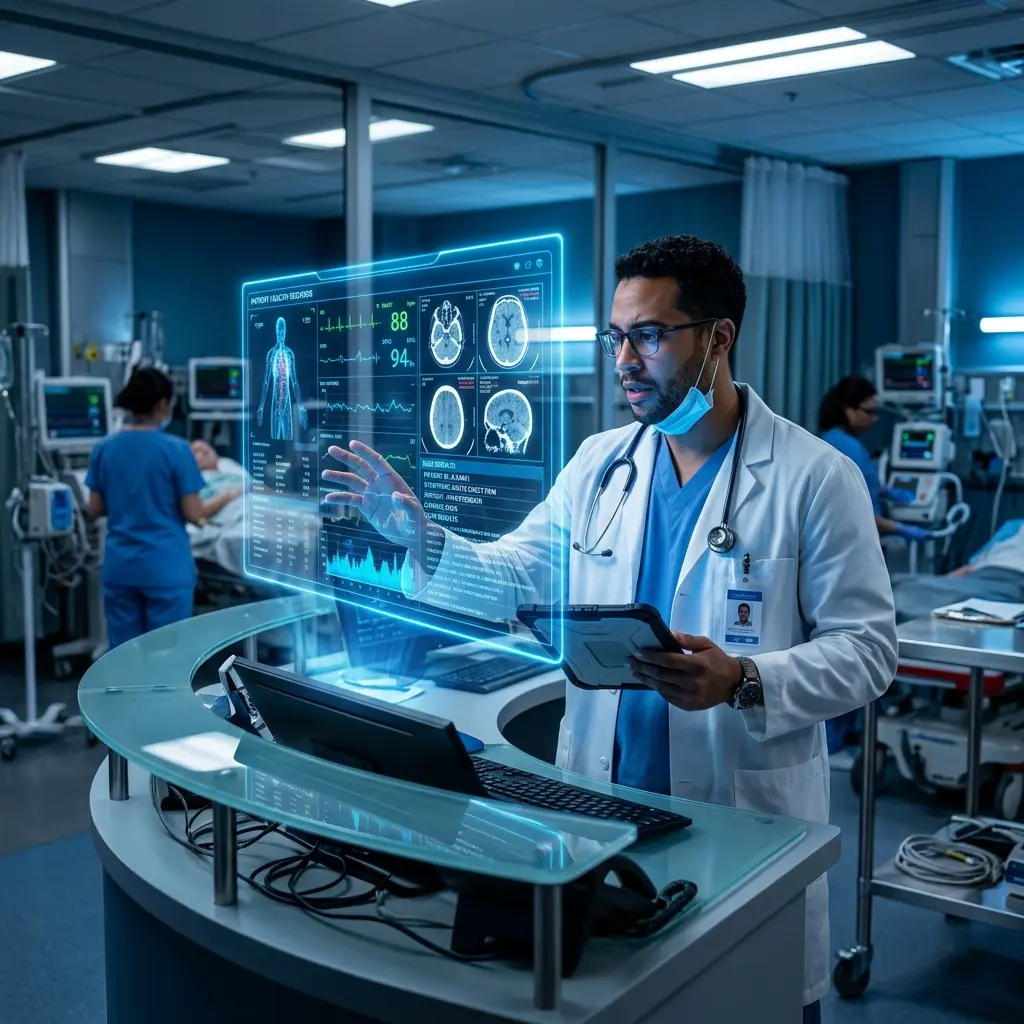
A landmark study published in the journal Science has demonstrated that advanced AI reasoning models are now capable of matching or exceeding the diagnostic accuracy of experienced Emergency Room (ER) physicians.
Utilizing "messy," real-world electronic health records (EHR), the AI successfully identified complex underlying conditions that had initially eluded human teams. This research marks a pivotal shift from AI as a simple text generator to a sophisticated clinical reasoning tool, a trend we highlighted in our comprehensive guide on AI healthcare for GCC enterprises.
I. The Experimental Framework: Real-World Stress Testing
Researchers from Harvard Medical School and Beth Israel Deaconess Medical Center moved beyond standardized benchmarks to test AI under the high-pressure, high-uncertainty conditions of an emergency department.
The Case Study: The Lupus Breakthrough
The study highlighted a specific case of a patient with a pulmonary embolism whose condition worsened despite standard treatment.
- Human Assessment: Focused on medication failure or clot progression.
- AI Assessment: Synthesized historical EHR data to identify a history of Lupus.
- The Outcome: The AI correctly deduced that heart inflammation (pericarditis/myocarditis) associated with the autoimmune disorder was the primary driver of the clinical decline.
II. Comparative Performance Metrics
The study evaluated the AI model (an OpenAI reasoning-based system) against a "physician baseline" consisting of two experienced doctors. The evaluation occurred across three distinct clinical stages:
| Stage | AI Performance | Physician Performance |
|---|---|---|
| Triage | High accuracy with limited data. | Standard initial assessment. |
| ER Treatment | Outperformed baseline in synthesis. | Focused on immediate symptoms. |
| Hospital Admission | Superior differential diagnosis. | High accuracy but slower synthesis. |
Key Findings
- Superiority Over GPT-4: The new reasoning model significantly outperformed its predecessor, particularly in handling clinical uncertainty.
- Handling "Messy" Data: Unlike previous models that required curated datasets, this model successfully navigated the fragmented and often contradictory notes found in real-world EHRs.
- Differential Diagnosis: The AI excelled at "thinking broadly," generating comprehensive lists of potential conditions that explained a patient's symptoms.
III. Limitations and the "Human Factor"
While the data is compelling, both the study authors and external experts urge caution regarding the "real-world" application of these findings. This aligns with ongoing debates regarding the ethical constraints of deploying AI as physicians.
- Sensory Input Gap: AI models currently rely solely on text-based data. They lack the ability to process non-verbal cues, physical tactile feedback, or the "sounds" of a patient that are vital to bedside medicine.
- Workflow Integration: Identifying a diagnosis is only one step. The "open question" remains how to integrate this intelligence into a hospital's workflow without causing alert fatigue.
- Long-Term Care Limitation: The study focused on the ER. Authors noted that AI performance might degrade if tasked with analyzing the records of a patient with a month-long hospital stay, where data volume becomes overwhelming.
IV. The Path Forward: Clinical Trials and Structural Change
The researchers emphasize that this is not a call to replace doctors, but rather a signal of a "profound change" in medical technology. For ai startups dubai/gcc, the challenge lies in creating hybrid systems where collaborative intelligence prevails over pure autonomous diagnosis.
Recommendations for Implementation
- Rigorous Testing: Forward-looking, prospective clinical trials are required to see how AI impacts actual patient outcomes.
- Collaborative Intelligence: AI should be viewed as a "reasoning partner" that provides a safety net for human cognitive biases.
- Ethical Guardrails: Ensuring that AI recommendations are transparent and that clinicians remain the final decision-makers.
Conclusion
The Harvard-Beth Israel study serves as a "call to action" for the medical community. As AI models move from simple chatbots to reasoning engines capable of solving complex medical mysteries, the challenge shifts from technological capability to clinical integration. The future of medicine likely lies in a hybrid model where human empathy and sensory intuition are augmented by the vast analytical reach of artificial intelligence.