AI-Powered Healthcare for GCC Enterprises: What Every Business Leader Needs to Understand and Why Digital Health AI Is the Investment That Pays for Itself

The GCC's healthcare system is at an inflection point. Governments across Saudi Arabia and the UAE are investing billions to transform how healthcare is delivered, and AI is at the centre of that transformation. For B2B enterprise leaders, the question is no longer whether AI is changing healthcare. It is whether their organisation is positioned to benefit from it, or still paying the cost of a healthcare model that was never built for the digital economy.
In this article
- What is AI-powered healthcare and why does it matter for B2B enterprises?
- The GCC digital health landscape in 2026
- The AI healthcare services every GCC enterprise needs to know
- Deep dive: what is an AI-powered digital health platform?
- How enterprise digital health AI works from triage to treatment
- Types of AI healthcare services and when to use each
- What does an enterprise AI health platform actually deliver?
- How to evaluate a digital health AI provider
What is AI-powered healthcare and why does it matter for B2B enterprises?
AI-powered healthcare is the application of machine learning, natural language processing, predictive analytics, and autonomous clinical decision support to the delivery, management, and administration of health services. In the enterprise context, it encompasses every point at which an organisation's relationship with healthcare—as an employer, insurer, government entity, or healthcare provider—can be made more effective, more accessible, and more cost-efficient through AI. This is a critical extension of the broader enterprise AI ownership trend we are seeing across the Gulf.
For GCC B2B enterprises, the healthcare challenge is structural. The region has one of the fastest-growing populations in the world, a workforce with high rates of chronic disease driven by lifestyle factors, and a healthcare system that, despite massive government investment, has historically struggled to deliver primary care at the scale and accessibility that a modern digital economy requires. The result, for enterprises that provide health coverage to their employees or manage health claims on behalf of insured populations, is a combination of high costs, low early-intervention rates, and a workforce whose health outcomes are managed reactively rather than preventatively.
Traditional healthcare delivery models compound this structural challenge. When an employee in Dubai or Riyadh needs a primary care consultation, the default path involves booking an appointment, travelling to a clinic, waiting, being seen briefly, and repeating the process for prescriptions, referrals, and follow-up. In a workforce where time is a scarce resource and healthcare facilities are unevenly distributed across urban and non-urban areas, this friction suppresses healthcare utilisation. Employees delay care until problems are serious, costly, and disruptive to productivity.
AI-powered digital health platforms change this model fundamentally. By moving primary care consultations to digital channels, providing 24/7 access to licensed physicians via video, voice, and text, supported by AI-powered triage that routes patients to the right level of care immediately, these platforms remove the friction that suppresses utilisation and replace reactive sick care with accessible, affordable, preventive care. For enterprises offering this as an employee benefit, the business case is direct. Healthier employees with faster access to care are more productive, take fewer sick days, and cost significantly less in insurance claims over time.
For insurers managing GCC health claims portfolios, AI-powered digital health is the intervention that addresses the most expensive driver of claims cost: unnecessary emergency and specialist visits for conditions that could have been managed in primary care if access had been easier.
The GCC digital health landscape in 2026
The GCC's digital health landscape in 2026 is defined by the convergence of government mandate, enterprise demand, and AI capability that has made this the most significant moment of transformation in the region's healthcare history. This echoes findings from our analysis on the GCC AI Paradox, where value realization in specific verticals like healthcare is now outpacing horizontal AI hype.
On the government side, Saudi Arabia's Vision 2030 Health Sector Transformation Programme has committed to providing inclusive health services to 88% of the Kingdom's population, implementing unified digital medical records for 100% of the population, and positioning the Kingdom's digital health market on a trajectory toward USD 11 billion by 2033. The Saudi Data and AI Authority has placed healthcare among the highest-priority sectors for AI deployment under the National AI Strategy 2031. In parallel, Saudi Arabia's Project Transcendence, a USD 100 billion initiative to build AI capabilities, specifically targets healthcare as a core application domain.
In the UAE, the Artificial Intelligence Strategy 2031 names healthcare as a primary sector for AI integration, and the country's health information infrastructure has reached a scale that makes AI deployment viable at a national level. Abu Dhabi's Malaffi platform connects 59 public and private hospitals, over 1,100 clinics, and 380 pharmacies, giving 53,476 clinicians access to unified patient records across 3,072 facilities. By 2025, Malaffi contained 3.5 billion clinical records representing 12.7 million unique patient profiles, a dataset of a scale that makes AI-powered population health analytics operationally feasible for the first time.
On the enterprise demand side, GCC businesses offering health insurance to employees are facing a claims environment that is both expensive and increasingly unsustainable under traditional delivery models. Chronic disease prevalence, including diabetes, cardiovascular conditions, and metabolic disorders driven by lifestyle factors, is significantly higher in GCC populations than global averages. These conditions are expensive to manage reactively and dramatically cheaper to manage preventively. Enterprises that can shift their insured populations from reactive sick care to preventive, AI-guided primary care reduce claims costs directly and measurably.
On the AI capability side, the combination of Arabic-language AI advances, sovereign cloud infrastructure, and purpose-built digital health platforms that have achieved production scale in the GCC market has created a service landscape that did not exist even three years ago. Enterprises no longer need to evaluate whether AI-powered healthcare is technically feasible in the GCC context. The question is which platform delivers the most effective outcomes for their specific population.
"Building an end-to-end platform and strengthening geographic presence have always been strategic priorities, because in healthcare, every decision made today is connected to every decision made before."
The AI healthcare services every GCC enterprise needs to know
The AI healthcare service landscape for GCC enterprises can be organised into five pillars, each addressing a different layer of an organisation's healthcare and workforce wellbeing requirements.
- AI-powered telehealth and virtual care provides on-demand access to licensed physicians through digital channels, video, voice, and text, supported by AI triage that assesses symptom severity, routes patients to the appropriate care level, and reduces unnecessary emergency visits. For enterprises offering health coverage to employees, telehealth removes the primary barrier to primary care utilisation. Employees who can consult a doctor at 11pm from their phone rather than taking half a day to visit a clinic use primary care more frequently, address health problems earlier, and generate significantly lower downstream claims costs.
- AI clinical decision support augments the diagnostic and treatment decisions of physicians and healthcare professionals with evidence-based AI recommendations, drawing on clinical guidelines, patient history, population data, and real-time research to surface diagnostic hypotheses, flag drug interactions, and recommend treatment pathways. For enterprise healthcare providers and hospital systems, clinical decision support reduces diagnostic error rates, improves treatment consistency, and accelerates the time from presentation to diagnosis for conditions where speed directly affects outcomes.
- Predictive health analytics applies machine learning to population health data, including claims records, diagnostic patterns, lifestyle risk factors, and treatment outcomes, to identify individuals at elevated risk of developing costly chronic conditions before those conditions require acute intervention. For insurers managing GCC health portfolios and self-insured enterprises, predictive analytics is the capability that shifts investment from treating disease to preventing it. It identifies the 20% of insured individuals whose risk profile suggests they will generate 80% of future claims, and intervenes with targeted preventive care programmes before those claims materialise.
- AI-powered pharmacy and diagnostics services integrates prescription management, medication delivery, and diagnostic testing into a unified digital health journey that removes the fragmentation between consultation, prescription, and follow-up. For enterprises managing employee health programmes, integrated pharmacy and diagnostics services ensure that the care journey initiated by a digital consultation is completed. Medication is taken, tests are done, and follow-up is scheduled, rather than stalling between disconnected service providers.
- Enterprise health management platforms provide the corporate administration layer that allows HR leaders, insurance managers, and occupational health teams to manage employee health programmes at scale. They track utilisation, monitor population health trends, manage claims, and measure the return on investment of healthcare benefits spending. For large GCC enterprises managing health coverage for thousands of employees across multiple locations, enterprise health platforms provide the visibility and management capability that makes health benefits a strategic asset rather than an unmanaged liability.

Deep dive: what is an AI-powered digital health platform?
An AI-powered digital health platform is an integrated technology environment that combines clinical service delivery, including physician consultations, diagnostic referrals, and prescription management, with artificial intelligence that makes every step of that care journey smarter, faster, and more appropriately targeted to the individual patient's needs.
Understanding what distinguishes a genuine AI-powered health platform from a digital appointment-booking tool requires examining four dimensions: the AI engine, the care continuum coverage, the population health analytics capability, and the enterprise integration layer.
The AI Engine
The AI engine is the core differentiator. In a genuine AI-powered health platform, AI is not a feature that sits on top of a conventional telehealth service. It is the foundational layer that shapes every patient interaction from the moment they describe their symptoms. AI-powered triage analyses the patient's stated symptoms against clinical knowledge bases, patient history, and population diagnostic patterns to generate a preliminary risk assessment and routing recommendation. It directs straightforward cases to on-demand physician consultation, moderate-risk cases to scheduled appointments with specialists, and high-risk presentations to emergency care, with appropriate urgency signalling in each case.
This triage layer does two things that human-only triage cannot match at scale. First, it is consistently available, operating at 3am during a public holiday with the same accuracy as during peak hours. Second, it learns continuously from outcomes. The AI model refines its triage accuracy with every case that passes through the system, building a progressively better understanding of which symptom presentations lead to which diagnoses in which population segments. The result is a system that gets measurably better over time without additional human resource investment.
The Care Continuum
The care continuum determines whether the platform can genuinely manage a patient's health journey end-to-end or only handles one phase of it. Platforms that offer telehealth consultations but route patients to offline pharmacies and diagnostic centres for next steps create fragmentation that reduces compliance and undermines outcomes. Platforms that integrate consultation, prescription management, medication delivery, diagnostic testing, specialist referral, and follow-up scheduling into a single continuous experience have demonstrated consistently better health outcomes and higher patient engagement than those providing only point-in-time consultation access.
For GCC enterprises offering digital health as an employee benefit, the care continuum question is commercially significant. An employee who consults a doctor digitally but cannot get their prescription delivered or blood test scheduled through the same platform will revert to traditional care pathways for the next interaction. The enterprise then loses the cost efficiency that the digital health investment was designed to deliver.
Population Health Analytics & Arabic Language Capability
Population health analytics is the enterprise layer that transforms a collection of individual consultations into a managed population health programme. AI-powered analytics platforms aggregate anonymised data from consultation patterns, diagnostic outcomes, prescription adherence, and health screening results to build a population health picture that allows HR and insurance leaders to understand their insured population's risk profile, identify emerging health trends before they become claims cost drivers, and measure the effectiveness of preventive health interventions over time.
Arabic-language capability is a non-negotiable requirement for digital health platforms serving GCC populations. Healthcare is among the most culturally and linguistically sensitive human experiences. A patient describing chest pain, mental health symptoms, or reproductive health concerns needs to do so in the language in which they think and feel. Arabic-first health platforms that were built for Arabic-speaking patients, with medical content libraries in Arabic, physician networks that serve in Arabic, and AI engines trained on Arabic-language health interactions, deliver fundamentally better patient engagement and diagnostic accuracy than multilingual platforms treating Arabic as a secondary capability.
How enterprise digital health AI works from triage to treatment
Understanding how AI-powered digital health operates in a production enterprise environment requires following a patient interaction through the complete care journey that the platform is designed to support.
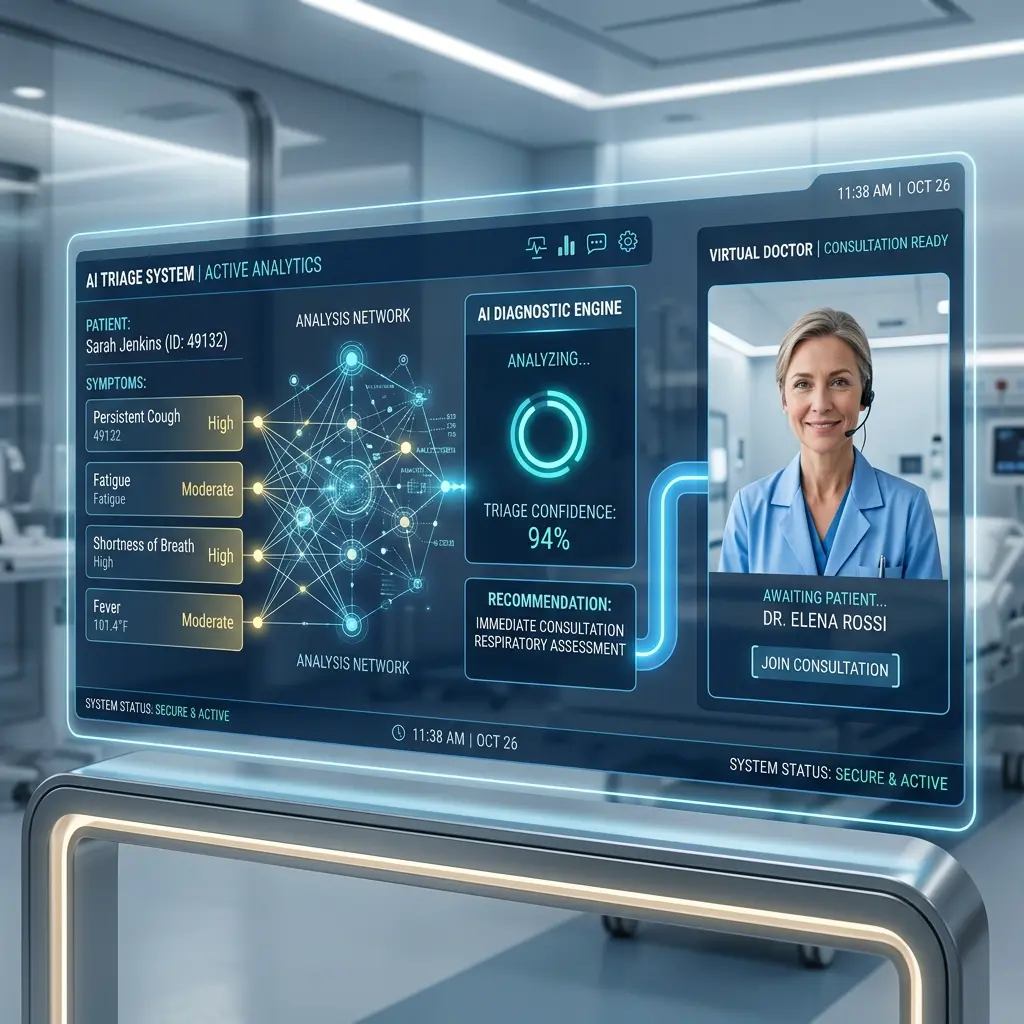
- Symptom presentation and AI triage is the entry point. An employee opens the digital health platform and describes their symptoms, in Arabic or English, via text or voice. The AI triage engine immediately processes this input against a clinical knowledge base, assesses symptom severity and urgency, reviews the patient's consultation history for relevant context, and generates a care routing recommendation. This happens in seconds, before any human clinician is involved. The triage output determines the patient's next step.
- Physician consultation with AI assistance is the clinical core. The patient connects with a licensed physician via video, voice, or text, and the physician has access to the patient's consultation history, the AI triage output, and AI-generated clinical decision support that surfaces relevant diagnostic hypotheses and treatment options based on the patient's presentation. The physician makes the clinical decisions; the AI provides the information architecture that makes those decisions faster and more comprehensively informed.
- Prescription and pharmacy integration closes the treatment loop. Where a consultation results in a prescription, the digital health platform manages the prescription digitally, transmitting it to a pharmacy partner for fulfilment and delivery, managing refills, and tracking adherence over time. Patients who take their medication consistently generate fewer acute episodes and fewer high-cost hospitalisations.
- Diagnostic coordination manages the referral and results pathway for investigations ordered during the consultation, including blood tests, imaging, and specialist assessments. It ensures that diagnostic results are returned to the consulting physician and integrated into the patient's ongoing health record.
- Population health reporting aggregates anonymised data from individual care journeys into enterprise-level health analytics, providing HR and benefits leaders with utilisation reports, health risk indicators, claims forecasting, and intervention effectiveness data.
Types of AI healthcare services and when to use each
Enterprise telehealth platforms provide 24/7 digital access to licensed physicians for employees and their dependants. Most impactful in large, geographically distributed workforces where in-person primary care access is inconsistent.
AI-powered health triage services provide the automated first-contact layer that assesses symptom severity and routes patients to appropriate care. Most valuable in high-volume healthcare environments where human triage capacity cannot match demand volume.
Predictive and preventive health analytics applies machine learning to insured population data to identify high-risk individuals before they generate high-cost claims events. Most relevant for large employers and insurers managing GCC health portfolios with significant chronic disease exposure.
Integrated pharmacy and diagnostics extends the digital care journey beyond consultation to include prescription fulfilment and diagnostic test coordination. Most valuable for enterprises managing populations with high rates of chronic disease.
Occupational health and wellness AI applies AI to the specific health and safety requirements of enterprise workforces. Increasingly important for GCC enterprises in sectors with significant physical or mental health risk profiles.
White-label corporate health platforms enable large enterprises and insurers to deploy AI-powered digital health services under their own brand. Most appropriate for large corporates and government health authorities wanting to offer digital health services without building the infrastructure from scratch.
What does an enterprise AI health platform actually deliver?
The output of a well-implemented enterprise digital health AI deployment is measurable across four dimensions that connect healthcare investment to business outcomes.
First, it delivers measurable reduction in healthcare utilisation costs. The primary cost driver in GCC enterprise health insurance is unnecessary emergency and specialist utilisation. AI platforms that make primary care immediately accessible reduce these costly presentations.
Second, it delivers improved workforce health outcomes and productivity. The healthcare cost of chronic disease in GCC workforces is a known quantity. Enterprises that invest in AI-powered preventive health programmes are investing in the long-term productivity of their most valuable asset.
Third, it delivers regulatory compliance and benefit administration efficiency. AI-powered health platforms that integrate regulatory compliance into their operational architecture provide the audit trails and data residency controls that regulators require.
Fourth, it delivers the Arabic-language, culturally aligned health experience that GCC populations engage with. For GCC enterprises with predominantly Arabic-speaking workforces, deploying a digital health platform built for Arabic-speaking patients drives meaningfully higher utilisation.
How to evaluate a digital health AI provider
The GCC digital health market has expanded rapidly. When evaluating a digital health AI platform for enterprise deployment, B2B leaders should examine five dimensions.
- Clinical network depth and physician quality. Evaluate providers on the size of their active certified physician network, specialties covered, languages available, and average wait time for on-demand consultations.
- AI capability depth. Ask providers to demonstrate their triage accuracy, explain the training data behind their clinical decision support models, and show the population health analytics outputs. Providers offering AI as a mere marketing label will not be able to provide specific data.
- End-to-end care continuum coverage. Evaluate whether the platform manages the complete care journey, including consultation, prescription, pharmacy fulfilment, diagnostic coordination, and follow-up.
- Arabic-language quality and cultural alignment. Consider the depth of the Arabic medical content library, the proportion of physicians offering Arabic-language consultations, and the quality of Arabic-language AI triage.
- Enterprise integration and population health analytics. Evaluate the enterprise administration layer. Providers who can demonstrate measurable claims cost reduction through their analytics are making a claim that can be tested against your own population data.
The Business Resilience Investment
For GCC enterprises operating in an environment of rising workforce health costs, increasingly demanding regulatory requirements, and a workforce that expects digital-first access to services that matter to them, AI-powered healthcare is not a welfare benefit. It is a business resilience investment, one that pays measurable returns in productivity, claims cost reduction, regulatory compliance, and the ability to attract and retain talent in a competitive regional market. The enterprises that build this capability into their employee proposition now, with providers who have achieved genuine production scale in the GCC context, are the ones that will define the standard for workforce health management in the region's digital economy.