The $500M Moat: Inside Kirkland and Ellis's Plan to Productise Legal Intelligence
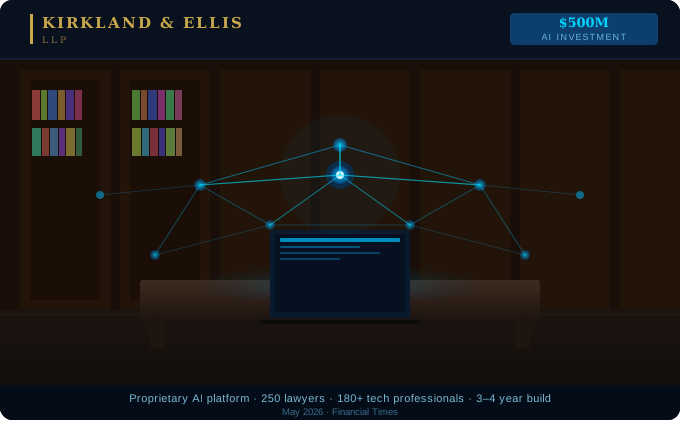
Kirkland and Ellis is committing $500 million to build a closed, proprietary AI platform trained on the knowledge of its top partners. The move reframes elite legal AI from tool adoption to outright intelligence ownership.
Key Takeaways
- ▸Kirkland and Ellis is investing $500 million to build a closed, proprietary AI platform trained on the codified knowledge of 250 of its top lawyers and partners.
- ▸The firm is spending more than $100 million in 2026 alone, with the balance deployed over three to four years, funded directly from partner revenues.
- ▸Outside technology vendors co-building the platform are contractually barred from reselling or repurposing the intellectual property. Kirkland retains full ownership.
- ▸The investment signals an accelerating shift from hourly billing to value-based pricing in elite law, as AI automates tasks that previously required hundreds of attorney hours.
- ▸AI hallucination errors at Sullivan and Cromwell and Pinsent Masons have increased institutional appetite for proprietary, human-curated training pipelines over generic LLMs.
The global elite legal sector has reached a defining structural inflection point. While the initial wave of artificial intelligence adoption in law was characterized by firm-wide subscriptions to third-party SaaS tools, effectively establishing a uniform technology baseline, the world's highest-grossing law firm is initiating an aggressive capital reallocation strategy to break away from commodity software.
Kirkland and Ellis's announcement of a $500 million capital commitment to engineer a closed, custom AI platform marks a pivot from AI consumption to AI production. By treating its institutional knowledge as proprietary training data rather than operational overhead, the firm is attempting to widen the competitive gap between the ultra-high-margin elite and the rest of the corporate legal market.
1. Beyond the Tech "Floor": The Economics of Elite Legal AI
The foundational logic driving Kirkland's half-billion-dollar expenditure is an explicit rejection of off-the-shelf legal technology. While generalized large language models (LLMs) and widely adopted legal AI tools like Harvey and Legora have significantly optimized everyday routine tasks, they simultaneously commoditize those exact capabilities across competing firms.
As Kirkland's chair Jon Ballis summarized: "The use of widely available AI tools is raising the floor for everyone... but we don't get hired for the floor."
Capital Expenditure Allocation
Kirkland's technology budget highlights how the firm is leveraging its massive financial scale, having recently broken legal industry records by posting $10.6 billion in revenue with profits per equity partner sitting at roughly $11.1 million, to out-spend the market.
- Year 1 (Immediate Runway): More than $100 million in current-year spend, 180 engineers and data scientists, and the ingestion of knowledge from 250 top-tier firm lawyers including 100 equity partners.
- Years 2 to 4 (Scaling Phase): Hundreds of millions for custom continuous training, with deep vendor lock-in enforced through non-resellable IP clauses.
By funding this immense platform entirely out of short-term partner revenue distributions, Kirkland is exploiting a financial edge that mid-market or even secondary elite firms cannot replicate without significantly destabilizing their partner compensation models.
2. IP Lock-In and the Architecture of "Collective Intelligence"
To engineer a highly defensive, un-relicensable technology moat, Kirkland is shifting away from typical enterprise licensing agreements. Instead, the firm is utilizing a hyper-isolated, proprietary development model built on three components.
- The IP Firewall: While outside technology corporations are being brought in to co-build the platform alongside Kirkland's internal team of 180 engineers and data scientists, the underlying contracts contain strict exclusivity restrictions. Third-party vendors are legally barred from selling or repurposing the engineered workflows, ensuring that Kirkland retains sole ownership of the intellectual property.
- Granular Knowledge Ingestion: The cognitive foundation of the platform relies on systematic mapping rather than raw web scraping. A select advisory group of 250 Kirkland lawyers, including 100 equity partners, are actively codifying their specialized institutional knowledge, procedural mechanics, and strategic legal maneuvers directly into the platform's fine-tuning pipeline.
- Monolithic Task Orchestration: Rather than requiring attorneys to switch between disjointed apps for discovery, drafting, or contract analysis, the platform is designed to handle mandates in their entirety. The system acts as an autonomous end-to-end legal workspace, fully informed by the firm's historical corporate experience.
This strategy contrasts sharply with other Magic Circle and elite competitors. Freshfields' alliance with Anthropic focuses on early model access to co-develop specialized tools that will eventually be packaged and sold to rival law firms. Kirkland's model, alternatively, treats its AI as an entirely closed corporate asset.
3. The Hallucination Crisis and Systemic Liability
Kirkland's massive flight toward hyper-curated, proprietary engineering arrives amid a wave of public, AI-driven litigation errors within global law firms. As firms rush unverified off-the-shelf LLM outputs into courts, judicial impatience is mounting.
Sullivan and Cromwell recently apologized to a US federal bankruptcy court after a major filing in a high-profile case was found to contain multiple AI-generated legal hallucinations. Pinsent Masons was reprimanded by a London High Court judge after false, unverified legal citations generated by an AI platform slipped into insolvency proceedings.
These high-profile structural failures underscore the systemic vulnerability of relying on raw, generic probabilistic models for high-stakes litigation and transactional advisory. By pouring hundreds of millions into ring-fenced verification loops and precise human-curated training pipelines, Kirkland is positioning its bespoke system as an explicit hedge against the reputational and financial liability of LLM hallucinations.
4. Accelerated Sunset of the Billable Hour
Perhaps the most far-reaching structural consequence of this massive investment is its downstream effect on the traditional economics of legal billing. For more than half a century, the billable hour has incentivized linear human effort over procedural efficiency. However, a technology platform capable of handling complete mandates autonomously completely severs the link between human time and output quality.
Under a traditional billable hour model, the primary incentive is maximizing total linear associate hours spent, with margin driven by arbitrage on junior attorney labor pools. Under the emergent value-based pricing model, the incentives reverse: speed, precision, and successful transactional outcome become the primary metrics, with margin driven by proprietary software scalability and data moats.
Because an automated platform compresses hundreds of hours of contract analysis and diligence into minutes, billing by the hour would result in an immediate collapse of top-line revenue for firms reliant on legacy billing. By embracing value-based pricing, Kirkland is transforming its $500 million R&D expense into a high-margin monetization engine, allowing the firm to price its services based on the immense scale of its automated output rather than the time spent creating it. The implications for enterprise AI spending and ROI expectations across all sectors are significant.
Conclusion
Kirkland and Ellis's $500 million software play is a vivid demonstration of the post-SaaS enterprise reality. In high-value, knowledge-dense industries, relying on public or globally licensed AI tools is a temporary bridge, not a sustainable competitive advantage. By productizing the collective intelligence of its highest-earning partners into an exclusive, highly integrated system, Kirkland is signaling that the true future winners of the AI transformation will not be those who rent intelligence, but those who own it outright. For enterprise leaders and technology strategists across the MENA region considering their own AI investment architecture, the Kirkland model offers a clear strategic reference: proprietary data moats and closed training pipelines will increasingly separate the market leaders from the market followers.
Related Articles
Governments Are Trading AI Subsidies for Equity Stakes. The Gulf Got There First
The UK just became the latest government to take equity stakes in AI companies rather than simply subsidizing them, a strategy Gulf sovereign funds have been running at a far larger scale for over a year.
Aug 26, 2026
FundingThink's $8M Pre-Seed: Inside MENA's Largest AI Infrastructure Round of the Year
Think just closed MENA's largest AI infrastructure pre-seed round, but the real story isn't that it beat rivals. It's that almost no one else in the region is betting pre-seed capital on this layer of the AI stack at all.
Aug 12, 2026
FundingGCC Sovereign AI Funding Roundup: 1001 and CNTXT AI Raise $90 Million Combined as Investors Back Local Infrastructure
Two GCC-based sovereign AI companies, 1001 and CNTXT AI, have together raised $90 million in recent funding rounds, with backing from Lux Capital, PIF-owned Sanabil Investments, and Abu Dhabi's AI71, signalling growing investor conviction in locally built and governed AI infrastructure.
Jul 15, 2026
Fundingdu Launches USD 50 Million Ventures Fund to Back AI, Fintech and Cybersecurity Startups Across MENA
UAE-based CNTXT AI has acquired Actualize, a GCC-focused startup building dialect-aware Arabic voice agents capable of completing transactions and workflow actions. The deal targets a GCC conversational AI market projected to reach USD 2.5 billion by 2034.
Jun 8, 2026
FundingFireworks AI Eyes $15 Billion Valuation as AI Inference Race Heats Up
Fireworks AI is in talks to raise a fresh funding round at a $15 billion valuation, nearly four times its $4 billion valuation from October 2025, as demand for AI inference infrastructure accelerates across enterprise markets globally.
May 28, 2026