Deccan AI Raises $25M to Build the World's Best AI Post-Training Engine from India
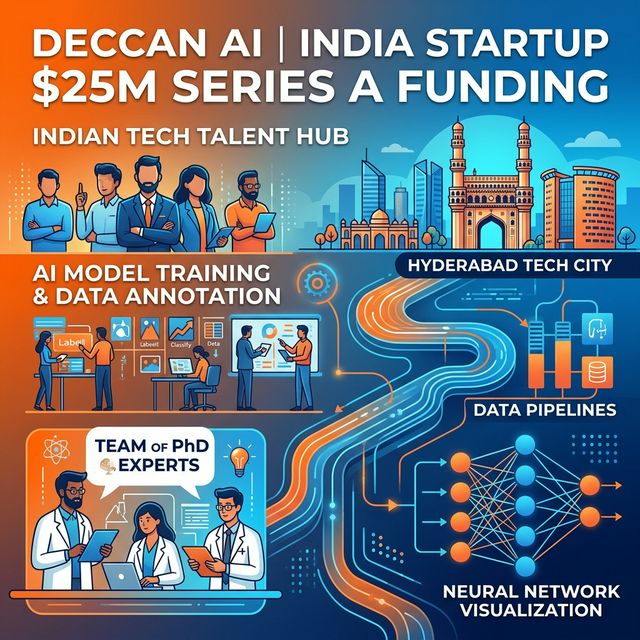
HYDERABAD / SAN FRANCISCO — As frontier AI labs race to build more capable models, the less glamorous but critically important work of making those models reliable in the real world is quietly becoming a billion-dollar industry. Deccan AI, a startup doing exactly that work, just closed a $25 million Series A.
The round was led by A91 Partners, with participation from Susquehanna International Group and Prosus Ventures. Founded in October 2024 by Rukesh Reddy, the company provides AI post-training services — including data generation, evaluation, and reinforcement learning from human feedback (RLHF) — to frontier model builders.
The startup's current customer roster includes Google DeepMind and Snowflake. Deccan runs about a dozen active projects at any given time, with around 10 enterprise customers.
India's PhD Network: The Real Competitive Moat
Deccan operates with a network of over 1 million contributors — 5,000 to 10,000 active per month — with roughly 10% holding advanced degrees, though that share spikes significantly on specialist projects. Top contributors can earn up to $7,000 per month, with hourly rates between $10 and $700 depending on the domain.
"Many of our competitors go to 100-plus countries to find the experts. If you have operations in just one country, it becomes far easier to maintain quality." — Rukesh Reddy, Founder, Deccan AI
That deliberate geographic concentration — in Hyderabad rather than across 100 markets — is Deccan's quality strategy. The company competes directly with Meta-owned Scale AI, Surge AI, Turing, and Mercor, but bets that depth beats breadth in post-training quality.
Why Post-Training Quality Is the New Battleground
Pre-training — feeding massive datasets into huge models — is largely a solved problem for well-resourced labs. Post-training is where models learn to be useful in the real world: following multi-step instructions, interacting with APIs, reasoning through ambiguity, and avoiding harmful outputs. Tolerance for errors in this phase, Reddy says, is "close to zero."
Beyond language tasks, Deccan is also expanding into training for "world models" — AI systems that understand physical environments, including robotics and vision — as AI moves from text into embodied applications. The company grew 10x in the past year and is now at a double-digit million dollar revenue run rate.
Implications for the MENA Region
The Deccan story highlights a pattern relevant to Gulf sovereign AI ambitions: the most valuable work in the AI value chain is not necessarily building the biggest model. It's the layered services — evaluation, training, red-teaming — that make models enterprise-ready.
MENA governments investing in AI infrastructure and AI-driven enterprise software adoption will increasingly need access to the kind of high-quality post-training services Deccan provides. Whether Gulf-based talent can compete for these contracts — and build homegrown equivalents — is a question policymakers should be actively exploring.
For now, India leads. But in the post-training economy, competitive advantage goes to whoever can field the most reliable domain experts, fastest.