When Science Meets Sabr: How AI Is Making Biological Parenthood Possible for MENA Families Who Were Told to Give Up Hope
For millions of families across the Arab world, the pursuit of parenthood is not merely a personal aspiration — it is a spiritual imperative, a social expectation, and, for many, an agonising medical journey. Now, artificial intelligence is rewriting the boundaries of what is biologically possible in reproductive medicine. From identifying a single viable sperm in a zero-count sample to robotically selecting the embryo most likely to become a living child, AI is offering a new answer to the most heartbreaking question in fertility medicine: what happens when there is nothing left to try?
Key Takeaways
- ▸AI can achieve conception where nothing else has worked
- ▸Islamic bioethics broadly permits these technologies
- ▸MENA has specific infertility risk factors
- ▸Access is profoundly unequal
- ▸Patient trust requires cultural investment
When Science Meets Sabr: How AI Is Making Biological Parenthood Possible for MENA Families Who Were Told to Give Up Hope.
The Weight of Infertility in the MENA Context
To understand why AI in reproductive medicine matters so profoundly in the Arab world, one must first understand the unique weight that infertility carries here.
The Epidemiological Reality
Infertility affects approximately 10–15% of couples globally, but MENA-specific data suggest rates that may be higher in certain populations, driven by:
• Elevated prevalence of male-factor infertility, including non-obstructive azoospermia and oligospermia, partly linked to heat exposure, lifestyle factors, and consanguineous marriage practices in some communities.
• High rates of polycystic ovary syndrome (PCOS) among Arab women, estimated to affect up to 18–20% of women of reproductive age in some Gulf studies, are among the highest rates documented globally.
• Later age at first marriage in urban Gulf populations, reducing the window for natural conception and increasing demand for fertility intervention.
• Limited public health data and stigma-driven underreporting, meaning the true burden of infertility across MENA is likely substantially underestimated.
The Cultural and Spiritual Dimension
In a region where the Qur’an describes children as a ‘blessing and adornment of this worldly life,’ and where tribal and familial structures place strong social expectations around parenthood, infertility carries a stigma that bears little resemblance to its experience in the secular West. Women disproportionately bear the social cost, even in cases of documented male-factor infertility. The financial burden of repeated IVF cycles, in health systems where fertility treatment is rarely covered by insurance, falls heavily on families of ordinary means.
It is into this context that AI-powered reproductive medicine is arriving, not as a luxury technology for the elite, but, increasingly, as a last resort for couples who have been told that biology has nothing left to offer them.
The Islamic Bioethical Framework: Where Faith and Technology Meet
Before examining the technologies, it is essential to address the question that MENA patients ask first: Is this permissible?
Islamic jurisprudence has engaged with assisted reproductive technology since the earliest IVF debates of the 1980s. The broad consensus across major Sunni scholarly bodies — including the Islamic Fiqh Academy of the OIC and the Egyptian Dar al-Ifta — permits IVF and ICSI between married couples, provided that:
• The sperm and egg originate exclusively from the husband and wife (no donor gametes).• Embryos created in excess of immediate need are handled according to agreed religious protocols — a particularly active area of scholarly debate.• Surrogacy is prohibited in Sunni jurisprudence (with more complex positions in Shia scholarship).
AI-powered tools that enhance the identification, selection, and fertilisation of a married couple’s own gametes fall comfortably within this framework. Indeed, for couples with near-zero gamete counts, AI may represent the only pathway to permissible biological parenthood — removing the circumstances that might otherwise drive families toward prohibited donor arrangements or cross-border reproductive travel.
The more complex bioethical questions arise around embryo selection, polygenic screening, and the storage of surplus embryos — areas where MENA’s religious scholars and medical ethicists are actively developing guidance, and where AI capabilities are moving faster than the jurisprudential consensus.
The STAR System: Finding the Needle in One Thousand Haystacks
The most dramatic application of AI in reproductive medicine targets male-factor infertility at its most absolute extreme: the complete absence of detectable sperm.
The Clinical Problem
Conditions such as Klinefelter syndrome (the most common chromosomal abnormality in males, affecting approximately 1 in 650 men) and non-obstructive azoospermia render sperm counts so low that conventional laboratory techniques — and even experienced human embryologists conducting microscopic searches — consistently fail to locate viable cells. For MENA couples affected by these conditions, the traditional clinical verdict has been absolute: no biological fatherhood is possible.
The Computational Solution
The Sperm Tracking and Recovery (STAR) system, developed at Columbia University Fertility Center, fundamentally changes this calculus:
• Imaging Scale: STAR captures more than 8 million high-resolution images of a sperm sample in under an hour — a volume that would require weeks of manual microscopic examination.• AI Pattern Recognition: The system identifies morphological and motility characteristics associated with viable, live sperm that are invisible to the human eye at standard magnification.• Clinical Outcome: In cases where conventional micro-dissection yielded nothing, STAR has successfully isolated the handful of sperm necessary for Intracytoplasmic Sperm Injection (ICSI), leading to confirmed pregnancies and live births.
The MENA Relevance
The MENA region has a specific demographic stake in STAR-type technologies. Consanguineous marriages — marriages between cousins or other relatives, practised across parts of the Gulf, North Africa, and the Levant — are associated with elevated rates of autosomal recessive conditions, including some forms of male infertility. The prevalence of Klinefelter syndrome and Y-chromosome microdeletions in MENA male infertility populations is an underresearched area, but clinical experience from Gulf fertility centres suggests the burden is substantial.
Critically, STAR-type technologies offer permissible biological fatherhood to men who would otherwise face the choice between childlessness and donor sperm — an option impermissible in mainstream Islamic jurisprudence. The theological significance of this is considerable.
Automated Embryology: Finding What Human Eyes Miss
The integration of AI into the fertility laboratory extends across the entire IVF workflow, systematically reducing the points of human error that have historically limited cycle success rates.
Identifying Hidden Eggs: The OvaReady Model
The OvaReady system by AutoIVF applies automated scanning to follicular fluid — the biological medium from which eggs are retrieved during ovarian stimulation. A February 2025 study found that this technology identified additional viable eggs in more than 50% of cases — cells that human embryologists had missed and that would otherwise have been discarded.
For MENA patients undergoing IVF — where each cycle represents a significant financial outlay in largely non-reimbursed health systems, and where PCOS-related ovarian response can produce complex retrieval profiles — the ability to maximise egg yield from every stimulation cycle has direct economic and emotional significance.
Robotic Fertilisation: The Aura System
Perhaps the most conceptually challenging advance for patients is full robotic fertilisation. Systems such as Aura, developed by Conceivable Life Sciences, automate up to 205 discrete tasks in the fertilisation process, including:
• Automated scanning and algorithmic selection of the morphologically optimal egg and sperm from the retrieved samples.• Robotic execution of the ICSI procedure — the physical injection of a single sperm into a single egg.
By late 2025, dozens of confirmed live births from fully automated Aura fertilisation cycles have been documented, demonstrating that robotic precision can match — and in some parameters exceed — experienced human embryologist performance.
The cultural reception of robotic fertilisation in MENA contexts requires careful framing. The ‘human touch’ carries symbolic weight in a region where the clinical relationship is highly personal and trust-based. Fertility clinics introducing these technologies will need to invest heavily in patient education, with Islamic bioethical endorsement from credible scholarly sources, to bridge the gap between clinical efficacy and patient acceptance.
AI Embryo Selection: The Judge at the Beginning of Life
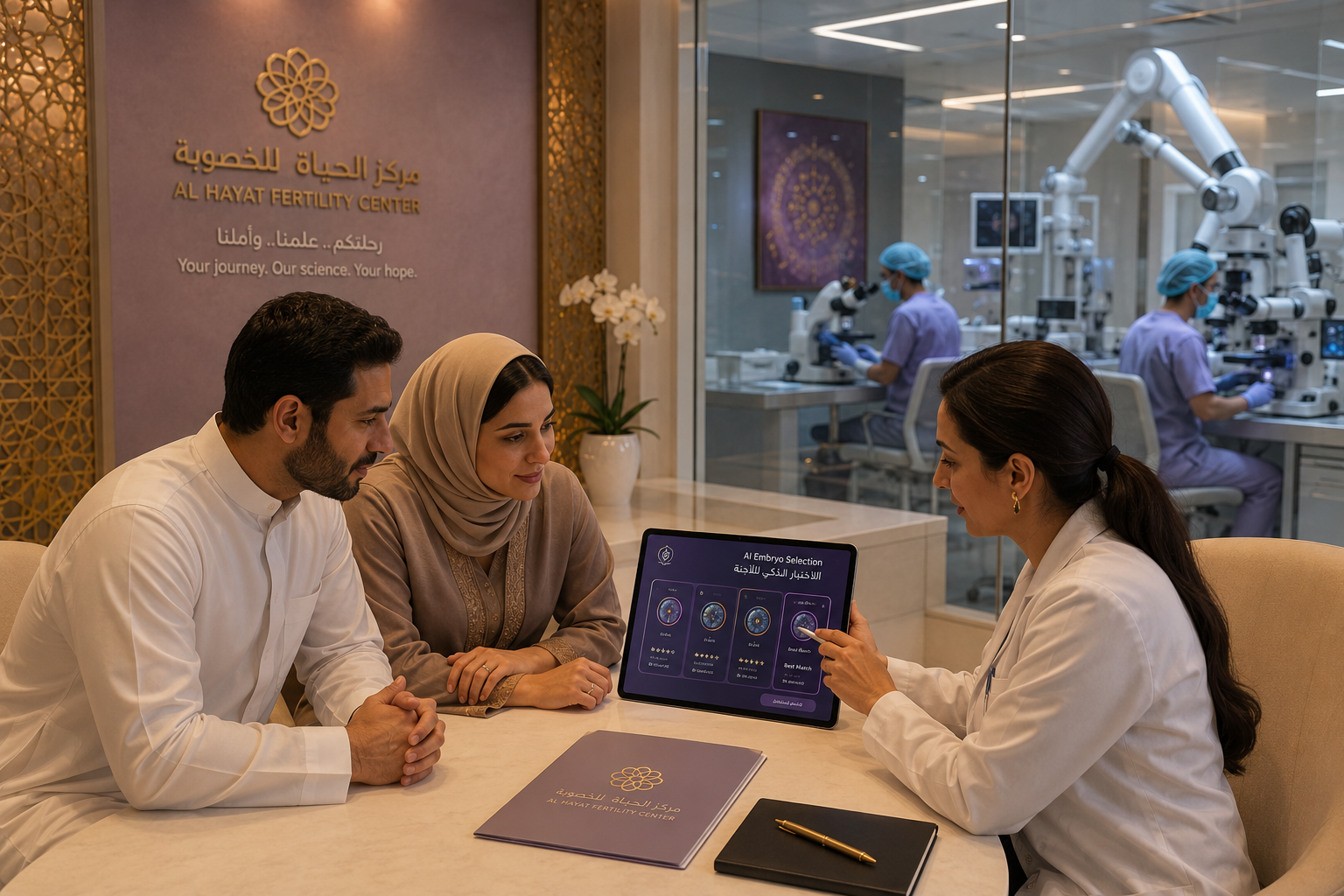
Once fertilisation has occurred, AI assumes a new role: evaluating which of the resulting embryos has the highest probability of successful implantation and live birth. This is arguably the most consequential — and most ethically complex — application of AI in reproductive medicine.
Time-Lapse Incubation and Developmental Scoring
AI-enhanced time-lapse incubators compile continuous video of embryo development from fertilisation onward. Machine learning models trained on large datasets of embryo development and outcome data identify microscopic growth patterns — cell division timing, morphological symmetry, fragmentation rates — that correlate with implantation success. Clinical studies suggest this approach boosts pregnancy rates by approximately 11% compared to conventional static assessment.
Polygenic Risk Screening: The MENA Dimension
A subset of fertility clinics globally now offer AI-assisted polygenic risk screening — evaluating embryos for their statistical predisposition to certain conditions. This application requires particular care in the MENA context:
• On the permissible end: screening for severe single-gene disorders with high prevalence in consanguineous MENA populations — such as sickle cell disease (prevalent in Gulf and Egyptian populations), beta-thalassaemia, and familial Mediterranean fever — aligns with the Islamic jurisprudential principle of preventing harm (dar’ al-mafsada).• On the contested frontier: screening for polygenic traits such as intelligence, height, or athletic capacity enters territory that Islamic scholars have consistently treated with deep caution, invoking concerns about ‘tampering with God’s creation’ (taghyir khalq Allah).
MENA’s fertility clinics, regulators, and religious authorities will need to develop explicit guidance on which applications of AI embryo selection are endorsed, which are permitted with conditions, and which cross ethical boundaries that local societies are not prepared to accept.
Ethical Friction: The Questions MENA Has Not Yet Answered
Beyond the jurisprudential questions addressed in Section II, AI-assisted reproduction raises ethical tensions that MENA societies are only beginning to confront.
Patient Comfort and the ‘Mechanical Conception’ Concern
A global survey by Pregnantish found that only 18% of fertility patients feel comfortable with AI-driven embryo selection. In MENA contexts, where conception is imbued with spiritual meaning and where the idea of a clinical ‘algorithm’ making decisions at the beginning of human life intersects uncomfortably with beliefs about divine will and the soul, this discomfort is likely to be more pronounced. Fertility clinics and Islamic scholars have an important joint role in articulating a framework in which AI is understood as a tool that assists human and divine agency — not one that replaces it.
Data Privacy and Genetic Information
AI-assisted embryo selection generates extraordinarily sensitive genetic data. In MENA jurisdictions where personal data protection frameworks are still maturing — and where family and tribal networks mean that genetic information has implications beyond the individual couple — the storage, use, and potential disclosure of this data requires specific regulatory attention.
The Designer Baby Frontier
The ability to select embryos based on polygenic traits — not just disease risk but characteristics such as intelligence, physical stature, or temperament — is approaching clinical feasibility globally. MENA’s religious and regulatory authorities face the same question as their counterparts everywhere, but in a context where the Islamic concept of fitra (the innate nature with which God creates each human being) adds a specific theological dimension to the debate about whether such selection is a medical intervention or an act of transgression.
Conclusion: The Algorithm at the Beginning of Life
The arrival of AI-powered reproductive medicine in the MENA region is not a future event — it is a present reality, unevenly distributed and under-regulated, but already changing lives in the fertility clinics of Dubai, Riyadh, Cairo, and Beirut.
For the millions of MENA families for whom parenthood is simultaneously a personal longing, a religious aspiration, and a social expectation, these technologies represent something profound: the possibility that what medicine has declared impossible may, in fact, be possible. The couple told that there is no viable sperm. The woman whose ovarian reserve has been exhausted. The family that has endured cycle after cycle of failure. For them, the algorithm is not a cold computational abstraction — it is an answer to a prayer that conventional medicine could no longer hear.
The challenge for MENA’s health systems, regulators, fertility clinics, and Islamic scholars is to ensure that this answer is available not only to the wealthy and the well-connected, but to every family that needs it. And to ensure that in the rush toward technological possibility, the ethical boundaries that MENA societies have carefully constructed around the beginning of human life are not quietly dissolved — not by malice, but by momentum.
Related Articles
Dubai Chambers Launches Agentic AI Training for 14,000 Member Companies
Dubai Chambers has launched specialised Agentic AI training tracks through a new e-learning platform, aiming to equip more than 14,000 member companies with the skills to adopt the technology across their operations.
Sep 2, 2026
AnalysisHumain and DataVolt Partner for 100MW AI Data Centre on Saudi Arabia's Red Sea Coast
Saudi AI firm Humain has partnered with DataVolt to build a 100MW data centre at Oxagon, NEOM, the first phase of a larger 1.5 gigawatt AI campus.
Sep 2, 2026
AnalysisUAE Banks Federation Chief: Agentic AI Is Banking's Next Phase, But Accountability Must Stay Human
UAE Banks Federation Director General Jamal Saleh argues agentic AI will define banking's next phase, pointing to the UAE's regulatory model as a template for the region, though one figure he cites needs context.
Aug 28, 2026
AnalysisDubai Chambers Signs Agentic AI Agreement with India's NASSCOM to Accelerate Private-Sector Adoption
Dubai Chambers has signed a preliminary agreement with India's NASSCOM to accelerate agentic AI adoption among private-sector companies in the UAE.
Aug 20, 2026
AnalysisAbu Dhabi's AIREV Partners with Qualcomm to Expand Sovereign Agentic AI Deployment
Abu Dhabi's AIREV has partnered with Qualcomm to integrate its autonomous AI platform with Qualcomm Dragonwing hardware, enabling sovereign AI deployment.
Aug 14, 2026