UAE's Agentic AI Mandate: 50% of Government Services Autonomous by 2028: What It Means for Enterprise
The UAE has announced the world's most ambitious government AI deployment: 50% of all federal services to run on autonomous agentic AI by 2028, with 80,000 employees in training. Deloitte's report this week confirms only 21% of regional enterprises have governance ready. The gap is the story.
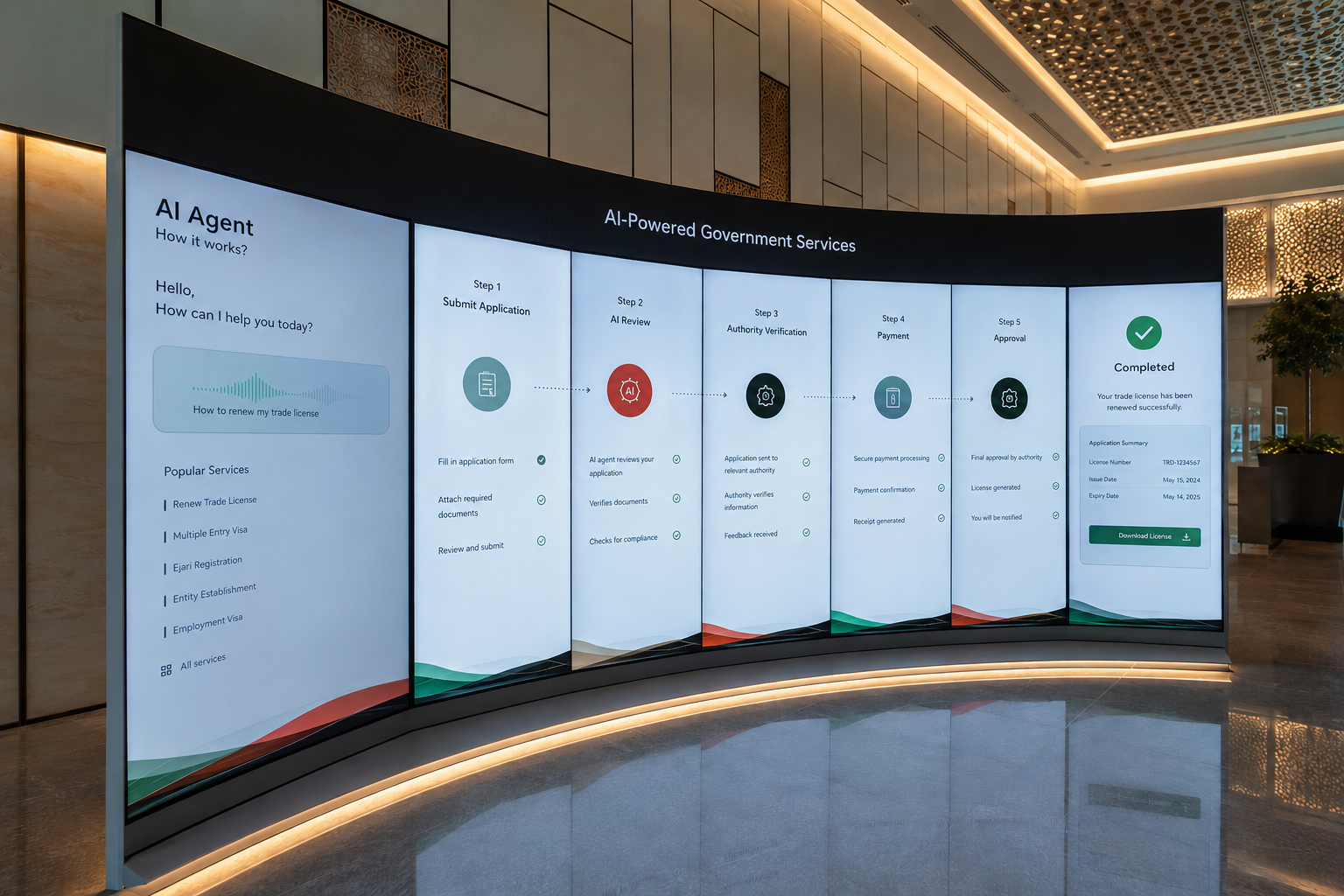
The UAE’s Agentic AI Mandate: A New Frontier for Governance and Enterprise
On 23 April 2026, the UAE announced one of the most consequential government AI directives in the world: a mandate to transition 50% of all federal government sectors, services, and operations to agentic AI systems capable of autonomous execution and decision making within two years. The initiative was announced by His Highness Sheikh Mohammed bin Rashid Al Maktoum, Vice President and Prime Minister of the UAE and Ruler of Dubai, under the direction of UAE President His Highness Sheikh Mohamed bin Zayed Al Nahyan.
Since the initial announcement, the UAE Cabinet has approved the federal governance framework defining the roles and responsibilities of all ministries and federal entities, and launched the largest government training programme in UAE history, covering 80,000 employees across every ministry and authority from senior executives to new joiners. The mandate positions the UAE as the first government globally to deploy agentic AI at this scale across public administration.
"Today, AI models can monitor changes, provide analyses, offer recommendations, manage operations, and run an independent series of actions without human intervention. AI will be our government executive partner to support decisions, enhance services, boost the efficiency of operations, and even evaluate results and introduce improvements in real time." — Sheikh Mohammed bin Rashid Al Maktoum
What Agentic AI at Government Scale Actually Means
Agentic AI is categorically different from the AI applications most organisations are currently deploying. Where generative AI assists with content creation or information retrieval, agentic systems execute multi step tasks, manage exceptions, monitor outcomes, and iterate without continuous human direction. For government services, this means autonomous processing of licence applications, permit approvals, benefit assessments, and regulatory filings. These are not digital forms with human reviewers, but systems that reason, act, and escalate according to defined governance parameters.
The UAE's ambition goes further than automation. The directive envisages AI as an executive partner to government. This framing implies genuine decision making authority within defined policy parameters, not just workflow acceleration. The Cabinet's governance framework, approved in mid-May, attempts to set the structural boundaries for that authority: roles, responsibilities, and accountability at ministerial and entity level.
The Governance Tension That Deloitte Identified This Week
Deloitte's 2026 State of AI in the Enterprise report, released on 4 June, placed a number alongside the UAE's ambition that enterprise technology leaders should hold simultaneously: only 21% of organisations globally have a mature governance model in place for agentic AI systems. In the Middle East, where deployment ambition is the highest of any region, this governance gap is not theoretical. It is the structural risk that determines whether the mandate delivers durable value or produces operational incidents that erode public and institutional trust.
The cybersecurity implications of autonomous government AI are among the most under discussed aspects of the mandate. Agentic systems operating across ministries with access to citizen data, financial systems, and service delivery infrastructure represent a substantially expanded attack surface compared to conventional e government portals. Security architecture for agentic AI must account for prompt injection risks, agent to agent communication integrity, and the challenge of monitoring systems that take actions at machine speed.
What the Mandate Means for Private Sector Enterprise in the UAE
Dubai's agentic AI mandate, announced separately, directs the broader private sector to transition as the public sector does. For enterprises operating in UAE markets, particularly those providing services to government, operating under Central Bank or sector regulator supervision, or procuring government services as part of their operations, the mandate has direct supply chain implications.
Vendors whose products and services interact with government workflows will need to ensure their own AI systems are compatible with agentic government infrastructure. This creates both an opportunity and a compliance obligation. Those whose enterprise SaaS and cloud platforms can integrate natively with UAE agentic government architecture will have a procurement advantage, while those that cannot will face growing friction in government adjacent markets.
For Saudi Arabia, the UAE's two year timeline sets an implicit benchmark. SDAIA's draft Responsible AI Policy, published for consultation in March 2026, signals that the Kingdom is moving from governance principles to operational requirements on a parallel track, though without a comparable public sector deployment mandate as yet.
The Next Twelve Months
The UAE's 80,000 employee training programme represents the most substantial government workforce AI upskilling initiative announced anywhere in the world. Its execution will be as consequential as the technology deployment itself. Deloitte's report identifies workforce readiness as the primary barrier to AI value realisation, and the training programme's quality and depth will determine whether government employees can function as effective human in the loop supervisors for the autonomous systems being deployed alongside them.
Enterprise leaders across the GCC who are calibrating their own AI transformation timelines now have the clearest possible signal from the region's most advanced AI governance environment: the question is not whether to build production grade agentic AI capability, but how fast the governance, security, and workforce infrastructure around it can be made ready.
Related Articles
Dubai Chambers Launches Agentic AI Training for 14,000 Member Companies
Dubai Chambers has launched specialised Agentic AI training tracks through a new e-learning platform, aiming to equip more than 14,000 member companies with the skills to adopt the technology across their operations.
Sep 2, 2026
AnalysisHumain and DataVolt Partner for 100MW AI Data Centre on Saudi Arabia's Red Sea Coast
Saudi AI firm Humain has partnered with DataVolt to build a 100MW data centre at Oxagon, NEOM, the first phase of a larger 1.5 gigawatt AI campus.
Sep 2, 2026
AnalysisUAE Banks Federation Chief: Agentic AI Is Banking's Next Phase, But Accountability Must Stay Human
UAE Banks Federation Director General Jamal Saleh argues agentic AI will define banking's next phase, pointing to the UAE's regulatory model as a template for the region, though one figure he cites needs context.
Aug 28, 2026
AnalysisDubai Chambers Signs Agentic AI Agreement with India's NASSCOM to Accelerate Private-Sector Adoption
Dubai Chambers has signed a preliminary agreement with India's NASSCOM to accelerate agentic AI adoption among private-sector companies in the UAE.
Aug 20, 2026
AnalysisAbu Dhabi's AIREV Partners with Qualcomm to Expand Sovereign Agentic AI Deployment
Abu Dhabi's AIREV has partnered with Qualcomm to integrate its autonomous AI platform with Qualcomm Dragonwing hardware, enabling sovereign AI deployment.
Aug 14, 2026