UAE Bets Its Global AI Ambitions on a Deepening Alliance With the Trump Administration
The UAE is positioning itself to become a global artificial intelligence powerhouse, betting that a deepening alliance with the Trump administration, anchored by a $30 billion, five gigawatt AI campus, will secure its place at the centre of the industry.
Key Takeaways
- ▸The UAE and US are building a five gigawatt, thirty billion dollar AI campus in Abu Dhabi, the largest AI facility of its kind outside the United States.
- ▸G42 is the UAE's national AI champion and lead developer of the Abu Dhabi AI campus, operating under the country's AI 2031 strategy.
- ▸The Trump administration reversed Biden-era restrictions on AI chip exports to the UAE, unlocking expanded access to Nvidia's most advanced chips.
- ▸MGX, the UAE's state investment vehicle, holds direct stakes in OpenAI, Anthropic and Databricks.
- ▸The UAE's AI strategy depends on continued US policy alignment; a future administration could reinstate export restrictions.
- ▸Saudi Arabia is pursuing a comparable state-backed AI strategy through Humain, indicating a wider Gulf-wide pattern rather than a UAE-specific approach.
- ▸Compute access, not investment appetite, remains the primary constraint on how fast Gulf states can scale their AI ambitions.
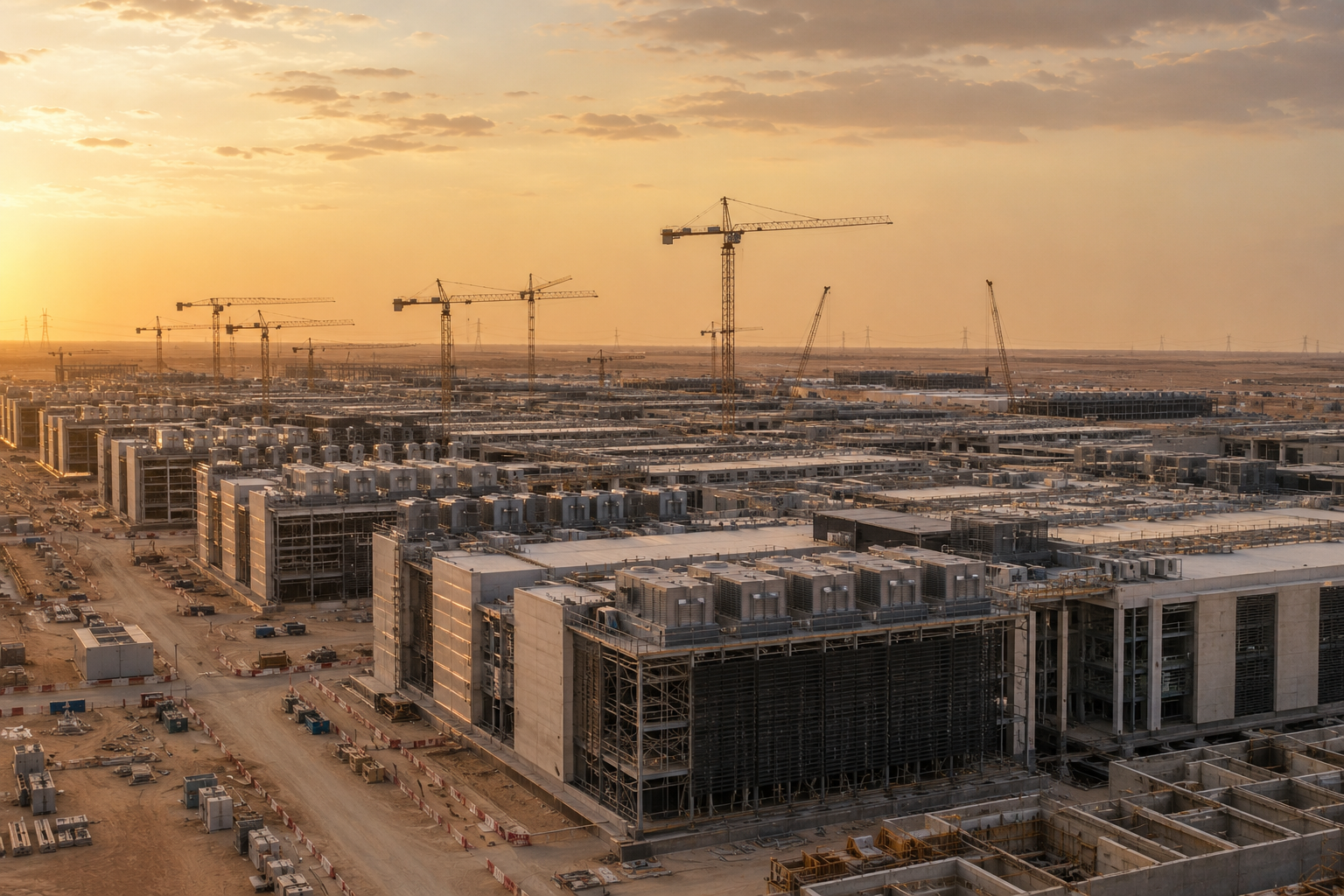
The United Arab Emirates is betting big on artificial intelligence, and it sees the Trump administration as central to making that bet pay off. Last year's announcement that the United States and the UAE would partner to build a five gigawatt, thirty billion dollar AI campus was hailed locally as a triumph, positioning a Gulf nation of just eleven million people to become a genuine global AI powerhouse.
The campus, being developed by Emirati AI and cloud computing company G42 in partnership with several American technology firms, is designed to be the largest facility of its kind outside the United States. It forms the centrepiece of the broader US-UAE AI Acceleration Partnership, a bilateral framework intended to deepen cooperation on artificial intelligence and advanced computing, and one that grants the UAE expanded access to Nvidia's most advanced AI chips, a resource that has long been the binding constraint on the country's ambitions.
A long game, not a single deal
The current momentum did not begin with a single announcement. G42 was established with an explicit mandate to become the UAE's national AI champion, and its footprint has expanded well beyond the Gulf since, with major infrastructure projects underway across Europe, Kenya and the United States alongside its flagship Abu Dhabi campus. The company sits at the centre of the UAE's AI 2031 strategy, the government's long-term plan to establish the country as a global leader in the technology and to diversify an economy still heavily reliant on oil revenue.
That strategy has been helped considerably by a shift in Washington's posture. The Trump administration rolled back Biden-era restrictions on exporting advanced AI chips to Gulf states, restrictions originally put in place over concerns that the technology could be diverted to or accessed by China. That policy reversal opened the door for the chip access the UAE had been pursuing for years, and Emirati officials have publicly framed the relationship with the current US administration as the decisive factor in accelerating their AI plans.
The dependency runs in both directions. The UAE has committed enormous capital to the partnership as part of a broader package of investment pledges tied to strengthening US-UAE technology ties, and MGX, the country's technology investment vehicle, is already an investor in OpenAI, Anthropic and Databricks, giving Abu Dhabi direct financial stakes across the frontier AI landscape rather than exposure through infrastructure alone.
What the UAE gets, and what it risks
For the UAE, the calculus is straightforward on paper: access to the compute and chips needed to pursue sovereign AI ambitions, in exchange for capital, energy resources and a deepening alignment with US technology policy. Independent analysis of the relationship has noted that the arrangement helps Washington ensure American companies lead the global AI race against China while extending US technology standards abroad, meaning the partnership serves strategic interests on both sides rather than being a one way concession.
The risks are also well documented. Export control policy can shift with future US administrations, leaving Gulf states exposed if a later White House reintroduces the restrictions the current one lifted. The UAE has also faced continued scrutiny over its technology ties to China even as it publicly commits to closer alignment with Washington, a balancing act that analysts say will require careful management as the scale of US investment grows.
Why this matters for the region
The UAE's approach, using state coordination, long-term strategic planning and sovereign capital to accelerate AI development, has become something of a template that other Gulf states are watching closely, even as each pursues its own variation. Saudi Arabia's AI ambitions, built around its own state-backed champion Humain and a similar pattern of large-scale US chip access deals, follow a broadly comparable playbook, suggesting a wider regional pattern rather than a UAE-specific anomaly.
For enterprises and investors tracking the region's AI trajectory, the throughline is clear: access to compute, not enthusiasm or ambition, remains the binding constraint on how fast any Gulf state can move, and the UAE's bet is that its relationship with Washington is the most reliable way to keep that access flowing.
Frequently Asked Questions
What is the US-UAE AI deal announced in 2025?
The US and UAE agreed to partner on a five gigawatt, thirty billion dollar AI campus in Abu Dhabi, developed by Emirati company G42 alongside US technology firms, forming the centrepiece of the broader US-UAE AI Acceleration Partnership.
Why did the Trump administration lift AI chip export restrictions on the UAE?
The Biden-era restrictions were originally imposed over concerns that advanced AI chips could be diverted to or accessed by China. The Trump administration rolled these back as part of a wider push to deepen US-UAE technology ties and secure Gulf capital and energy resources for American AI infrastructure.
What is G42's role in the UAE's AI strategy?
G42 is the UAE's state-backed national AI champion, tasked with building the country's AI infrastructure. It leads the Abu Dhabi AI campus project and has expanded operations into Europe, Kenya and the United States.
What is MGX and what has it invested in?
MGX is the UAE's technology investment vehicle. It holds direct financial stakes in OpenAI, Anthropic and Databricks, giving Abu Dhabi exposure across the frontier AI landscape beyond infrastructure alone.
How does Saudi Arabia's AI strategy compare to the UAE's?
Saudi Arabia is pursuing a similar model through its own state-backed champion, Humain, combined with large-scale US chip access deals, following a comparable state-coordinated, sovereign capital-driven playbook to the UAE.
What is the main risk to the UAE's AI strategy?
The primary risk is political: US export control policy can shift with future administrations. If a later White House reinstates chip restrictions, the UAE's compute access, and by extension its AI ambitions, could be constrained again.
Related Articles
UAE Banks Federation Chief: Agentic AI Is Banking's Next Phase, But Accountability Must Stay Human
UAE Banks Federation Director General Jamal Saleh argues agentic AI will define banking's next phase, pointing to the UAE's regulatory model as a template for the region, though one figure he cites needs context.
Aug 28, 2026
AnalysisDubai Chambers Signs Agentic AI Agreement with India's NASSCOM to Accelerate Private-Sector Adoption
Dubai Chambers has signed a preliminary agreement with India's NASSCOM to accelerate agentic AI adoption among private-sector companies in the UAE.
Aug 20, 2026
AnalysisAbu Dhabi's AIREV Partners with Qualcomm to Expand Sovereign Agentic AI Deployment
Abu Dhabi's AIREV has partnered with Qualcomm to integrate its autonomous AI platform with Qualcomm Dragonwing hardware, enabling sovereign AI deployment.
Aug 14, 2026
AnalysisWorld Bank Names UAE a Global AI Leader in Foundation Models and Talent
The World Bank's 2026 World Development Report names the UAE among a small group of countries building advanced foundation AI models from scratch.
Aug 11, 2026
AnalysisDubai to Automate Building Permit Approvals with AI, Cutting Days to Minutes
Dubai Municipality is rolling out an AI system that automatically issues building permits for villas, cutting processing times from days to minutes.
Aug 10, 2026