The Great AI Backlash: Why Tech's 'Inevitable' Future Faces an Existential Crisis
Over 70% of Americans say AI is advancing too quickly. Record data centre cancellations in Q1 2026 are turning public backlash into a hard infrastructure constraint: and Wall Street is starting to price in the risk.
Key Takeaways
- ▸Only 18% of people aged 14-29 feel hopeful about AI, according to Gallup polling in 2026.
- ▸Over 70% of Americans believe AI is advancing too fast, spanning both major political parties.
- ▸A record number of AI data centre projects were cancelled in Q1 2026 due to community resistance, per Heatmap Pro data.
- ▸Morgan Stanley has flagged public pushback as a "binding constraint" on AI data centre buildout globally.
- ▸Globally, 59% of respondents expect AI to do more good than harm, up from 55% - scepticism is concentrated in Western markets.
- ▸For MENA enterprise leaders, the backlash is a governance signal - transparent AI deployment and public trust strategies are now a board-level priority.
If artificial intelligence were a candidate running for political office, it would currently be losing in a landslide.
For the past several years, the Silicon Valley hype cycle has operated under a single, unwavering dogma: the total integration of AI into global society is an inevitability. However, a powerful undercurrent of public backlash is rapidly hardening. Driven by visceral fears of systemic job displacement, surging electricity rates, environmental degradation, and the further consolidation of wealth among tech billionaires, the public is actively pushing back.
The industry's core narrative of "inevitable progress" is fracturing against a wall of societal resistance.
The Anatomy of the Backlash: Disdain Across Generations
The growing friction between tech elites and the public was put on stark display at a recent university commencement ceremony. When Florida real estate executive Gloria Caulfield told the graduating class that "artificial intelligence is the next Industrial Revolution," her words were instantly drowned out by a chorus of boos from the audience.
Had the speaker consulted current demographic data, the jeers would have come as no surprise. The anti-AI sentiment is not localised; it spans generations, socio-economic classes, and political parties.
Key Public Opinion Indicators
The Youth Sentiment Gap: According to a recent Gallup survey, a mere 18% of young people ages 14 to 29 report feeling hopeful about the trajectory of artificial intelligence.
Bipartisan Technophobia: An Economist/YouGov poll revealed that over 70% of Americans believe AI is advancing far too quickly. Crucially, this sentiment bridges the deep political divide, with 68% of Republicans and 77% of Democrats in complete alignment.
The Multi-Year Decline: Additional polling from YouGov tracks a steep trajectory in public distrust: negative views of AI have climbed from 34% three years ago to just over 50% today.
Silicon Valley's Blind Spot: Echo Chambers and Executive Disconnect
Despite these staggering numbers, the executives presiding over frontier AI labs appear remarkably unfazed or entirely oblivious.
When questioned about the mounting friction, multiple tech leaders expressed genuine surprise at the negative polling data. To the tech elite, AI is an evolutionary step as certain and unstoppable as the rise of the commercial internet in the late 1990s.
For example, when Superhuman Mail CEO Rahul Vohra, whose company develops AI-powered email assistants was pressed on the hostile climate surrounding AI adoption, he seemed unfamiliar with the premise. Upon hearing the polling metrics, Vohra simply replied: "We don't really see that."
This deep disconnect highlights a dangerous echo chamber. While tech insiders look at the technology through a lens of optimisation and productivity, the broader public looks at it through a lens of survival, equity, and environmental cost.
"What is not inevitable is that these technologies will be embedded in every aspect of our lives, become indispensable, or replace humans. Nothing in the future is inevitable, and no single person, company, or group gets to decide what will happen." - Dr. Avriel Epps, Assistant Professor, University of California, Riverside
The Physical Limit: Infrastructure and Financial Liabilities
This public "hate wave" is no longer just a public relations headache; it has officially transformed into a structural and financial liability for AI labs. The backlash is targeting the industry's most critical and vulnerable resource: compute power.
AI models require immense data centre clusters to process massive datasets and answer user queries. However, local communities are no longer welcoming these energy-intensive facilities with open arms.
AI models require immense data centre clusters to process massive datasets and answer user queries. However, local communities are no longer welcoming these energy-intensive facilities with open arms.
The Data Centre Standstill
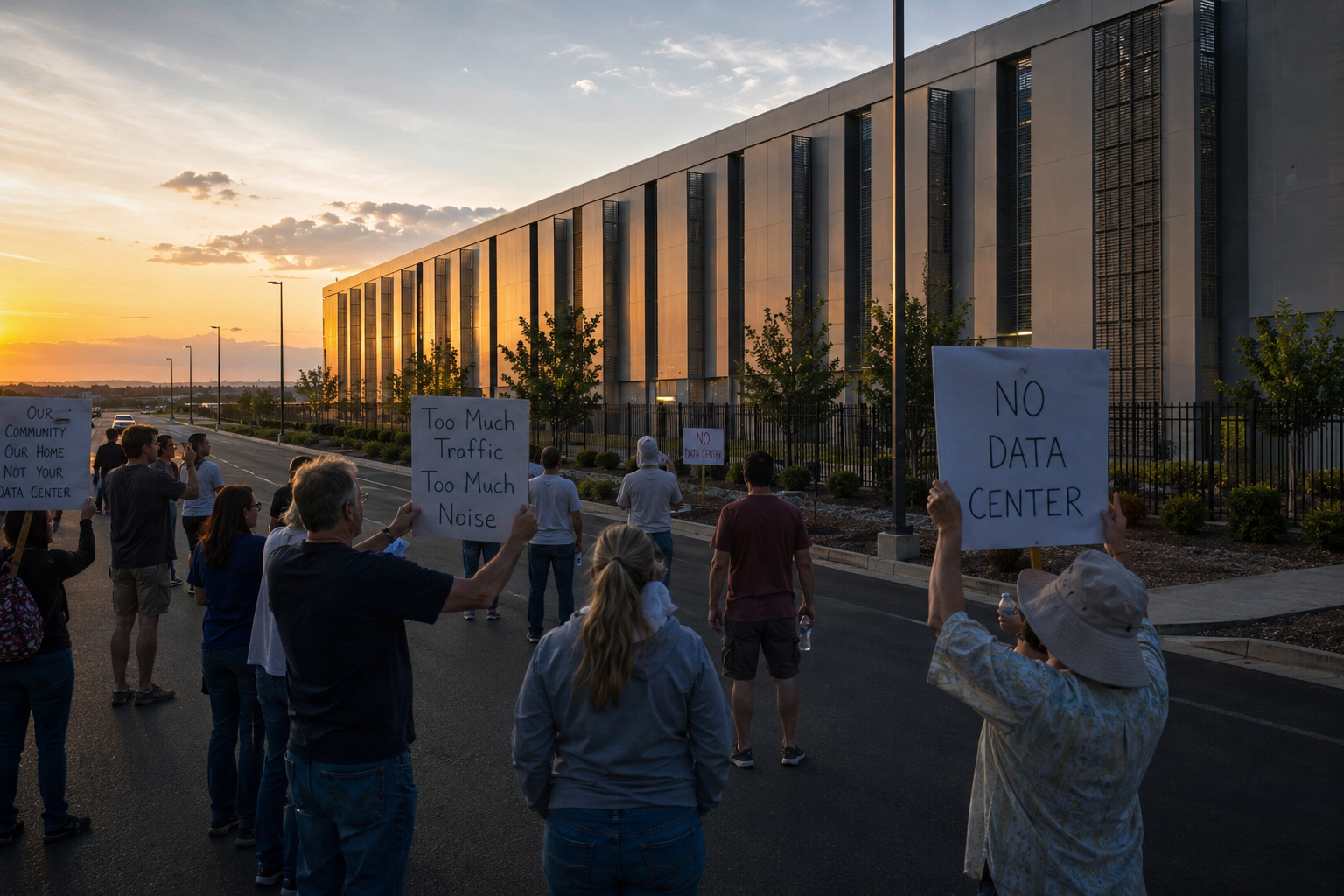
According to proprietary market data from Heatmap Pro, a record number of data centre construction projects were outright cancelled in the first quarter of 2026 due to aggressive local community resistance. People are increasingly refusing to allow localised power grids to be strained and water reserves to be depleted for the sake of training large language models.
The financial sector is taking immediate notice of this structural bottleneck. Morgan Stanley analysts highlighted the trend in a recent macro risk assessment note, writing that "public pushback is emerging as a binding constraint, particularly around data centre buildout." Jefferies investment bank sent a warning to its clients, noting that these persistent infrastructure setbacks are actively sapping confidence among major institutional tech investors.
In the MENA region, where AI infrastructure investment is accelerating rapidly - from Saudi Arabia's giga-project integrations to the UAE's national AI strategy - these global sentiment dynamics carry direct strategic relevance for boards and policy teams monitoring public trust risks around AI deployment.
A Divergent Global Reality Check
To be clear, artificial intelligence is not going to vanish. It has been embedded in foundational software architecture for years and will inevitably remain a fixture of modern life. The real battleground is not over its existence, but its governance and design philosophy.
Arun Bahl, CEO of Aloe - an AI company focused on building highly auditable, trustworthy models - summarises the choice ahead: "Some version of AI is inevitable... but we have a choice. Is it the dystopian plot? Or can we have tools that humans trust?"
Interestingly, this intense scepticism is acutely concentrated in Western economies like the United States. Globally, the outlook skews noticeably more pragmatic. According to historical tracker data from Stanford University, the global share of respondents who expect AI to do more organic good than harm actually rose to 59%, up from 55% in the prior year's index.
Conclusion: Tech's Looming Accountability Crisis
The baseline takeaway for Silicon Valley is sobering: the AI industry has a profound public relations and narrative problem that threatens to paralyse the hyper-growth its founders took for granted.
If AI companies continue to dismiss public anxiety as mere ludditism, the binding constraints of political regulations, community zoning defeats, and investor retreat will do what tech logic deemed impossible - slow the machine down.
Related Articles
Dubai Chambers Launches Agentic AI Training for 14,000 Member Companies
Dubai Chambers has launched specialised Agentic AI training tracks through a new e-learning platform, aiming to equip more than 14,000 member companies with the skills to adopt the technology across their operations.
Sep 2, 2026
AnalysisHumain and DataVolt Partner for 100MW AI Data Centre on Saudi Arabia's Red Sea Coast
Saudi AI firm Humain has partnered with DataVolt to build a 100MW data centre at Oxagon, NEOM, the first phase of a larger 1.5 gigawatt AI campus.
Sep 2, 2026
AnalysisUAE Banks Federation Chief: Agentic AI Is Banking's Next Phase, But Accountability Must Stay Human
UAE Banks Federation Director General Jamal Saleh argues agentic AI will define banking's next phase, pointing to the UAE's regulatory model as a template for the region, though one figure he cites needs context.
Aug 28, 2026
AnalysisDubai Chambers Signs Agentic AI Agreement with India's NASSCOM to Accelerate Private-Sector Adoption
Dubai Chambers has signed a preliminary agreement with India's NASSCOM to accelerate agentic AI adoption among private-sector companies in the UAE.
Aug 20, 2026
AnalysisAbu Dhabi's AIREV Partners with Qualcomm to Expand Sovereign Agentic AI Deployment
Abu Dhabi's AIREV has partnered with Qualcomm to integrate its autonomous AI platform with Qualcomm Dragonwing hardware, enabling sovereign AI deployment.
Aug 14, 2026