The Ear That Never Sleeps: Amazon's Bee Wearable and the Age of Ambient Surveillance
Amazon's $50 Bee wearable promises frictionless ambient life-logging, but testing it reveals a stark reality: the thin line between a helpful personal assistant and a corporate microphone stitched to your wrist. Here is what the privacy trade-offs actually look like in daily use.
Key Takeaways
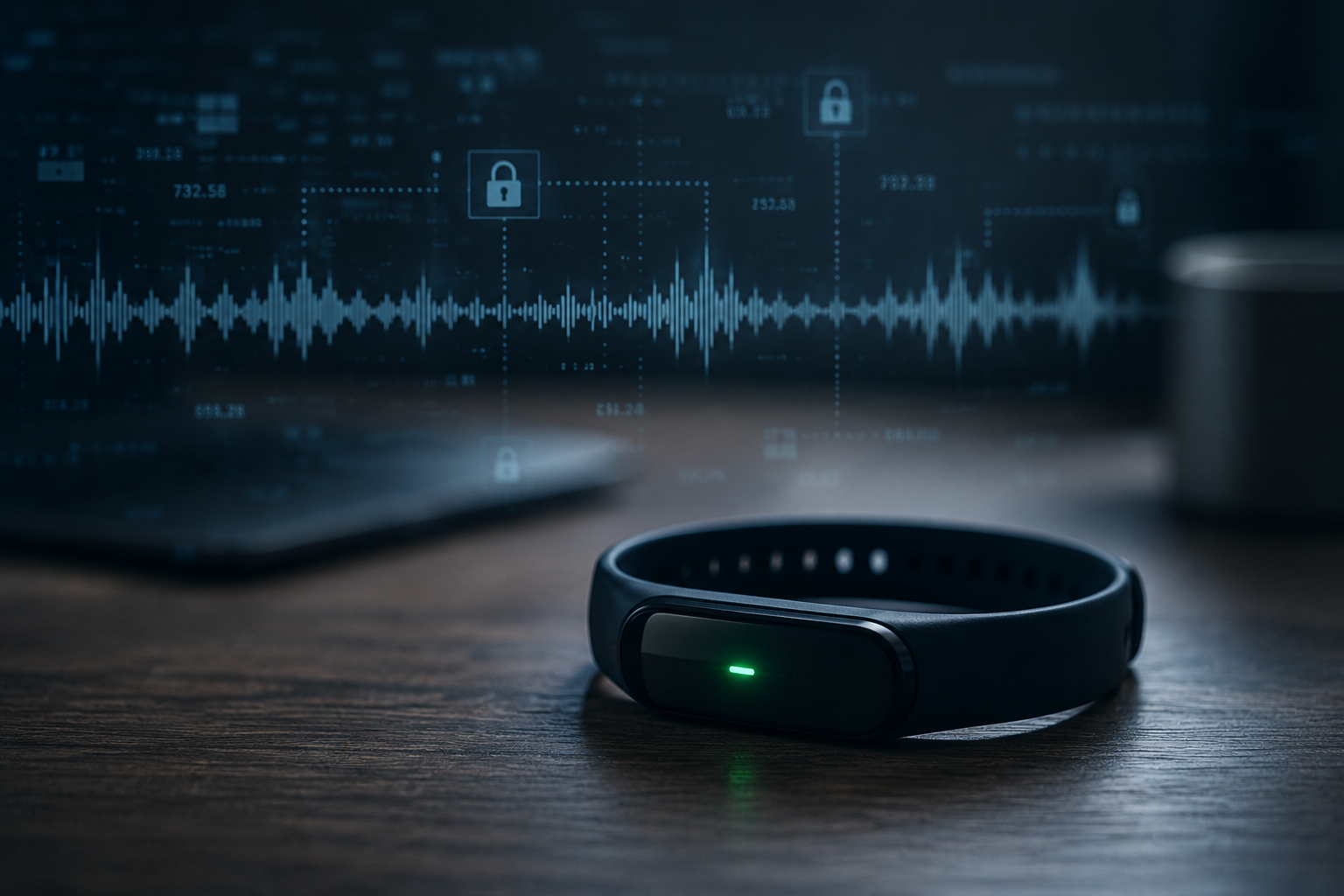
- ▸The Amazon Bee retails at $50 and resembles a basic fitness tracker with no screen and a single recording button.
- ▸It captures ambient audio, transcribes it via Whisper, and uses large language models in Amazon's cloud to generate summaries and action items.
- ▸Structured professional meetings and business calls where accurate summary generation outweighs privacy concerns
- ▸No on-device processing: all audio is cloud-dependent, and speaker diarisation is absent, requiring manual participant labelling.
- ▸No on-device processing: all audio is cloud-dependent, and speaker diarisation is absent, requiring manual participant labelling.
- ▸All-party consent recording laws in many jurisdictions may make public use of the Bee legally problematic without explicit disclosure.
- ▸All-party consent recording laws in many jurisdictions may make public use of the Bee legally problematic without explicit disclosure.
Silicon Has Left the Pocket
The device race has officially migrated from our palms to our bodies. Following Amazon's acquisition of hardware startup Bee, the tech giant has rapidly iterated on a $50 screen-free, modular wearable. Marketed primarily as an ambient conversational diary, the minimalist gadget promises to eliminate mental friction by capturing, transcribing, and organising the fleeting conversations of daily life.
Testing the device exposes a sharp modern dilemma: the boundary between automated productivity and total digital surveillance is vanishingly thin. For privacy advocates, a wearable microphone explicitly engineered to harvest ambient real-world interactions represents a deeply unsettling evolution in personal data collection.
Technical Architecture: How the Bee Operates
The Bee Pioneer edition is intentionally unassuming in its physical form. Resembling a basic fitness tracker, it abandons the screen entirely to focus on on-demand and ambient audio capture. The workflow relies heavily on the user's smartphone to offload heavy computational processing through three sequential stages:
Bee hardware dual microphones filter ambient noise and stream audio over Bluetooth.
The companion mobile app coordinates transcription via Whisper and cross-references Apple HealthKit data.
Audio is uploaded to Amazon's cloud, where large language models generate summaries, action items, and thematic categories.
A single press of a physical button toggles the recording state, accompanied by a flashing green LED indicator visible to those nearby.
Enterprise Utility Versus the Transcribing Mess
Where It Works: Professional Environments
In structured, professional settings the Bee functions as a competent meeting secretary. During active business calls the app faithfully segments conversations, generating reliable summaries that reduce the burden of manual note-taking. However, this capability is not fundamentally distinct from existing software-only transcription tools such as Otter.ai, optimised for workplace meeting synchronisation, or Granola, built for real-time executive summaries. The hardware layer adds portability, but the core value proposition remains a solved software problem.
Where It Struggles: Transcription Bottlenecks
Evaluated strictly as a transcription tool, the Bee reveals significant developmental gaps. Long recordings frequently devolve into an unstructured wall of text for two distinct reasons:
Speaker Identification Deficits: The system cannot reliably differentiate between unique voices, requiring users to manually label each participant after the fact.
Contextual Omissions: The software frequently drops entire conversational segments, making it unsuitable for compliance use cases or legally sensitive documentation.
On the other hand, the device's contextual semantic mapping is surprisingly capable. During an ambient trial at a casual social gathering watching a film, the algorithm accurately bypassed fictional on-screen audio to label the session as a Tarantino Film Scene Analysis, correctly inferring the external social context from surrounding conversation.
The Privacy Paradox: The Cost of Total Recall
Despite marketing that centres on personal life enrichment, including relationship mapping, stress-pattern tracking, and holistic life coaching, the data permissions required to operate the Bee are extraordinarily broad. To reach optimal functionality, users must grant the following system-level access:
Real-time GPS location
Full photo and media library
Complete phone contacts
Live calendar read and write access
Continuous mobile notification monitoring
Health data including resting heart rate and sleep cycles
The Cloud Storage Imperative
This aggregated trove of human telemetry is processed and retained within Amazon's cloud ecosystem. The corporate privacy policy outlines standard cryptographic safeguards, including encryption at rest and in transit alongside third-party security audits, yet Amazon's vast scale makes it a perpetual and high-value target for data security exploits. A breach is not a theoretical risk; it is a statistical inevitability at sufficient scale.
The Third-Party Consent Problem
A critical legal and ethical tension persists around recording compliance. While the wearer can toggle the green LED indicator, ambient recording routinely captures third parties who have never consented to having their voices transcribed, analysed, and stored by a multinational cloud apparatus. Restaurants, public transit, private homes: every environment becomes a potential recording studio the moment the device is active.
Tech advocates point to a fully local processing prototype demonstrated privately to select creators as the ultimate solution. Amazon, however, has provided zero consumer timeline for edge-AI deployment. Until that changes, the consent problem remains unsolved by design.
Conclusion: A Tool for the Office, a Threat at Home
Amazon's Bee is a fascinating early-stage artefact of ambient hardware computing. For executives managing packed schedules who are comfortable with cloud-based transcription trade-offs, it delivers tangible administrative relief.
As an intimate companion for private life, however, it demands too much. Until the device can compute entirely on-device without continuous cloud synchronisation, placing Amazon's microphone around your wrist is a high-wire act of digital trust. The Panopticon, it turns out, is now available for fifty dollars and ships in two days.
Related Articles
Dubai Chambers Launches Agentic AI Training for 14,000 Member Companies
Dubai Chambers has launched specialised Agentic AI training tracks through a new e-learning platform, aiming to equip more than 14,000 member companies with the skills to adopt the technology across their operations.
Sep 2, 2026
AnalysisHumain and DataVolt Partner for 100MW AI Data Centre on Saudi Arabia's Red Sea Coast
Saudi AI firm Humain has partnered with DataVolt to build a 100MW data centre at Oxagon, NEOM, the first phase of a larger 1.5 gigawatt AI campus.
Sep 2, 2026
AnalysisUAE Banks Federation Chief: Agentic AI Is Banking's Next Phase, But Accountability Must Stay Human
UAE Banks Federation Director General Jamal Saleh argues agentic AI will define banking's next phase, pointing to the UAE's regulatory model as a template for the region, though one figure he cites needs context.
Aug 28, 2026
AnalysisDubai Chambers Signs Agentic AI Agreement with India's NASSCOM to Accelerate Private-Sector Adoption
Dubai Chambers has signed a preliminary agreement with India's NASSCOM to accelerate agentic AI adoption among private-sector companies in the UAE.
Aug 20, 2026
AnalysisAbu Dhabi's AIREV Partners with Qualcomm to Expand Sovereign Agentic AI Deployment
Abu Dhabi's AIREV has partnered with Qualcomm to integrate its autonomous AI platform with Qualcomm Dragonwing hardware, enabling sovereign AI deployment.
Aug 14, 2026