The Co-Evolution of Silicon and Software: Alibaba’s Bid for China’s AI Infrastructure
Alibaba has unveiled the Zhenwu M890 AI chip, three times faster than its predecessor, alongside its flagship Qwen3.7-Max model. The dual launch is China's most aggressive push yet toward full-stack AI independence from Western silicon.
Key Takeaways
- ▸Alibaba unveiled the Zhenwu M890 AI accelerator at its Cloud Summit in Hangzhou on 20 May 2026, delivering three times the performance of its predecessor
- ▸The M890 features 144GB of GPU memory and 800GB per second interchip bandwidth and has already been deployed to over 400 clients across 20 sectors
- ▸Alibaba's Qwen3.7-Max LLM ran autonomously for 35 hours making over 1,000 tool calls to optimise its own performance on the M890 chip without prior documentation
- ▸US export controls and Beijing regulatory pressure are jointly accelerating China's shift to domestically designed AI silicon with Alibaba and Huawei as the primary beneficiaries
- ▸Alibaba has committed 380 billion yuan ($53 billion) to cloud and AI infrastructure over three years targeting the Zhenwu V900 in 2027 and J900 in 2028
For over a year, Chinese technology giants have faced a stark operational dilemma: how to scale frontier-level artificial intelligence while completely severed from the global standard of high-end silicon. While Western AI infrastructure expands along a predictable path of Nvidia H100s and Blackwell clusters, Washington's tightening export controls have effectively forced a fragmented, domestic-first hardware environment within China.
On Wednesday, 20 May 2026, Alibaba Group presented its most aggressive response yet to this computing bottleneck at its annual Cloud Summit in Hangzhou.
The e-commerce and cloud conglomerate unveiled the Zhenwu M890, a new proprietary AI training and inference accelerator designed by its semiconductor subsidiary, T-Head. Boasting three times the raw performance of its predecessor, the chip was launched in lockstep with Alibaba's latest flagship large language model, Qwen3.7-Max.
Rather than viewing hardware and software as separate corporate efforts, Alibaba's dual release exposes a highly coordinated blueprint. In a closed market, the winner of the AI race will not simply be the company with the best model, but the one that tightly integrates software algorithms with the specific, idiosyncratic architecture of domestic silicon.
Decoupling the Hardware: Inside the Zhenwu M890
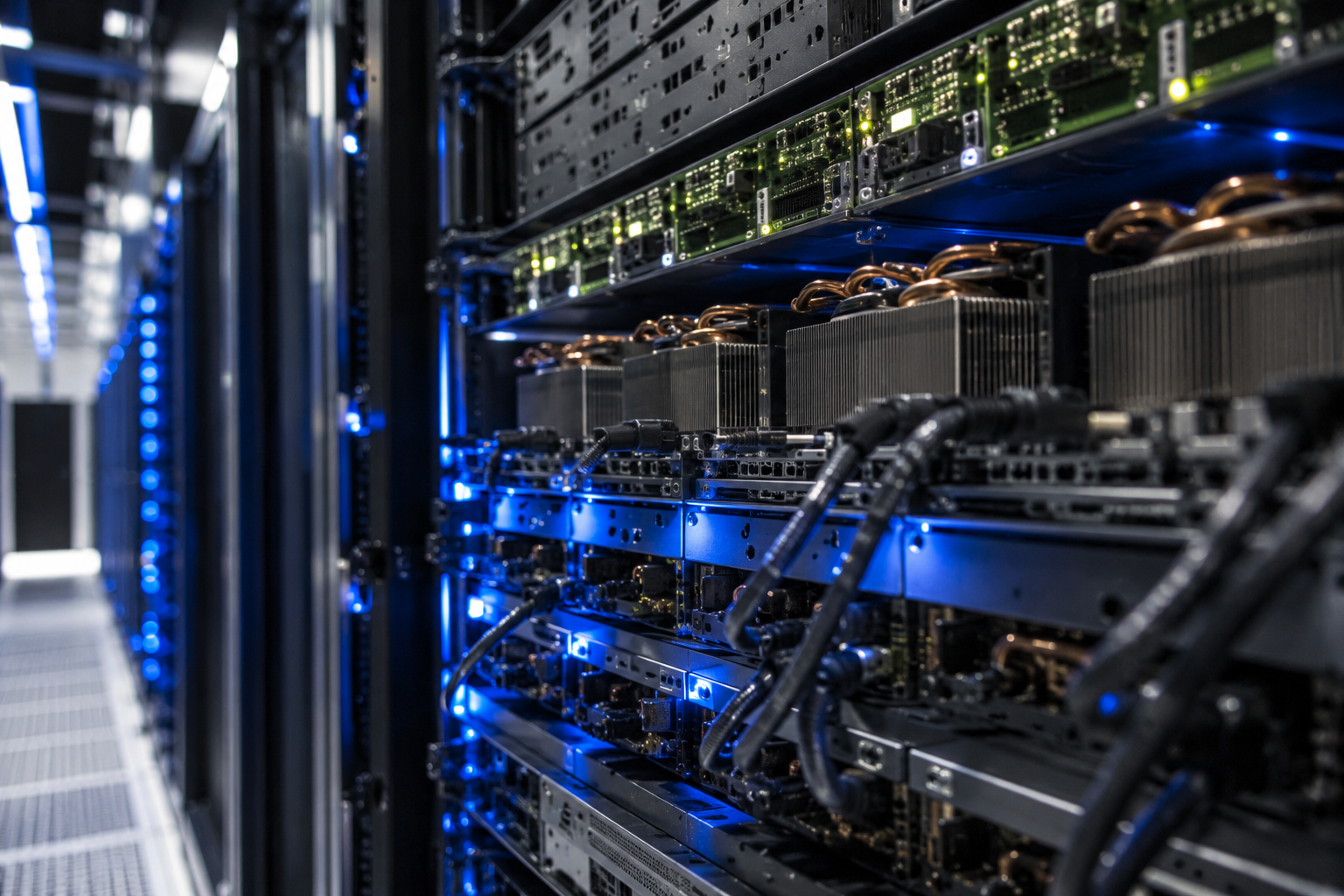
The Zhenwu M890 represents a massive evolutionary jump over Alibaba's previous high-end silicon, the Zhenwu 810E. Engineered explicitly to address the massive working memory and processing bottlenecks of contemporary AI workloads, the M890 is a dual-purpose accelerator capable of both full-scale training and inference, carries 144 GB of GPU memory (up from 96 GB), delivers 800 GB per second interchip bandwidth, and achieves a 3.0x performance increase over its predecessor. Together, these specifications allow developers to train models end-to-end on domestic stacks, accommodate multi-billion parameter context windows, and accelerate multi-node distributed cluster communications.
Alibaba confirmed that its internal supply chain has matured enough to scale production immediately, revealing it has already deployed 560,000 Zhenwu units to more than 400 clients across 20 distinct sectors. To facilitate enterprise adoption, the company also launched the Panjiu AL128, a hyperscale server rack that packages 128 of the M890 accelerators into a single, unified node.
Despite the impressive performance leap, analysts caution that the chip highlights the structural hurdles Chinese foundries face. "The advertised memory capacity and bandwidth figures are still lagging behind those of major Western chip companies," notes Myron Xie, an analyst at SemiAnalysis. Xie points out that Alibaba has remained conspicuously silent on explicit raw compute metrics such as FP16 or INT8 FLOPS.
However, in a market heavily restricted by geopolitics, raw parity with the West is secondary to local viability. "On raw silicon power, the M890 is not a true competitor to Nvidia's H200," says Brady Wang, Associate Director at Counterpoint Research. "But it does not need to be. In the Chinese market, it is a highly believable replacement."
The Rise of Agentic AI: The Qwen3.7-Max Synergy
The launch of the Zhenwu M890 cannot be evaluated independently from Alibaba's software ecosystem. Simultaneously with the chip announcement, Alibaba introduced Qwen3.7-Max, its flagship base model engineered specifically for agentic AI, autonomous software systems capable of navigating complex, long-horizon, multi-step tasks without continuous human validation.
Agentic workloads are notoriously demanding on underlying infrastructure. They require models to remain continuously active over long periods, repeatedly calling tools, reading multi-thousand-token system responses, and optimising code in real time.
To demonstrate the depth of their full-stack integration, Alibaba showcased a blind-test scenario where Qwen3.7-Max was tasked with an autonomous kernel optimisation challenge. The model operated continuously across 35 hours, invoking over 1,000 tool calls to optimise critical programming operators on the Zhenwu M890 platform, all without any initial documentation regarding the chip's internal architecture.
During this multi-stage evolutionary task, Qwen3.7-Max automatically partitioned the prefix KV-cache to maximise the chip's 36 streaming multiprocessor cores and re-architected custom Triton operators to drastically reduce host-to-device communication overhead. The result was a 10.0x geometric mean speedup in software execution directly on the newly minted domestic hardware, outperforming competing regional models including Zhipu's GLM 5.1 and Moonshot's Kimi K2.6.
Market Realities: Institutional Mandates and the Foundry Bottleneck
Alibaba's pivot toward self-sufficient ecosystem creation is accelerated by shifting regulatory pressures within China. Beijing has aggressively tightened its domestic oversight regarding the procurement of Western computing power. Even though Washington cleared slowed-down regional variants like Nvidia's H200 for export to China, Chinese authorities are privately and publicly steering domestic champions away from American procurement pipelines.
"Given that Nvidia remains locked out of the top tier of China, it is highly unlikely that Nvidia will serve as a long-term supplier into the entirety of the Chinese market," notes Leonid Mironov, portfolio manager at Gavekal. Mironov emphasises that this hardware reality makes tech incumbents with deep-pocketed semiconductor subsidiaries, specifically Alibaba via T-Head and Tencent, critically important long-term positions for capital allocators.
Yet a primary structural risk for Alibaba remains its manufacturing baseline. While T-Head excels at designing architecture, it remains reliant on local foundries like Semiconductor Manufacturing International Corporation (SMIC) to fabricate physical silicon. As demand for AI computing resources surges exponentially across China's enterprise landscape, securing stable, high-yield advanced manufacturing allocation from domestic foundries will be the defining factor in whether Alibaba can sustain its multi-year hardware roadmap, which aims to debut the Zhenwu V900 in 2027 and the J900 in 2028.
The Era of Full-Stack Insulation
Alibaba's aggressive financial commitment, anchored by its massive three-year, 380-billion-yuan ($53 billion) cloud and AI infrastructure pledge, underlines a critical corporate reality: to protect profit margins in its cloud computing segment, it must drive down the cost of compute.
By utilising proprietary, in-house silicon like the Zhenwu M890 to power its public cloud instances and native LLMs like Qwen3.7-Max, Alibaba bypasses the massive markups of global hardware supply chains while completely insulating its operations from foreign regulatory shifts. In the 2026 AI landscape, full-stack sovereignty is no longer an idealistic objective for technology giants. It is an absolute prerequisite for operational survival.
Related Articles
UAE Banks Federation Chief: Agentic AI Is Banking's Next Phase, But Accountability Must Stay Human
UAE Banks Federation Director General Jamal Saleh argues agentic AI will define banking's next phase, pointing to the UAE's regulatory model as a template for the region, though one figure he cites needs context.
Aug 28, 2026
AnalysisDubai Chambers Signs Agentic AI Agreement with India's NASSCOM to Accelerate Private-Sector Adoption
Dubai Chambers has signed a preliminary agreement with India's NASSCOM to accelerate agentic AI adoption among private-sector companies in the UAE.
Aug 20, 2026
AnalysisAbu Dhabi's AIREV Partners with Qualcomm to Expand Sovereign Agentic AI Deployment
Abu Dhabi's AIREV has partnered with Qualcomm to integrate its autonomous AI platform with Qualcomm Dragonwing hardware, enabling sovereign AI deployment.
Aug 14, 2026
AnalysisWorld Bank Names UAE a Global AI Leader in Foundation Models and Talent
The World Bank's 2026 World Development Report names the UAE among a small group of countries building advanced foundation AI models from scratch.
Aug 11, 2026
AnalysisDubai to Automate Building Permit Approvals with AI, Cutting Days to Minutes
Dubai Municipality is rolling out an AI system that automatically issues building permits for villas, cutting processing times from days to minutes.
Aug 10, 2026