The Algorithmic First Officer: How AI is Quietly Rewriting the Rules of Aviation
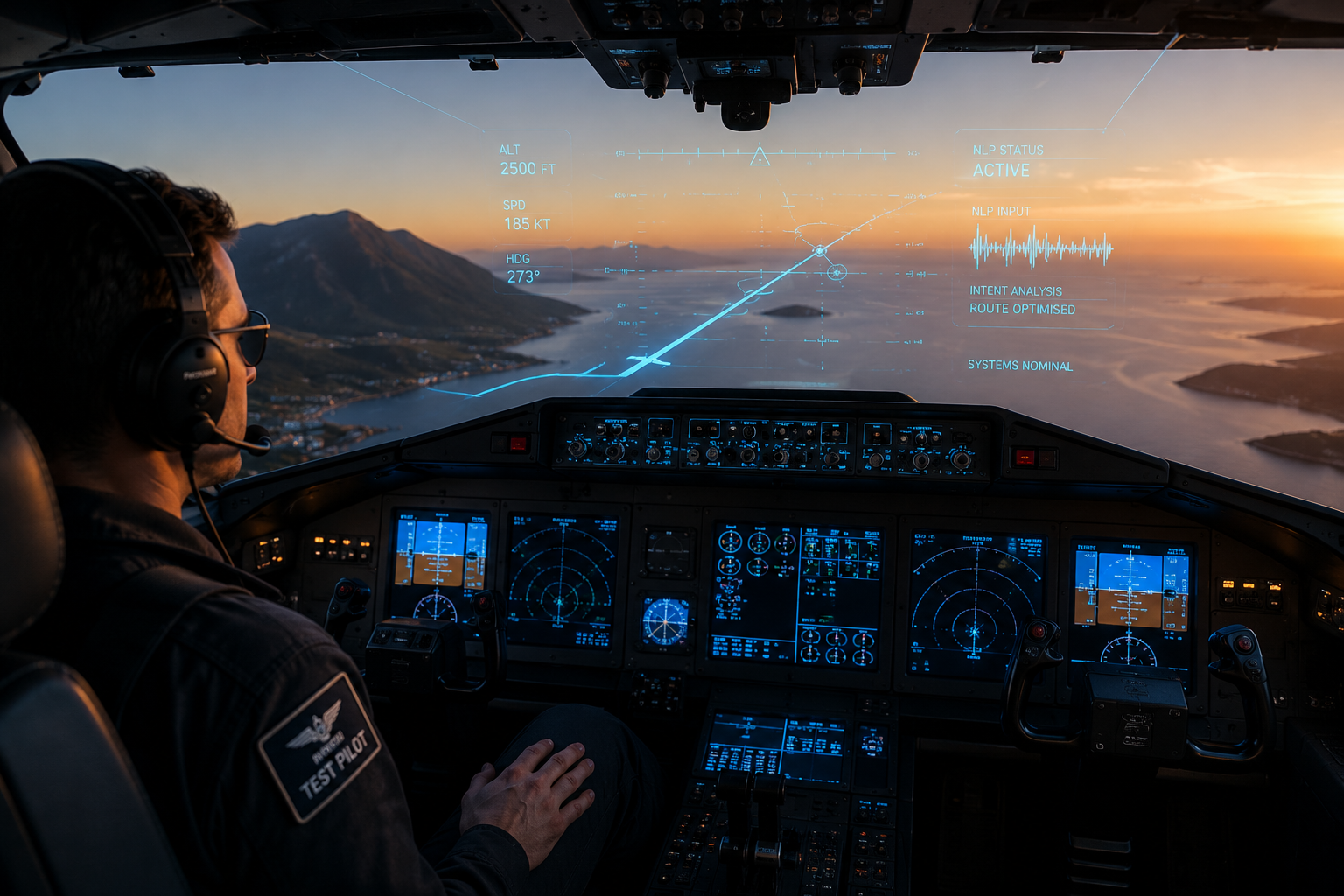
At Quonset State Airport in Rhode Island, a Cessna Caravan climbs into the coastal sky with the test pilot's hands completely off the controls. The aircraft is being flown by the Merlin Pilot, an AI system that listens to air traffic control, plans its own manoeuvres, and presents them to the human for a single button press to authorise. Welcome to the cockpit of the near future.
Key Takeaways
- ▸An AI autonomous flight system by Merlin Labs that controls aircraft from takeoff to touchdown and communicates with ATC using natural language processing.
- ▸Experimental test flights completed. A $105 million USSOCOM contract is active for C-130J Super Hercules military cargo integration as of 2026.
- ▸Boeing projects the industry needs more than 600,000 new commercial pilots over the next 20 years to meet demand and cover retirements.
- ▸The AI presents all flight path changes to a human pilot for approval via a single Authorize button. The pilot remains in command at all times.
- ▸AI probabilistic behaviour conflicts with FAA deterministic certification standards. Developers wrap AI cores in hard-coded safety guardrails to achieve compliance.
A Routine Departure That Is Anything But
At Quonset State Airport in Rhode Island, a modified Cessna Caravan taxis onto the runway, throttles up, and climbs smoothly into the coastal sky. To an outside observer it looks like a routine test flight. Inside the cockpit, the dynamic is entirely unconventional: the test pilot in the left seat is flying jazz-hands style, with his hands completely clear of the yoke and throttles.
The aircraft is being controlled by the Merlin Pilot, an advanced autonomous flight system developed by aviation startup Merlin Labs. While traditional autopilot systems have navigated commercial airliners across oceans for decades, they operate within rigid, rule-based boundaries. This new generation of aviation technology introduces adaptive artificial intelligence capable of communicating with air traffic control, adjusting to dynamic weather patterns, and executing flight phases from takeoff to touchdown without direct human manipulation of the controls.
As global aviation confronts severe labour deficits and an overstretched airspace infrastructure, the industry has stopped asking whether AI should fly aircraft. The question now is how quickly regulators can certify it.
Technical Architecture: Beyond Traditional Autopilot
To understand why AI integration represents a structural shift rather than an incremental upgrade, it helps to contrast it with the legacy flight deck automation it is built to extend.
Conventional flight management computers follow deterministic rules: a pre-programmed GPS route and altitude profile that the aircraft executes mechanically. These systems cannot react to commands that fall outside their programmed parameters. If an air traffic controller issues an emergency vectors change over the radio, traditional automation remains completely blind to that instruction until a human manually inputs it on the mode control panel.
Modern fly-by-wire systems add an important layer by acting as electronic filters, preventing a pilot from inadvertently overstressing the airframe, but they share the same fundamental blind spot: no situational awareness beyond what a human feeds them.
Systems like the Merlin Pilot bridge this gap through three structural layers working in sequence:
- Natural Language Processing: The system continuously monitors aviation radio frequencies, parsing spoken ATC instructions into machine-readable flight commands in real time.
- Acoustic Synthesis: The software confirms instructions back to controllers using a synthetic voice indistinguishable from standard radio communication.
- Human-in-the-Loop Authorisation: For civil certification purposes, the AI does not act autonomously on a radio command. It presents the calculated path change to the human pilot, who executes the manoeuvre by pressing a single Authorize button.
That final safeguard is not a limitation of the technology. It is the regulatory architecture that makes certification possible at all.
The Macro Drivers: Why Aviation Cannot Wait
The Global Pilot Shortage
The commercial airline industry is facing an unprecedented labour crunch with no near-term relief in sight. Long-range forecasting from Boeing projects that global air carriers will require more than 600,000 new commercial pilots over the next two decades to match travel demand and absorb a wave of mandatory age-based retirements. Training pipelines, which typically require two to three years to produce a commercial-rated pilot and many more to develop the experience hours required for airline command, cannot scale fast enough to close that gap.
Air Traffic Control System Strain
Aviation safety boards have faced intense scrutiny following a spike in high-profile airport surface close calls and system outages that exposed the fragility of ageing infrastructure. In Washington, the regulatory appetite for automation has sharpened. U.S. Transportation Secretary Sean Duffy has been outspoken about integrating AI tools to reduce controller workload across increasingly congested sectors.
We are never going to outsource the national airspace to AI tools. Controllers are going to control the airspace, but we can make their jobs easier by reducing workloads across increasingly crowded sectors. - Sean Duffy, U.S. Secretary of Transportation
Mitigating Human Error
Aviation safety data consistently links roughly 80 percent of accident causes to human factors, most commonly fatigue, cognitive overload, or a breakdown in crew resource management. Proponents of AI copilots argue that offloading the mechanics of radio communication and flight path tracking to an algorithmic system returns the human pilot to their highest-value role: strategic oversight and emergency judgement rather than routine workload management.
Regulatory and Cultural Friction
The Certification Bottleneck
The Federal Aviation Administration maintains some of the most rigorous safety certification standards in the world, built on a foundation of determinism: the principle that a given input will always produce a specific, predictable output. Deep learning models, by their nature, exhibit probabilistic behaviour that can produce unexpected results in rare edge cases. To satisfy FAA redundancy audits, startups must construct hard-coded, deterministic safety guardrails around the AI core, creating a compliant architecture that wraps the probabilistic engine inside a certifiable shell.
That engineering challenge is solvable, but the certification pathway is measured in years rather than months.
Organised Labour Opposition
The Air Line Pilots Association, representing more than 79,000 pilots across the United States and Canada, has been unambiguous about its position: technology serves pilots, not the other way around.
Technological advancements can improve aviation safety, but they will never be a substitute for the pilots on an aircraft. The most important safety feature on every airline flight will always be two well-trained and rested pilots on the flightdeck. - Capt. Jason Ambrosi, President, Air Line Pilots Association
ALPA's position carries significant political weight. Any regulatory pathway that proposes reducing minimum crew complements on passenger aircraft will face sustained institutional resistance before it reaches a rulemaking docket.
The Military Proving Ground
Because passenger-carrying autonomous flights face a runway measured in decades rather than years, autonomous flight developers are routing their commercial strategy through military logistics. The risk tolerance is higher, the regulatory pathway is compressed, and the operational data generated is directly transferable to civil certification arguments.
Merlin Labs has secured a $105 million contract with U.S. Special Operations Command to integrate its autonomy stack into the fleet of Lockheed Martin C-130J Super Hercules cargo transports. The programme unfolds in three phases:
| Phase 1 - Preliminary Design (Completed Q1 2026) | Phase 2 - System Integration Ground Rig Testing | Phase 3 - Takeoff-to-Touchdown Demo Crew-Reduced Theater Ops |
|---|
The objective is deliberate: mature the technology in high-stakes tactical environments, accumulate thousands of hours of operational telemetry, and use that validated safety record to systematically address commercial regulatory requirements. Military flight hours are not a detour from the civil certification path. They are the path.
Conclusion: Managing the Algorithm, Not the Stick
The endgame for autonomous flight pioneers is not a pilotless commercial jet. The near-term strategy is incremental crew reduction: moving from two pilots to one in commercial cargo feeders, then applying those proven safety baselines to wider transport categories before eventually extending the framework to passenger operations.
As autonomous testbeds continue logging crosswind landings and instrument approaches on experimental runways, the cockpit itself is undergoing a quiet but profound transformation. The future of flight may depend less on a pilot's stick-and-rudder feel and more on their ability to supervise, interrogate, and override the artificial intelligence flying beside them.
The first officer's seat is being redesigned. The occupant just does not have hands yet.
Related Articles
Dubai Chambers Launches Agentic AI Training for 14,000 Member Companies
Dubai Chambers has launched specialised Agentic AI training tracks through a new e-learning platform, aiming to equip more than 14,000 member companies with the skills to adopt the technology across their operations.
Sep 2, 2026
AnalysisHumain and DataVolt Partner for 100MW AI Data Centre on Saudi Arabia's Red Sea Coast
Saudi AI firm Humain has partnered with DataVolt to build a 100MW data centre at Oxagon, NEOM, the first phase of a larger 1.5 gigawatt AI campus.
Sep 2, 2026
AnalysisUAE Banks Federation Chief: Agentic AI Is Banking's Next Phase, But Accountability Must Stay Human
UAE Banks Federation Director General Jamal Saleh argues agentic AI will define banking's next phase, pointing to the UAE's regulatory model as a template for the region, though one figure he cites needs context.
Aug 28, 2026
AnalysisDubai Chambers Signs Agentic AI Agreement with India's NASSCOM to Accelerate Private-Sector Adoption
Dubai Chambers has signed a preliminary agreement with India's NASSCOM to accelerate agentic AI adoption among private-sector companies in the UAE.
Aug 20, 2026
AnalysisAbu Dhabi's AIREV Partners with Qualcomm to Expand Sovereign Agentic AI Deployment
Abu Dhabi's AIREV has partnered with Qualcomm to integrate its autonomous AI platform with Qualcomm Dragonwing hardware, enabling sovereign AI deployment.
Aug 14, 2026