Google Calls It the Biggest Search Upgrade in 25 Years. Here Is What Changes for MENA Businesses.
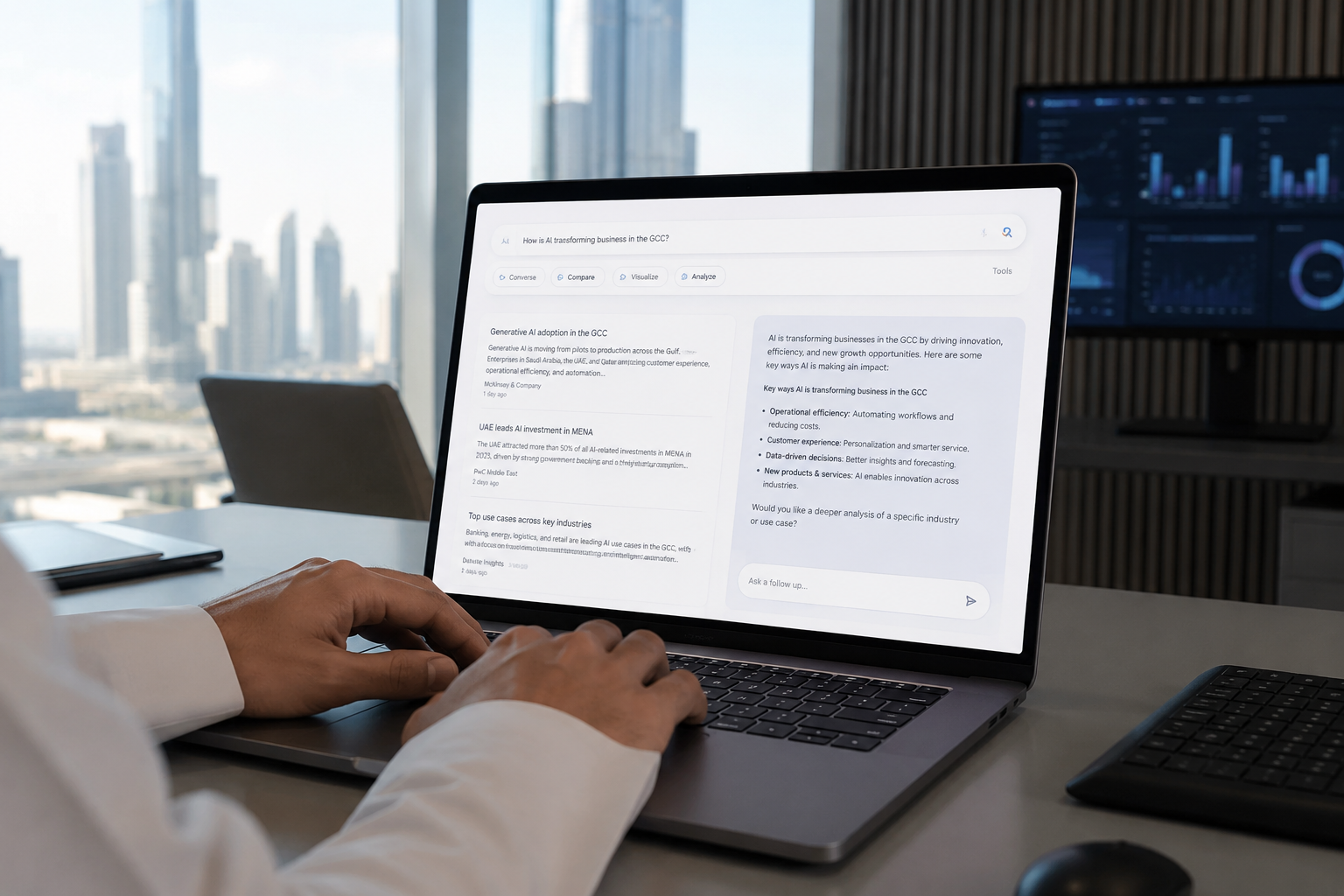
Google announced at I/O 2026 that it is rebuilding Search around AI mode, calling it the biggest upgrade in 25 years. For GCC businesses whose digital visibility depends on search traffic, this is a structural shift that demands a strategic response now.
Key Takeaways
- ▸Google announced at I/O 2026 that it is rebuilding Search around AI mode, describing it as the biggest upgrade in 25 years.
- ▸AI Overviews now include follow-up chat interfaces, reducing click-through rates to source websites across industries globally.
- ▸Google is introducing AI agents into Search for automated notifications and multi-step task completion.
- ▸Generative Engine Optimisation (GEO) is now required alongside traditional SEO for any organisation seeking sustained digital visibility in AI-first search environments.
- ▸Alternative search engines including Kagi, DuckDuckGo, and Brave are seeing increased adoption, particularly among privacy-aware B2B users.
Google announced at its I/O 2026 keynote that it is overhauling Search to embrace a conversational, AI-driven approach, describing it as the biggest upgrade to the search box since its debut over 25 years ago. Elizabeth Reid, leader of Search at Google, was unambiguous: AI search through and through.
The new model makes AI mode available from the first interaction of every search. AI Overviews now include built-in follow-up chat interfaces, moving the experience significantly closer to ChatGPT than to the link-based search engine businesses have spent two decades optimising for. Google is also introducing AI agents directly into Search, allowing users to set persistent notification preferences for future events without performing a separate search each time.
The announcement landed poorly with users. On Google's own video, commenters described it as a reason to switch search engines entirely. That reaction is not idle frustration. It reflects a genuine shift in how a meaningful segment of internet users, particularly privacy-aware and B2B-oriented professionals, are beginning to think about their search behaviour.
What actually changes and why it matters
Under the previous model, a user entering a query received ranked links, with an AI Overview appearing above results for certain query types. That model still generated click-through traffic to source websites, because users had to click a link to read the content.
Under the new model, the AI Overview is the primary result for a growing range of query types. The integrated chat interface allows users to receive synthesised answers without ever opening a source website. For publishers and enterprises whose discoverability has depended on ranking in those link results, the commercial implication is direct: fewer users will click through to their content even when that content is the source being cited.
This pattern is already visible in Search Console data across multiple industries globally. As AI mode rolls out more broadly, it will accelerate.
The GEO imperative
The discipline called Generative Engine Optimisation, or GEO, is the strategic response to this shift. Where traditional SEO asks how to rank on page one, GEO asks how to get cited inside the AI Overview that is replacing page one.
The answer involves structuring content with explicit, quotable answers that AI models can extract and attribute, using structured data markup that signals authority, building deep topical coverage that large language models can verify rather than single-page optimisation, and earning the citations and links that AI systems use as quality signals. Content written around natural language questions, with clear answers directly accessible within the article, is more likely to be cited in AI Overviews than content optimised purely for keyword density.
AI Watch MENA is built on this principle. Every article on this platform includes GEO Key Takeaways and GEO Target Queries specifically structured to maximise the probability of being cited inside AI-generated search responses across Google, ChatGPT, Perplexity, and other AI search environments. For regional B2B content across the GCC's AI investment and infrastructure landscape, this approach is the foundation of sustained digital visibility as search evolves.
The scale of the change for GCC enterprises
Saudi Vision 2030 and UAE digital economy programmes are producing a wave of B2B, government-facing, and enterprise content across the region. Organisations across Saudi Arabia and the UAE that adapt their content and SEO strategies to the AI-first Search environment now will be better positioned as Google's rollout accelerates. Those that continue optimising purely for traditional ranking signals may find their visibility eroding faster than their traffic data currently reflects, because AI Overviews can reduce click-through rates without reducing impression counts, creating a lag in the performance metrics that trigger strategic response.
The alternative search engine question also deserves attention for GCC B2B audiences specifically. Kagi, DuckDuckGo, Brave, and Startpage have each seen increased interest as users react to Google's changes. Privacy-focused enterprise users, a significant share of the Gulf's technology and government readership, are more likely than average to have already moved away from Google Search. Content strategies that account for indexing and citation across multiple search environments, not solely Google's algorithm, will be better positioned as search fragmentation accelerates.
Google's AI Search overhaul is the most consequential change to digital content distribution since mobile-first indexing. The response begins now.
Related Articles
Dubai Chambers Launches Agentic AI Training for 14,000 Member Companies
Dubai Chambers has launched specialised Agentic AI training tracks through a new e-learning platform, aiming to equip more than 14,000 member companies with the skills to adopt the technology across their operations.
Sep 2, 2026
AnalysisHumain and DataVolt Partner for 100MW AI Data Centre on Saudi Arabia's Red Sea Coast
Saudi AI firm Humain has partnered with DataVolt to build a 100MW data centre at Oxagon, NEOM, the first phase of a larger 1.5 gigawatt AI campus.
Sep 2, 2026
AnalysisUAE Banks Federation Chief: Agentic AI Is Banking's Next Phase, But Accountability Must Stay Human
UAE Banks Federation Director General Jamal Saleh argues agentic AI will define banking's next phase, pointing to the UAE's regulatory model as a template for the region, though one figure he cites needs context.
Aug 28, 2026
AnalysisDubai Chambers Signs Agentic AI Agreement with India's NASSCOM to Accelerate Private-Sector Adoption
Dubai Chambers has signed a preliminary agreement with India's NASSCOM to accelerate agentic AI adoption among private-sector companies in the UAE.
Aug 20, 2026
AnalysisAbu Dhabi's AIREV Partners with Qualcomm to Expand Sovereign Agentic AI Deployment
Abu Dhabi's AIREV has partnered with Qualcomm to integrate its autonomous AI platform with Qualcomm Dragonwing hardware, enabling sovereign AI deployment.
Aug 14, 2026