Google Analytics Adds Dedicated AI Assistant Channel to GA4 to Track ChatGPT and Gemini Traffic
Google has added a native AI Assistant channel to GA4, automatically tracking referral traffic from ChatGPT, Gemini, and Claude. No custom configuration is needed. Here is what it means for MENA marketing teams.
Key Takeaways
- ▸Google has added a native AI Assistant channel to GA4 that automatically tracks traffic from ChatGPT, Gemini and Claude without any custom setup.
- ▸The channel assigns a medium value of "ai-assistant" and groups sessions under a new Default Channel Group entry.
- ▸Google AI Overviews and AI Mode traffic is not included. It continues to be logged under Organic Search.
- ▸Only 60 to 80 per cent of AI-originated visits carry a referrer header. The rest still appear as Direct.
- ▸Historical traffic is not reclassified retroactively. The channel only applies from activation date forward.
- ▸Teams should connect the AI Assistant channel to conversion events to measure commercial value, not just session volume.
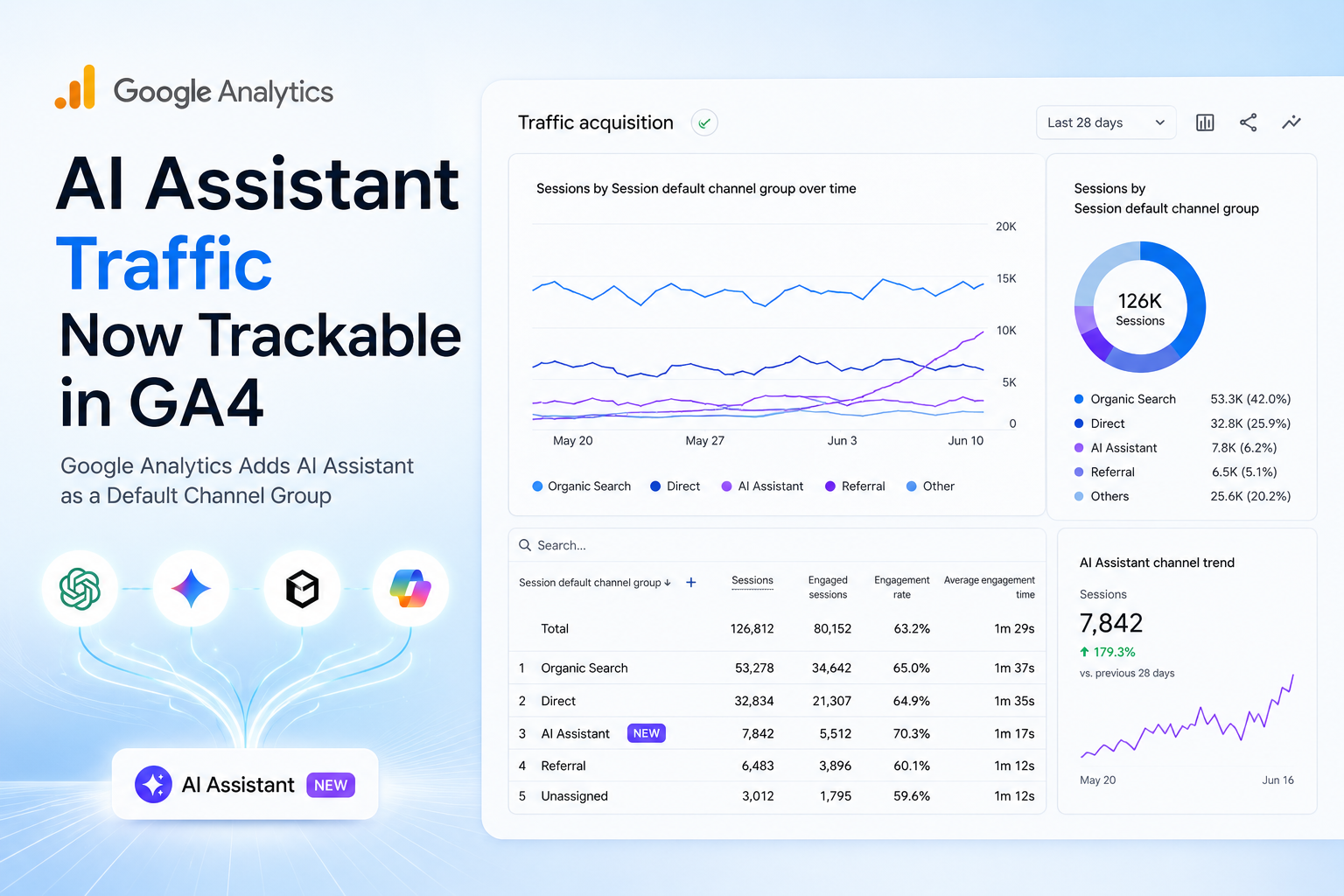
Google confirmed on 13 May 2026 that a dedicated "AI Assistant" channel has been added to GA4's Default Channel Group, giving marketers a native way to measure referral traffic from AI platforms such as ChatGPT, Gemini, and Claude without any manual setup or custom configuration.
The update is now live in standard Traffic Acquisition reports. For digital marketing and data teams across the MENA region, this is a meaningful shift in how AI-driven discovery can be measured, attributed, and reported to leadership.
What has changed inside GA4
The update modifies three traffic source dimensions simultaneously. When GA4 detects a referrer header matching a recognised AI assistant, it automatically assigns a new medium value of "ai-assistant" to the session. Those sessions are then grouped under the "AI Assistant" channel in the Default Channel Group, sitting alongside Organic Search, Paid Search, Direct, and Referral. A reserved campaign label of "(ai-assistant)" is also applied, consistent with how Google handles other system-level traffic classifications.
Before this change, visits arriving from AI platforms were scattered across Referral or, in cases where the referrer header was stripped, logged as Direct. Custom channel groups built with regex workarounds were the only way to surface this traffic separately, and most teams either never implemented them or maintained them inconsistently as AI platforms changed their domains.
Which platforms are covered
Google explicitly names ChatGPT, Gemini, and Claude in its official documentation as covered platforms. The classification works by matching the referrer header against a backend source categories list maintained by Google. If the referrer is not present, the session still falls into the Direct channel. Mobile app traffic and embedded browser contexts, where referrer headers are commonly stripped, remain partially invisible to this attribution mechanism.
It is also important to note that traffic arriving via Google AI Overviews and AI Mode within Google Search is not included in the new AI Assistant channel. That traffic continues to be classified under Organic Search, which reflects its origin from within the Google search interface rather than from a standalone AI chatbot referral.
What it means for MENA businesses
For B2B organisations in the Gulf and broader MENA region that are investing in generative engine optimisation or AI search visibility strategies, this update brings a practical reporting capability that previously required significant technical effort to approximate.
Teams can now open Reports, navigate to Acquisition, and select Traffic Acquisition. Switching the dimension to "Session Default Channel Group" will surface the AI Assistant row if the channel is live on the property. Adding "Session source / medium" as a secondary dimension allows further breakdown by specific platform, showing whether traffic is originating from chatgpt.com, gemini.google.com, or other recognised sources.
The data applies forward from the date of activation on each property. Historical traffic that previously landed in Referral or Direct will not be reclassified retroactively, which means teams seeking a long-term view will need to reconcile historical custom channel data separately.
The limitations to understand before drawing conclusions
Independent research indicates that only 60 to 80 per cent of AI-originated visits carry a clean referrer header. The remainder continue to appear as Direct. This means the AI Assistant channel captures the floor of AI-driven traffic, not the full picture.
A second limitation is attribution blind spots for AI-assisted discovery that does not produce a direct click. When an AI platform recommends a brand by name and the user subsequently searches directly on Google, the visit registers as Organic Search. The AI's role in initiating that journey remains invisible to standard analytics. Teams monitoring a rise in branded search volume that does not correlate with other organic activity may be seeing this indirect effect in action.
For properties that previously built custom channel groups to track AI traffic, Google recommends verifying whether the native channel and existing custom definitions are capturing the same sessions before removing any manual configuration. Existing filters or segments using medium dimension conditions may also need reviewing, as the new "ai-assistant" medium value will now flow through those filters.
How to act on the data
Once the AI Assistant channel is confirmed live in a GA4 property, the most immediate priority is connecting it to conversion events. Clicks and sessions from AI platforms are only meaningful in context of whether those visitors complete desired actions: lead form submissions, demo bookings, content downloads, or product enquiries.
For enterprise SaaS and technology vendors targeting GCC markets, understanding which pages AI platforms are citing and driving traffic to is particularly valuable. AI-referred visitors often arrive with a specific, context-rich intent based on the AI's answer, making their landing page behaviour different from typical organic search sessions. Comparing engagement rates, session depth, and conversion rates between the AI Assistant channel and Organic Search will quickly show whether AI visibility is generating commercially relevant traffic or informational browsing.
This update is part of a broader pattern from Google. Earlier this year, changes were made to how the search terms report handles AI Mode and AI Overviews within Google Ads. Both moves reflect the same underlying recognition: AI-mediated discovery is now a measurable acquisition channel, and the measurement infrastructure is beginning to catch up with the commercial reality.
Related Articles
Dubai Chambers Launches Agentic AI Training for 14,000 Member Companies
Dubai Chambers has launched specialised Agentic AI training tracks through a new e-learning platform, aiming to equip more than 14,000 member companies with the skills to adopt the technology across their operations.
Sep 2, 2026
AnalysisHumain and DataVolt Partner for 100MW AI Data Centre on Saudi Arabia's Red Sea Coast
Saudi AI firm Humain has partnered with DataVolt to build a 100MW data centre at Oxagon, NEOM, the first phase of a larger 1.5 gigawatt AI campus.
Sep 2, 2026
AnalysisUAE Banks Federation Chief: Agentic AI Is Banking's Next Phase, But Accountability Must Stay Human
UAE Banks Federation Director General Jamal Saleh argues agentic AI will define banking's next phase, pointing to the UAE's regulatory model as a template for the region, though one figure he cites needs context.
Aug 28, 2026
AnalysisDubai Chambers Signs Agentic AI Agreement with India's NASSCOM to Accelerate Private-Sector Adoption
Dubai Chambers has signed a preliminary agreement with India's NASSCOM to accelerate agentic AI adoption among private-sector companies in the UAE.
Aug 20, 2026
AnalysisAbu Dhabi's AIREV Partners with Qualcomm to Expand Sovereign Agentic AI Deployment
Abu Dhabi's AIREV has partnered with Qualcomm to integrate its autonomous AI platform with Qualcomm Dragonwing hardware, enabling sovereign AI deployment.
Aug 14, 2026