The Sidewalk Gridlock: How Delivery Robots are Rewriting Urban Planning, Labor, and Pedestrian Rights
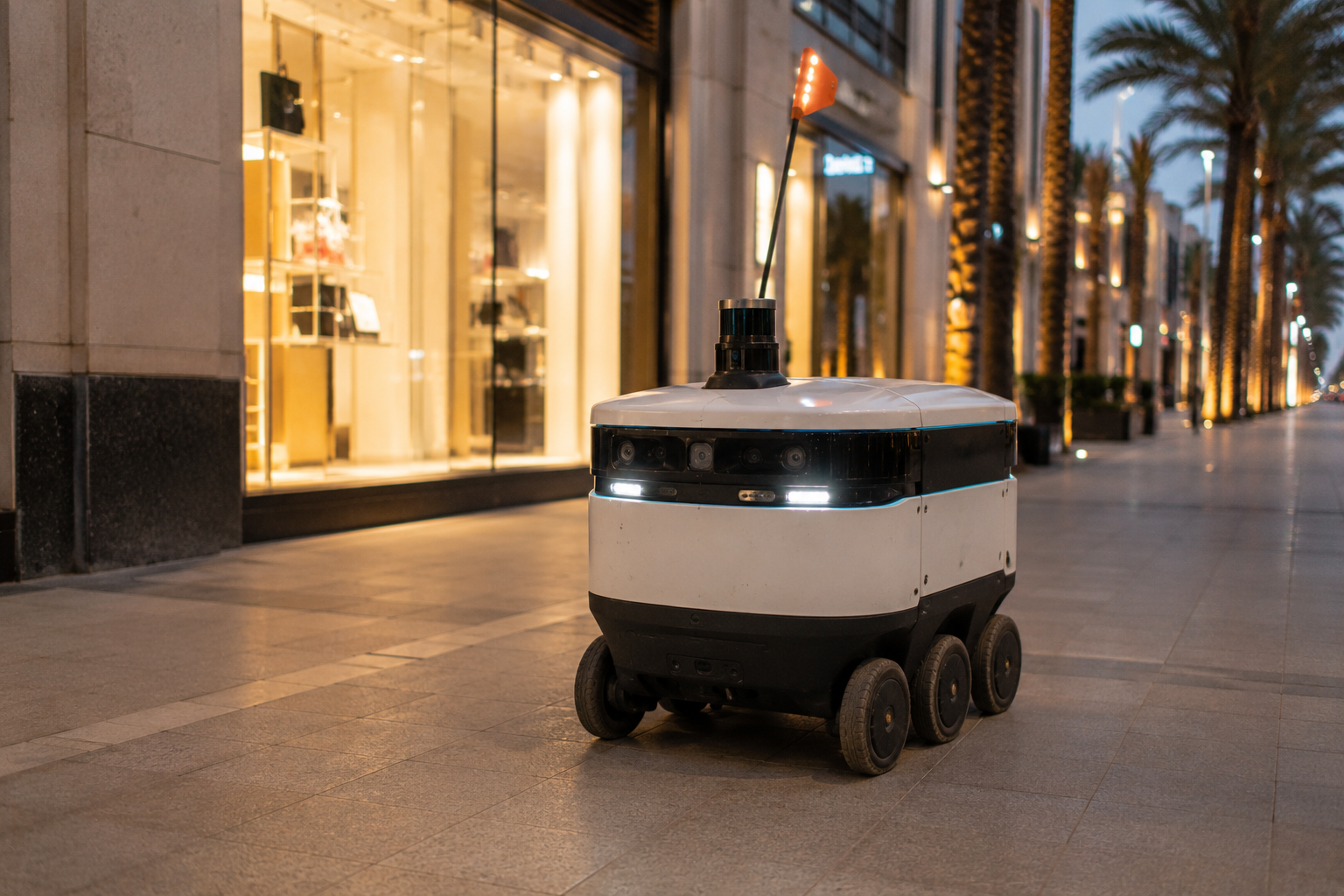
Serve Robotics has deployed 500 autonomous delivery robots across 40 Los Angeles neighbourhoods in a single month. As cities worldwide grapple with pedestrian safety, labour displacement, and sidewalk congestion, Gulf smart city planners have a rare window to learn from early mistakes before autonomous micro-mobility arrives at scale in the region.
Key Takeaways
- ▸Serve Robotics deployed 500 autonomous delivery robots across 40 Los Angeles neighbourhoods in a single month in May 2026, up from two neighbourhoods in 2023.
- ▸Cornell University researchers developed the Robotability Score, a data-driven framework that evaluates whether a neighbourhood's pedestrian patterns can absorb autonomous delivery robot fleets without creating congestion or safety incidents.
- ▸Real-world delivery robot incidents include a cyclist struck in New Jersey, a bus shelter shattered in Chicago, and a Waymo vehicle collision with a delivery robot in Los Angeles.
- ▸Dubai, Abu Dhabi, and Riyadh are developing autonomous last-mile delivery and smart mobility strategies, making Gulf-specific planning frameworks an immediate priority for regional city planners.
- ▸Labour displacement is a documented consequence of autonomous delivery robot deployment, with each automated delivery directly replacing a human gig-economy courier or restaurant driver.
The rapid deployment of autonomous delivery robots across major American metropolitan areas has transformed city sidewalks into the latest battleground for urban spatial rights. What began as localised pilot programmes has scaled into commercial operations, with companies like Serve Robotics and Coco Robotics deploying hundreds of units across dense urban corridors.
While proponents champion autonomous delivery robots as zero-emission solutions to the last-mile delivery crisis, their integration has triggered significant friction. This article examines the multi-faceted impact of delivery robots on urban infrastructure, pedestrian safety, labour dynamics, and the emerging regulatory frameworks designed to govern public walkways, with particular relevance for Gulf cities now developing their own smart mobility strategies.
The Scaling of Autonomous Micro-Mobility
The footprint of autonomous micro-mobility has expanded rapidly beyond small-scale testing environments. In Los Angeles, Serve Robotics recently deployed an additional 500 autonomous bots across 40 distinct neighbourhoods, a massive escalation from its two-neighbourhood footprint in 2023. Simultaneously, competitors like Coco Robotics maintain hundreds of active units, establishing a persistent physical presence on public walkways.
Rapid deployment of autonomous delivery robots is outpacing the municipal infrastructure designed to support them, creating a feedback loop where sidewalk congestion drives pedestrian friction, which in turn forces reactive and often restrictive policy responses from city governments.
This rapid proliferation is most acute in high-density commercial zones such as Los Angeles's Sunset Boulevard, where outdoor dining, foot traffic, and autonomous couriers compete for the same narrow strips of pavement. Sidewalks historically designed for pedestrian transit and accessibility compliance are now functioning as unregulated commercial freight lanes.
Infrastructure Friction and Pedestrian Safety
The introduction of autonomous delivery robots into pedestrian ecosystems creates distinct operational and safety challenges. Rather than seamlessly blending into human traffic, robots frequently create physical and psychological friction for pedestrians.
Behavioural Obstructions
Research led by Steven Gehrke at Northern Arizona University tracked robot behaviour and found that when an autonomous delivery robot detects a human crossing its path, its default safety protocol is to execute an immediate halt. While this prevents direct collisions, it frequently leaves a bulky, stationary obstacle in high-traffic bottlenecks, forcing pedestrians, pushchair users, and wheelchair users to navigate around an immobile machine.
Real-World Incidents and Liability
While industry representatives maintain that autonomous fleets operate in strict accordance with safety regulations, real-world data highlights growing liabilities across several categories.
- Pedestrian Collisions: In New Jersey, an autonomous unit operated by Avride reportedly struck a cyclist, resulting in a head injury and a broken collarbone.
- Infrastructure Damage: High-profile software or hardware anomalies, such as an ADR shattering a glass bus shelter in Chicago, underscore the physical risks of deploying heavy autonomous hardware in public spaces.
- Autonomous Congestion: In 2024, a collision between a Waymo autonomous vehicle and a delivery robot in Los Angeles highlighted the complex, uncoordinated intersection of different automated systems operating in the same urban ecosystem.
Socio-Economic and Cultural Impacts
The reception of delivery robots by urban populations is deeply polarised, characterised by a tension between anthropomorphic sympathy and active resistance.
The Anthropomorphism Paradox
Technology developers intentionally design autonomous delivery robots with features intended to ease public integration, including digital blinking eyes, personalised nametags, and polite digital prompts such as "Push crosswalk button for me?" This design strategy leverages human psychology to reduce friction at the point of encounter.
During inclement weather, social media channels frequently document residents expressing pity for robots struggling through storms. One clip of a delivery robot making its rounds in a rainstorm went viral, with the person filming it saying "She's doing her best, you guys." This creates an anthropomorphic paradox: the public assigns grit and personality to a mechanical asset owned by venture-backed logistics corporations with no emotional experience of the conditions they operate in.
Labour Displacement and Public Backlash
Beneath the aesthetic appeal lies genuine economic anxiety. Every automated delivery directly displaces a human gig-economy courier or restaurant delivery driver. Service staff and labour advocates consistently raise concerns about the erosion of entry-level delivery employment, particularly in cities where gig work represents a critical income source for lower-income communities.
This economic friction, combined with sidewalk overcrowding, has catalysed active community resistance. Incidents of robot tampering, where pedestrians manually power down units, block their paths, or use them as improvised seating, represent a grassroots rejection of the commercial use of public space. In Los Angeles, one resident demonstrated how to power off a delivery robot and sat on it while explaining that the city is already one of the worst in the world for pedestrians and does not need additional obstacles on its pavements.
Emerging Regulatory Frameworks and the Robotability Score
As municipal governments face mounting complaints, the regulatory landscape is shifting from passive observation to active intervention. Glendale, California has debated a total moratorium on delivery robots, while Chicago has placed strict caps on fleet expansion.
The Robotability Score
To prevent heavy-handed bans while protecting public infrastructure, researchers at Cornell University, under Professor Wendy Ju and doctoral student Matt Franchi, developed a framework called the Robotability Score. Modelled after real-estate walkability indices, this framework evaluates urban environments based on their structural and cultural capacity to absorb autonomous robotic fleets before deployment.
| Urban Metric | Pedestrian Dynamics | Robotability Impact |
|---|---|---|
| High Density / Commuter | Fast-paced, linear movement (e.g., Manhattan) | Low: Robots cause severe bottlenecks and high friction. |
| High Density / Leisure | Ambling, browsing, outdoor dining (e.g., Silver Lake) | Moderate: High potential for physical obstruction with tables and patrons. |
| Low-to-Medium Density | Sporadic foot traffic, wide rights-of-way (e.g., suburban LA) | High: Minimal pedestrian conflict; optimal for automated transit. |
"The score is very community-centric in the sense that the existing environment needs to be respected, or else the score degrades," Franchi said. The Robotability Score gives urban planners and technology companies a data-driven tool to establish zoning frameworks for autonomous micro-mobility, enabling decisions such as barring robots from narrow historical corridors or designating specific loading zones for automated drop-offs before deployment rather than in response to complaints.
Conclusion: Meeting in the Middle
The future of autonomous delivery does not depend solely on the capabilities of the technology itself. It depends on spatial equity and the willingness of companies to operate within civic frameworks rather than ahead of them.
For autonomous delivery robots to achieve long-term viability, technology companies must transition from aggressive deployment to collaborative urban integration. This requires respecting municipal zoning, applying frameworks like the Robotability Score during planning rather than after pushback, and recognising that public sidewalks are, first and foremost, civic spaces for human beings.
For smart city planners across the Gulf, the Los Angeles experience is not a distant case study. Dubai and Abu Dhabi have both announced autonomous last-mile delivery pilots as part of broader smart mobility strategies, and Saudi Arabia is actively developing smart city infrastructure under Vision 2030. The Robotability Score framework offers exactly the kind of data-driven zoning tool that Gulf municipalities could apply before deployment scales to the point where reactive regulation becomes the only option available. The window to plan ahead is now, not after the first fleet of autonomous robots creates the same friction on Gulf pavements that Los Angeles is navigating today.
Related Articles
Dubai Chambers Launches Agentic AI Training for 14,000 Member Companies
Dubai Chambers has launched specialised Agentic AI training tracks through a new e-learning platform, aiming to equip more than 14,000 member companies with the skills to adopt the technology across their operations.
Sep 2, 2026
AnalysisHumain and DataVolt Partner for 100MW AI Data Centre on Saudi Arabia's Red Sea Coast
Saudi AI firm Humain has partnered with DataVolt to build a 100MW data centre at Oxagon, NEOM, the first phase of a larger 1.5 gigawatt AI campus.
Sep 2, 2026
AnalysisUAE Banks Federation Chief: Agentic AI Is Banking's Next Phase, But Accountability Must Stay Human
UAE Banks Federation Director General Jamal Saleh argues agentic AI will define banking's next phase, pointing to the UAE's regulatory model as a template for the region, though one figure he cites needs context.
Aug 28, 2026
AnalysisDubai Chambers Signs Agentic AI Agreement with India's NASSCOM to Accelerate Private-Sector Adoption
Dubai Chambers has signed a preliminary agreement with India's NASSCOM to accelerate agentic AI adoption among private-sector companies in the UAE.
Aug 20, 2026
AnalysisAbu Dhabi's AIREV Partners with Qualcomm to Expand Sovereign Agentic AI Deployment
Abu Dhabi's AIREV has partnered with Qualcomm to integrate its autonomous AI platform with Qualcomm Dragonwing hardware, enabling sovereign AI deployment.
Aug 14, 2026