The Seven-Figure Dev Shop: Inside the $1.3 Million Monthly Token Bill Realizing Zero-Marginal-Cost Engineering
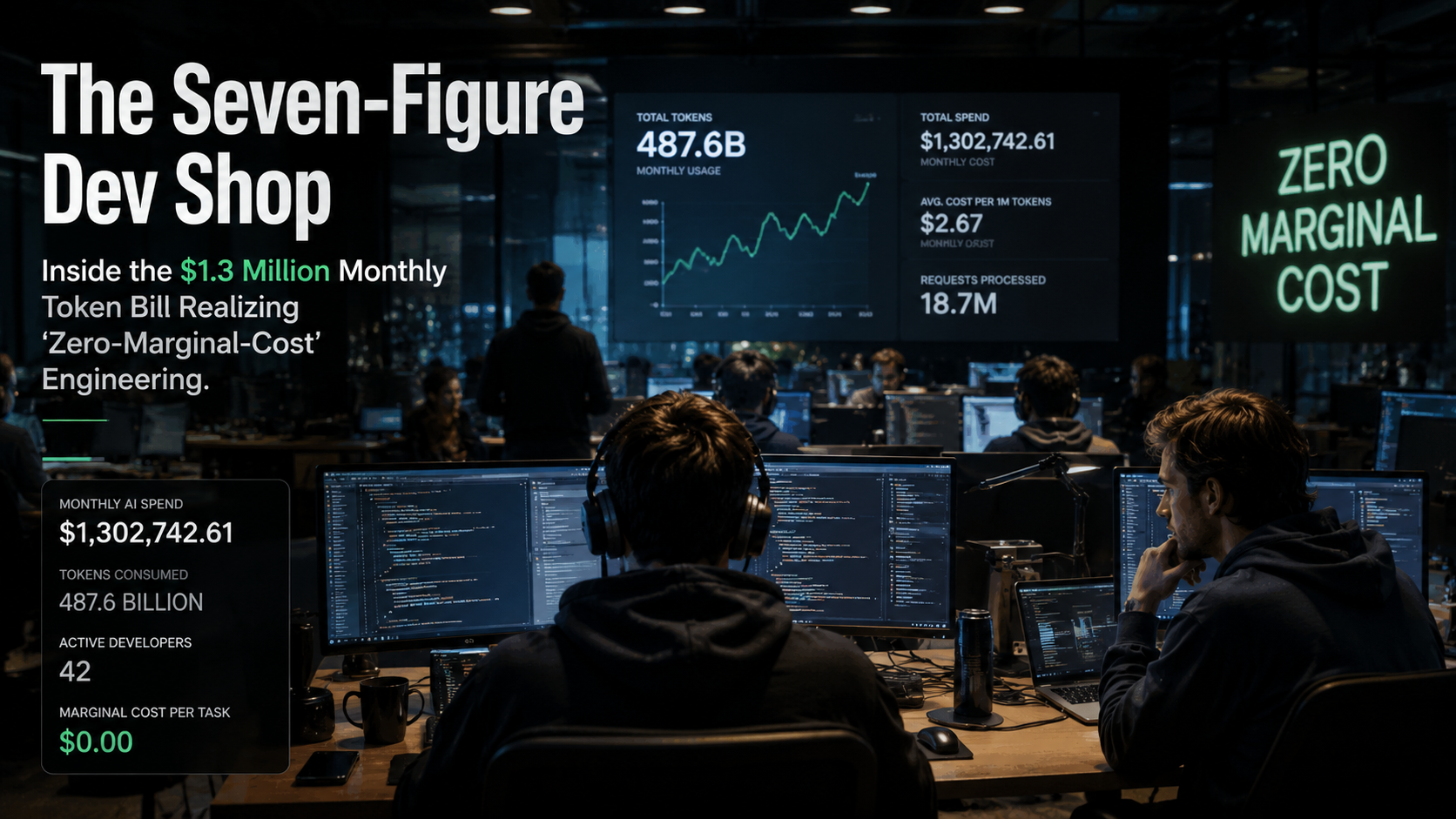
OpenClaw creator Peter Steinberger shocked the tech ecosystem by sharing a staggering 1.3 million dollar monthly OpenAI API usage dashboard, peeling back the curtain on the hidden compute costs and scaling economics of a 100-agent autonomous software factory.
Key Takeaways
- ▸The Price of True Autonomy
- ▸Extreme Human Leverage
- ▸Continuous Autonomous Operations
- ▸The Premium Cost of Latency
- ▸Market Subsidy Defici
The holy grail of modern software engineering has long been the concept of the autonomous development lifecycle: a self healing, self writing codebase maintained by a tireless workforce of software agents.
Peter Steinberger, the Austrian developer who founded the viral open-source project OpenClaw and subsequently joined OpenAI, provided a breathtaking look at exactly what that future looks like when capital constraints are removed.
Steinberger shared a screenshot of his OpenAI API usage dashboard revealing a jaw dropping monthly invoice: $1,305,088.81 spent in a single 30-day billing cycle.
The seven figure tab did not belong to a multinational enterprise; it was accumulated by a lean three person core team managing a tireless digital army of roughly 100 autonomous coding instances.
Inside the Automated Code Factory
The massive surge in token consumption reflects an ecosystem where human engineers have shifted roles from active writers to high level orchestrators. The three person human team acts effectively as a board of directors, while their fleet of 100 autonomous agents functions as a multi department engineering organization.
These agents operate in continuous loops across multiple core operational fronts:
Development & Integration: Agents parse the broader project roadmap, translate long term goals into functional code, and independently open Pull Requests (PRs) on GitHub.
Continuous Code Hygiene: Specialized instances review incoming PRs, deduplicate overflowing GitHub issues, and autonomously author bug fixes.
Security & Regression Auditing: The fleet constantly scans code commits for security vulnerabilities while matching execution benchmarks against performance targets, piping alerts directly to the team's Discord server.
Async Meeting Participation: In an extreme display of agentic autonomy, specific instances are deployed to listen to voice meetings, synthesize conversation context, and immediately generate functional PRs for features mentioned by the human team.
The Raw Metrics of Hyper-Automation
The scale of compute required to sustain this autonomous perpetual motion machine stretches the boundaries of standard API allocations. According to the disclosed telemetry dashboard, the project's parameters spanned astronomical boundaries.
The primary model driving this massive volume was a cutting edge GPT-5.5 instance. Because OpenClaw operates as a lab environment to stress test software development at the absolute limits of capability, OpenAI, Steinberger's employer, fully subsidized the invoice.
The Hidden Leverage: Decoding Fast Mode and Subsidies
Following intense discussion across tech circles regarding the astronomical overhead, Steinberger provided a crucial technical breakdown of the cost structure. The 1.3 million dollar peak reflects execution on OpenAI's premium "Fast Mode" pricing tier, which optimizes inference speeds and minimizes agent latency at a massive price premium.
Steinberger noted that simply disabling Fast Mode and defaulting to standard processing queues drops the baseline monthly operational bill to roughly $300,000.
Fast Mode Price (Peak Optimization): $1,305,088.81
Standard Mode Price (Disabling Fast Tier): ~$300,00
Even at $300,000, the gap between commercial API costs and the retail developer ecosystem remains vast. For comparison, a single flat-rate Codex Pro enterprise tier subscription costs roughly $200 per month. This subscription delivers an estimated $5,000 to $6,000 in real API equivalent value before hitting usage throttles.
By this math, the non fast mode workload utilizes the raw compute equivalence of approximately 60 enterprise pro accounts simultaneously. While average industry telemetry suggests standard developer assistant usage hovers between $100 and $200 per month, an unconstrained multi agent setup blows past traditional per seat licensing models completely.
Conclusion: The Structural Re-alignment of Development Economics
The massive token burn generated by OpenClaw highlights an existential pricing conflict looming over the entire development ecosystem. Major platform players, including OpenAI's Codex, Anthropic's Claude Code, and standalone tools like Cursor, are engaged in a fierce customer acquisition war, heavily subsidizing flat-rate consumption far below true API inference costs to lock in user bases.
OpenAI's structural shift to token-based developer billing makes these massive margins transparent. While critics point out the immense energy consumption and underlying computing strain of running 100 autonomous instances, Steinberger views it as an important glimpse into a post-scarcity engineering paradigm.
If token costs decay exponentially over the coming years as hardware optimizations scale, a three-person startup wielding an army of a hundred tireless digital workers will move from a 1.3 million dollar corporate privilege to a standard operational setup.
Related Articles
DEWA Showcases AI-Powered Asset Management Strengthening Dubai's Power Network
DEWA CEO Saeed Mohammed Al Tayer toured the authority's Al Ruwayyah complex to review a cluster of AI-driven initiatives, including an Asset Health Centre that predicts equipment failures before they happen, as Dubai's power network shifts from reactive to predictive maintenance.
Sep 4, 2026
IntelligenceJordan's Public Sector AI Programme: What 92% Completion Rate and Five Active AI Agent Use Cases Tell Us About MENA Government Technology
Jordan completed 78 of 85 public sector modernisation axes in H1 2026. Five AI agent use cases are now in active development across five government entities. 23 data teams assessed for maturity. This is what structured government AI adoption looks like in MENA.
Aug 17, 2026
IntelligenceAI Agents Move Into UAE Retail as Shadow AI and Governance Gaps Raise Concern
UAE retailers are moving from AI-driven insight to fully autonomous AI agents for pricing and inventory, but experts warn that fragmented systems and unmonitored "shadow AI" could expose businesses to serious governance risk.
Jul 28, 2026
IntelligenceBirchford Technologies Launches First MENA AI Translator to Fix Cross-Border Payment Compliance Gap
Birchford Technologies has launched ProLink AI Translator, the first MENA platform combining SWIFT's AI model with proprietary reference data to convert unstructured postal addresses into ISO 20022 compliant payment data ahead of a November 2026 deadline.
Jul 27, 2026
IntelligenceAnthropic Launches Claude Opus 5, Delivering Near-Frontier Performance at Half the Price
Anthropic has launched Claude Opus 5, a new frontier model delivering performance close to its top-tier Fable 5 model at half the cost, alongside what the company describes as its most aligned and safest model to date.
Jul 27, 2026