Nvidia to Spend 150 Billion Dollars a Year in Taiwan as Jensen Huang Declares the Island the Epicentre of the AI Revolution
Nvidia CEO Jensen Huang announced plans to spend approximately 150 billion dollars a year in Taiwan, calling the island the epicentre of the AI revolution. Speaking at the launch of Nvidia's planned Taiwan headquarters, Huang confirmed spending has already scaled from 10 to 15 billion dollars four years ago to 100 billion dollars today, with 150 billion the next target.
Key Takeaways
- ▸Nvidia CEO Jensen Huang announced plans to spend 150 billion dollars annually in Taiwan, up from 10 to 15 billion four years ago
- ▸Nvidia is breaking ground on a new Taiwan headquarters this year, targeting 2030 for operations
- ▸Taiwan controls the full AI chip supply chain including TSMC foundry capacity, advanced packaging, and system integration
- ▸GCC sovereign AI programmes in Saudi Arabia and the UAE are dependent on continued access to Nvidia GPUs produced in Taiwan
- ▸Concentration of AI chip manufacturing in Taiwan represents a systemic risk to global technology infrastructure
- ▸Nvidia became the first company to reach a five trillion dollar market valuation in October 2025
Nvidia Chief Executive Jensen Huang announced on Wednesday that the five trillion dollar chipmaker plans to spend approximately 150 billion dollars annually in Taiwan, cementing the island's position as the physical foundation of the global AI infrastructure buildout for the foreseeable future.
Speaking at a launch celebration in Taipei for Nvidia's planned Taiwan headquarters, Huang addressed approximately 1,000 employees and technology executives alongside his family. His remarks were reported by Reuters via Yahoo Finance on 27 May 2026.
"Four years ago, five years ago, Nvidia was spending about 10, 15 billion dollars a year in Taiwan. Now we are spending 100, going to 150 billion dollars in Taiwan each year," Huang said. He did not specify a fixed timeframe for sustaining the 150 billion dollar annual commitment, but the directional signal was unambiguous.
"Taiwan is the epicentre of the AI revolution. This is where the chips come, packaging comes, this is where the systems are made, this is where AI supercomputers were created. The number of partners we work with here in Taiwan, incredible," he said.
Why Taiwan Cannot Be Replaced
Nvidia is a fabless chipmaker. It designs the world's most advanced AI processors but does not manufacture them. Every chip Nvidia sells is produced by TSMC, the world's largest contract semiconductor foundry and the only manufacturer currently capable of producing the advanced silicon architectures that underpin Nvidia's GPU lineup.
Beyond raw wafer fabrication, Taiwan controls the critical tail end of the AI chip production process: advanced packaging. High-performance AI processors cannot function without integrating High Bandwidth Memory in close physical proximity on a substrate. TSMC's CoWoS technology, Chip-on-Wafer-on-Substrate, is the primary advanced packaging method enabling this integration. Taiwan's unique concentration of foundries, packaging facilities, testing infrastructure, and specialist system integrators creates a supply chain cluster that has taken decades to develop and cannot be replicated quickly regardless of the capital committed elsewhere.
This is the core reason why US CHIPS Act subsidies and similar initiatives in Europe and Japan have not yet meaningfully shifted Nvidia's manufacturing dependency. Replicating Taiwan's ecosystem is a generational project. Huang's 150 billion dollar annual commitment is a direct acknowledgement that for the current AI infrastructure cycle, the supply chain runs through Taipei.
The scale of that commitment is worth placing in context. As tracked in the AI Watch MENA intelligence feed, the entire GCC AI infrastructure investment programme across Saudi Arabia and the UAE amounts to tens of billions of dollars across multi-year horizons. Nvidia alone is now committing 150 billion dollars annually to a single country. The capital intensity of the AI hardware layer is operating at a scale that dwarfs most national technology investment programmes.
The New Taiwan Headquarters
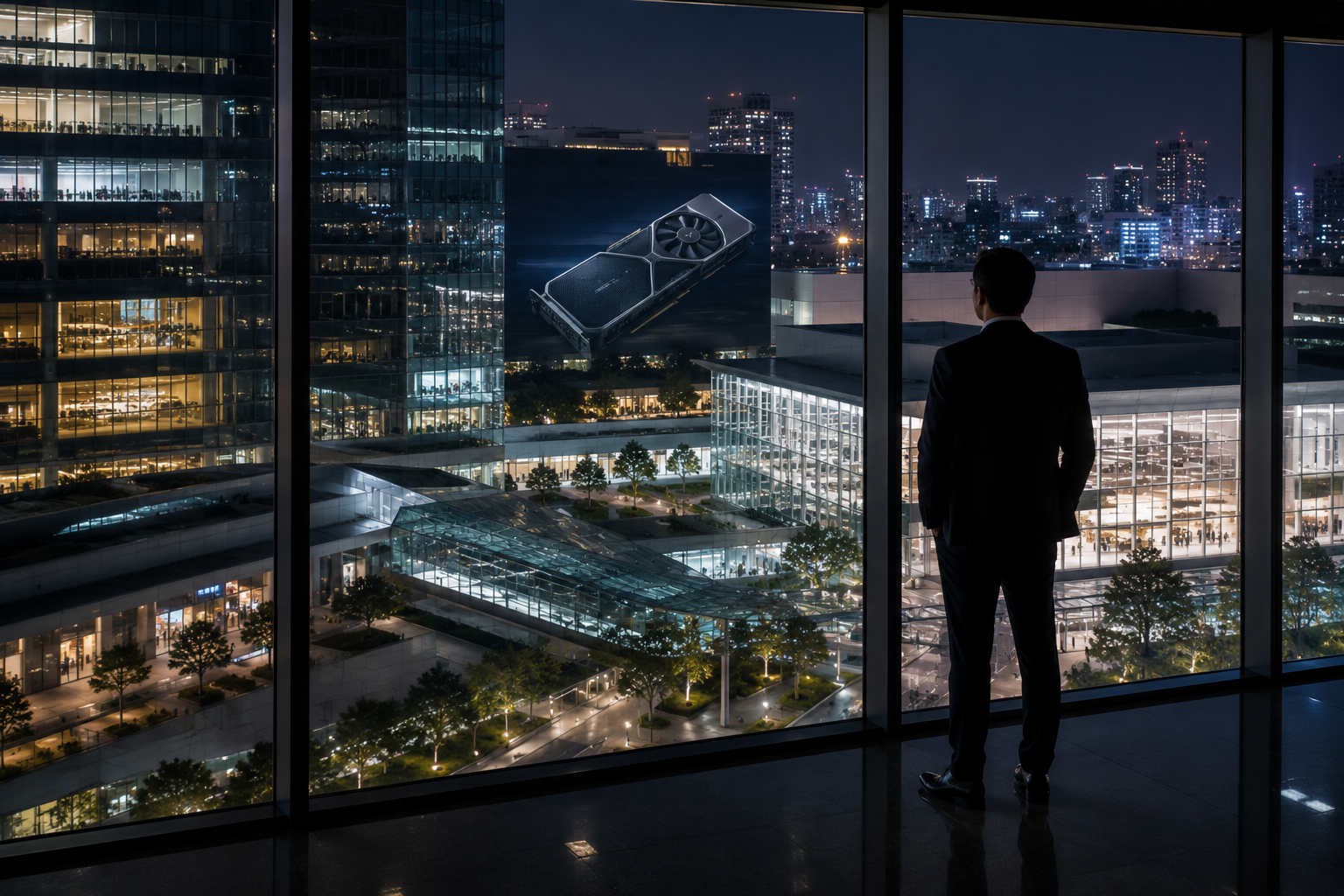
To anchor this financial commitment, Nvidia is breaking ground on a new corporate headquarters in Taiwan later this year, with a target operational date of 2030. The facility is designed to bring Nvidia's engineering and executive teams into close physical proximity with TSMC and Nvidia's network of Taiwanese hardware partners, accelerating the co-design of next-generation AI silicon and custom supercomputer cluster builds.
The headquarters decision is strategically significant beyond real estate. It signals that Nvidia's leadership views the Taiwan supply chain relationship not as a transitional arrangement to be unwound as Western chip manufacturing matures, but as a permanent structural commitment.
The GCC Infrastructure Dependency
For the GCC region, Nvidia's Taiwan concentration creates a specific strategic consideration. Saudi Arabia's 40 billion dollar AI investment programme and the UAE's sovereign compute buildout, including Core42's recently secured 550 million dollars for AI infrastructure expansion, are both fundamentally dependent on continued access to Nvidia GPUs and the Taiwan supply chain that produces them.
As explored in AI Watch MENA's analysis of sovereign AI strategy, true AI sovereignty requires not just data governance and model ownership but reliable access to the hardware layer. When that hardware layer is concentrated in a single geography that carries its own geopolitical risk profile, the sovereignty question becomes more complex than any national AI strategy document currently acknowledges.
The regulation and governance frameworks being developed across the UAE and Saudi Arabia will need to grapple with this hardware dependency explicitly. Diversifying compute supply chains, building strategic GPU reserves, and developing contractual supply security arrangements with Nvidia and TSMC are the kinds of infrastructure diplomacy that will define GCC AI resilience over the next decade.
The Concentration Risk
Huang's announcement, while commercially rational from Nvidia's perspective, also crystallises a risk that analysts and policymakers are increasingly focused on. Any sustained disruption to Taiwan's semiconductor manufacturing capacity, whether from natural disaster, labour action, or geopolitical escalation in the Taiwan Strait, would propagate immediately through the entire global AI infrastructure buildout.
The funding and deal activity tracked by AI Watch MENA reflects an investment community that has largely priced this risk as manageable. Whether that assessment holds as AI infrastructure spending continues to concentrate in a single geographic cluster is a question that will define technology investment strategy through the remainder of this decade.
For now, the message from Taipei is clear. The road to artificial general intelligence runs through Taiwan, and Nvidia is betting 150 billion dollars a year on that remaining true.
Related Articles
DEWA Showcases AI-Powered Asset Management Strengthening Dubai's Power Network
DEWA CEO Saeed Mohammed Al Tayer toured the authority's Al Ruwayyah complex to review a cluster of AI-driven initiatives, including an Asset Health Centre that predicts equipment failures before they happen, as Dubai's power network shifts from reactive to predictive maintenance.
Sep 4, 2026
IntelligenceJordan's Public Sector AI Programme: What 92% Completion Rate and Five Active AI Agent Use Cases Tell Us About MENA Government Technology
Jordan completed 78 of 85 public sector modernisation axes in H1 2026. Five AI agent use cases are now in active development across five government entities. 23 data teams assessed for maturity. This is what structured government AI adoption looks like in MENA.
Aug 17, 2026
IntelligenceAI Agents Move Into UAE Retail as Shadow AI and Governance Gaps Raise Concern
UAE retailers are moving from AI-driven insight to fully autonomous AI agents for pricing and inventory, but experts warn that fragmented systems and unmonitored "shadow AI" could expose businesses to serious governance risk.
Jul 28, 2026
IntelligenceBirchford Technologies Launches First MENA AI Translator to Fix Cross-Border Payment Compliance Gap
Birchford Technologies has launched ProLink AI Translator, the first MENA platform combining SWIFT's AI model with proprietary reference data to convert unstructured postal addresses into ISO 20022 compliant payment data ahead of a November 2026 deadline.
Jul 27, 2026
IntelligenceAnthropic Launches Claude Opus 5, Delivering Near-Frontier Performance at Half the Price
Anthropic has launched Claude Opus 5, a new frontier model delivering performance close to its top-tier Fable 5 model at half the cost, alongside what the company describes as its most aligned and safest model to date.
Jul 27, 2026