Meet Moya: World’s First ‘Biomimetic AI Robot’ That Can Bend, Smile and Wink with Unsettling Human-like Accuracy
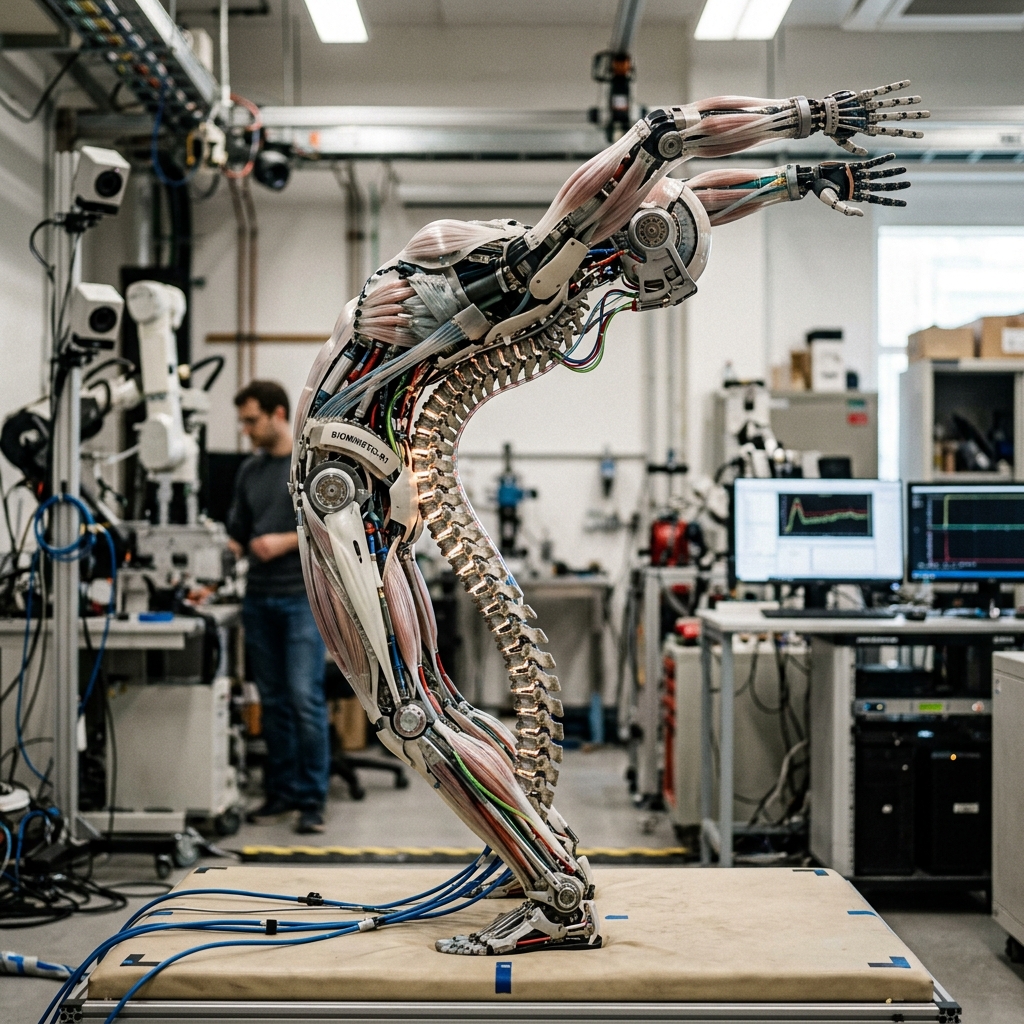
Beyond the Uncanny Valley: Meet Moya, the World’s First Fully Biomimetic AI Robot
Forget the clinking of gears and the jerky, calculated pivots of industrial machines. The future of robotics just took a sharp turn toward the biological. Developed by the Shanghai Engineering Research Center of Humanoid Robots, Moya is being hailed as the world’s first fully "biomimetic" embodied intelligent robot—a machine built to move, bend, and react like a living organism.
A Skeletal Revolution: Bone and Muscle over Gears
While famous robots like Boston Dynamics’ Atlas rely on powerful hydraulic systems and rigid metal frames, Moya utilizes a design philosophy that mirrors human anatomy. Instead of traditional mechanical joints, the robot features:
- Pneumatic Artificial Muscles: These actuators contract and expand via air pressure, creating a fluid "push-pull" motion that replaces the stutter of electric motors.
- A Flexible Spine: Moya’s torso can twist and lean, distributing weight across its structure just as a human does when reaching for a high shelf.
- Composite Bone Geometry: The skeletal frame uses lightweight materials shaped to mimic human bone structures, providing natural attachment points for its "muscles."
The result is a robot that doesn't just move; it flexes. In demonstrations, Moya exhibits organic compensation patterns—shifting its shoulders and rotating its torso in a single, fluid sequence that is almost indistinguishable from a human stretch.
Why "Soft" is Better: The Power of Adaptability
Moya isn't just a feat of aesthetics; it's a solution to a long-standing problem in robotics: rigidity. While stiff robots dominate predictable factory floors, they often fail in the "messy" real world.
"A flexible spine and muscle-like actuators allow the robot to absorb shocks, adapt to irregular surfaces, and manipulate fragile objects without crushing them."
By using variable tension, Moya can "feel" its way into a grip. This makes it a prime candidate for future work in disaster zones, cluttered homes, or construction sites where the ground is rarely level and the environment is constantly changing.
Embodied Intelligence: A Brain for the Body
Controlling artificial muscles is notoriously difficult because they stretch and deform unevenly. To manage this, Moya utilizes an Embodied Intelligence Framework.
Rather than simply following a set of coordinates, the robot’s software is "aware" of its physical properties. It continuously models how its muscles will behave under different loads, allowing for real-time adjustments to posture and force. This tight coupling of software and hardware is what prevents the mechanical "stops" seen in traditional robotics, resulting in a slow, deliberate, and hauntingly lifelike grace.
The Path Forward
While Moya is currently a prototype, it represents a proof of concept for a new era of robotics. The Shanghai team is now focused on solving the "power gap"—pneumatic muscles currently lack the raw lifting strength of their hydraulic cousins.
Future iterations may see a hybrid approach, blending small, high-power motors for heavy lifting with the flexible muscle systems for fine manipulation. For now, Moya stands as a startling reminder that the line between "machine" and "organism" is becoming increasingly blurred.