Manus AI's $2B Meta Deal Has a Beijing Problem — and the Founders Can't Leave
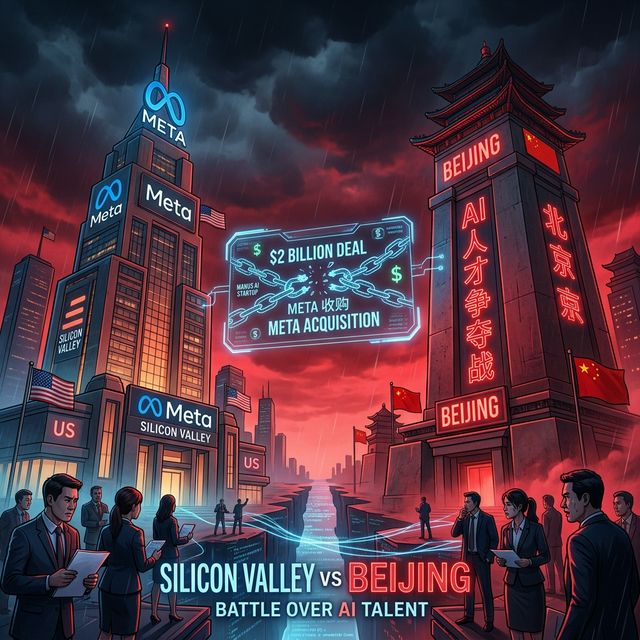
BEIJING / SINGAPORE — It was a bold play: relocate from Beijing to Singapore, restructure your cap table, sell to Meta for $2 billion, and pledge to shut down your China operations entirely. Manus AI thought it had successfully escaped Beijing's orbit. It had not.
The least surprising chapter of Manus's story is now playing out in real time. According to the Financial Times, the startup's co-founders — Xiao Hong and Ji Yichao — were summoned this month to a meeting with China's National Development and Reform Commission and were told they would not be leaving the country for the foreseeable future.
No formal charges have been filed. Beijing is calling it a routine regulatory review. Nobody in the industry believes that.
The Rise: From Demo Video to $2 Billion
Manus burst onto the global AI scene in spring 2025 with a viral demo video showing an AI agent autonomously screening job candidates, planning vacations, and analysing stock portfolios. The company cheekily claimed it outperformed OpenAI's Deep Research — and the world paid attention.
Within weeks, Benchmark — the consummate Silicon Valley venture firm behind Uber, Snap, and Twitter — led a $75 million funding round at a $500 million valuation. It was an eyebrow-raising investment in a Chinese AI company, and it immediately drew scrutiny in Washington.
"Who thinks it is a good idea for American investors to subsidise our biggest adversary in AI, only to have the CCP use that technology to challenge us economically and militarily? Not me." — Senator John Cornyn, at the time of funding
By December 2025, Manus had millions of users and was generating over $100 million in annual recurring revenue. Then Meta came calling.
The Singapore Manoeuvre
Manus spent the better part of 2025 engineering a corporate escape from China's jurisdiction. The company relocated its headquarters and core team from Beijing to Singapore, restructured its ownership, and stripped out its Chinese investor base following the Meta acquisition announcement.
Meta pledged to cut all ties with Manus's Chinese investors and shut down its China operations entirely. By every formal measure, Manus was making itself a Singapore company — and therefore a legitimate American acquisition target.
This is what the Chinese government has a phrase for: "selling young crops" — promising homegrown AI companies that exit to foreign buyers before they've matured, taking their intellectual property and talent with them.
Beijing's Playbook: Subtle Is Not One of Their Traits
China has repeatedly demonstrated that no company operates fully outside its reach, regardless of where it is legally incorporated. The Jack Ma example — a 2020 public speech mildly criticising regulators, followed by months of disappearance, a killed IPO, and a $2.8 billion fine — established the template.
Manus' founders appear to be encountering that same playbook now. The "inquiry" into whether the Meta deal violated Beijing's foreign investment rules is the mechanism. The message is the point.
What This Means for the Global AI Race
For investors, founders, and enterprise buyers in the MENA region evaluating Chinese AI companies and their products, the Manus story contains several practical lessons.
- IP provenance matters. AI models and platforms originally developed in China carry regulatory risk that does not disappear with a Singapore office address.
- Key-person risk is real. If the founders or lead engineers of an AI company cannot leave their home country, enterprise continuity is compromised.
- The US-China AI decoupling is accelerating. The political window for cross-border AI deals is narrowing rapidly, which creates opportunities for neutral hubs — potentially including the UAE — to play intermediary roles.
The UAE and Saudi Arabia have both cultivated relationships with major AI players on both sides of the US-China divide. The Manus case will test whether that neutrality holds as the AI arms race escalates.
At some point, Manus' team probably thought they'd gotten away with it. The $2 billion deal, the Singapore headquarters, the clean cap table — it all looked airtight. But in the highest-stakes technology competition in human history, Beijing is not watching from the sidelines. Now it wants answers. And Manus's founders are apparently not going anywhere until it gets them.