From folding boxes to fixing vacuums, GEN-1 robotics model hits 99% reliability
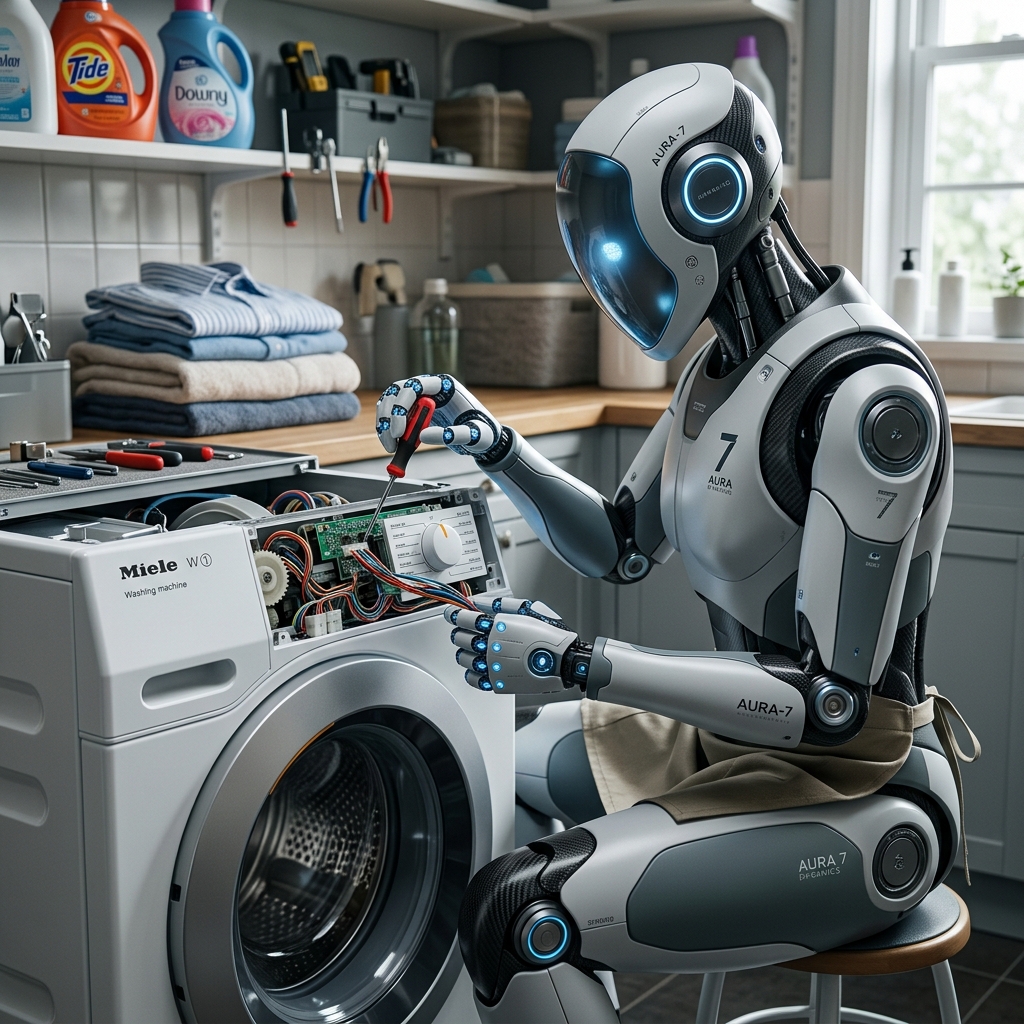
From Lab to Living Room: GEN-1 Robotics Model Achieves 99% Reliability
The dream of a truly autonomous household robot—one that can fold laundry as effortlessly as it fixes a vacuum—just moved significantly closer to reality. Robotic machine learning firm Generalist has unveiled GEN-1, a breakthrough physical AI system that achieves "production-level success" across a staggering array of manual tasks.
By bridging the gap between rigid programming and human-like improvisation, GEN-1 marks what the company calls a "GPT-3 moment" for the world of robotics.
Overcoming the "Data Desert" of Robotics
While Large Language Models (LLMs) like ChatGPT were built by scraping trillions of words from the internet, robotics has long suffered from a lack of quality data. You cannot simply "download" the muscle memory required to handle a delicate plastic bag or thread a washer.
To solve this, Generalist utilized "Data Hands"—wearable pincers that record the micro-movements and visual cues of human workers.
- The Scale: Over 500,000 hours of physical interaction data.
- The Result: A library of "petabytes" of movement that allows the AI to understand the nuances of touch and physics.
The 99% Success Rate: Speed and Precision
The leap from the company’s previous proof-of-concept (GEN-0) to GEN-1 is substantial. The new model operates at three times the speed and has achieved a 99% reliability rate in complex tasks including:
- Mechanical Servicing: Repairing and maintaining robot vacuums.
- Precision Logistics: Packing smartphones and folding boxes.
- Delicate Handling: Placing coins into the narrow slots of a wallet.
Remarkably, the system requires only about one hour of "embodiment training" to adapt its massive pre-trained brain to a specific robot's physical frame.
The Power of Improvisation: "Mistakes Happen for Free"
Perhaps the most impressive feat of GEN-1 is its ability to recover from the unexpected. Traditional robots often freeze when an object is moved or a task goes wrong. GEN-1, however, can improvise.
“Nobody has programmed the robot to make mistakes, therefore nobody has programmed the robot to recover from mistakes,” explains Generalist engineer Felix Wang. “And that just happens for free.”
In testing, the model has demonstrated uncanny, unprogrammed behaviors:
- The "Shimmy": Shaking a plastic bag to help a plush toy slide inside.
- Self-Correction: Automatically refolding a shirt if it is nudged out of position mid-task.
- Regrasping: Adjusting its grip on tiny hardware when pieces are bumped off course.
The Competitive Landscape: Is the "Optimus" Era Over?
Generalist’s announcement comes at a time of intense competition—and some skepticism—in the robotics field.
- Google: Continues to advance its Gemini Robotics models, focusing on human-robot communication.
- Physical Intelligence: Making strides with mobile platforms that can clean spills and make beds.
- Tesla: While Elon Musk’s Optimus humanoid garnered headlines, the project faced criticism after 2024 demos were revealed to be teleoperated by humans. Musk recently admitted the bots are not yet doing "useful work."
The Future: An Economically Useful Robot
Generalist believes GEN-1 has hit an inflection point. By moving beyond "staged" successes to 99% reliability, these models are ready for deployment in economically useful settings, such as factories and warehouses.
For the average consumer, this breakthrough signals a shift in the timeline for domestic help. If a robot can now learn to master complex, flexible tasks in just an hour, the long-promised "laundry-folding robot" may finally be leaving the realm of science fiction and entering the assembly line.