Online Bot Traffic Will Exceed Human Traffic by 2027, Cloudflare CEO Says
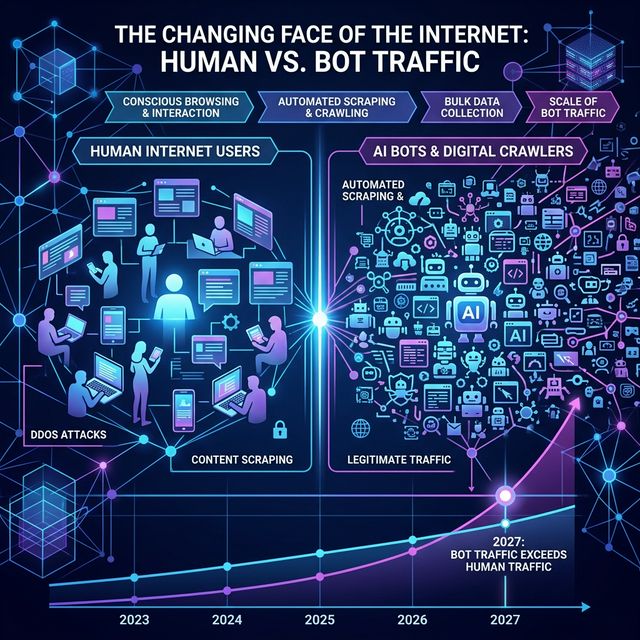
The internet is undergoing a structural shift that most businesses have not yet priced into their digital strategy. By 2027, artificial intelligence bots will generate more traffic on the web than human users — a prediction from Cloudflare CEO Matthew Prince that should reshape how MENA companies think about their online presence and infrastructure.
Speaking at the SXSW conference in Austin, Cloudflare's Matthew Prince made a striking observation about the trajectory of internet traffic. The company, whose infrastructure is used by roughly one-fifth of all websites globally, has a uniquely positioned view of how traffic patterns are evolving — and what Prince described is a tipping point that is moving faster than most organisations realise.
"If a human were doing a task — let's say you were shopping for a digital camera — and you might go to five websites. Your agent or the bot that's doing that will often go to 1,000 times the number of sites that an actual human would visit," Prince said. "So it might go to 5,000 sites. And that's real traffic, and that's real load, which everyone is having to deal with and take into account."
From 20% Bots to Bot Majority: The Generative AI Effect
Before the generative AI era, internet traffic was approximately 80% human and 20% bot — with the largest bot being Google's search crawler, followed by legitimate web archiving and monitoring tools, and then a smaller share of malicious scrapers and bad actors. That equilibrium is now breaking down rapidly.
The core mechanic driving this is how AI models source their information. When a user asks ChatGPT, Perplexity, or any AI search product a question, the underlying system may dispatch agents to dozens, hundreds, or thousands of web pages to gather context before synthesising an answer. Each of those visits is a real HTTP request to a real server. Multiply this by hundreds of millions of daily AI queries, and the resulting traffic load is extraordinary.
Prince's projection — that bot traffic will exceed human traffic by 2027 — maps onto the compound growth curves of generative AI adoption. Unlike the COVID-era traffic spike, which plateau'd within months, this is a structural, not cyclical, shift. "We're seeing internet traffic grow and grow and grow, and we don't see anything that's going to slow it down or stop it," he added.
The Infrastructure Implications: Sandboxes for AI Agents
Prince outlined a future where the underlying web infrastructure would need to evolve fundamentally to accommodate AI agents. He described the concept of ephemeral "sandboxes" — isolated computing environments that can be spun up instantly for an AI agent to complete a task, then torn down when finished.
"What we're trying to think about is, how do we actually build that underlying infrastructure where you can — as easily as you open a new tab in your browser — you can actually spin up new code, which can then run and service the agents that are out there," he said. At scale, he envisions millions of these sandboxes being created every second globally.
This architecture has direct parallels to what cloud providers already do with serverless computing, but at a granularity and volume that would dwarf current usage patterns. The technical challenge is not merely processing power — it is the latency, identity, and security layers needed to make ephemeral agent environments trustworthy and manageable.
What MENA Businesses Must Know
The implications for MENA digital businesses are layered and urgent. First, content visibility is no longer solely about human SEO. If AI bots are visiting and indexing sites to answer user queries, the structure, schema, and content depth of a website becomes as important for AI readability as it has been for search engine optimisation. This is the emerging discipline of Generative Engine Optimization (GEO) — and the Cloudflare data suggests the window to get ahead of it is narrow.
Second, server infrastructure and CDN strategy must account for bot traffic at scale. UAE-based businesses relying on shared hosting or underpowered infrastructure may find their sites degrading under the combined load of human users and AI crawlers — affecting user experience and potentially causing crawl budget exhaustion that harms discoverability.
Third, the data about your business that exists online will be ingested by AI systems, whether you consent or not. Cloudflare already offers tools for businesses to block specific AI bot traffic they do not want. The question for MENA businesses is not whether to engage with this reality, but how to manage it strategically — deciding which AI systems they want to train on their content and on what commercial terms.
GCC Relevance
The Gulf's digital economy — built around e-commerce, financial services, and government portals — will be on the front lines of this bot traffic surge. UAE businesses optimising for AI discoverability now sit ahead of most global peers. Saudi Arabia's Vision 2030 push to digitise government services creates a unique exposure: AI agents querying government portals for information could generate traffic volumes that existing infrastructure was never designed to handle. For digital infrastructure investors, the Cloudflare thesis points squarely toward data centre capacity, edge computing buildout, and cloud-native CDN services as structural growth plays in the MENA region through 2030.
Sources: TechCrunch / SXSW 2026 — Matthew Prince interview — March 2026