Anthropic Economic Index report: Learning curves

The Anthropic Economic Index uses privacy-preserving data analysis to track how Claude is being used across the economy. It’s part of an effort to understand the economic impacts of AI as early as possible, so that business leaders and policymakers have adequate time to prepare.
What has changed since the last report
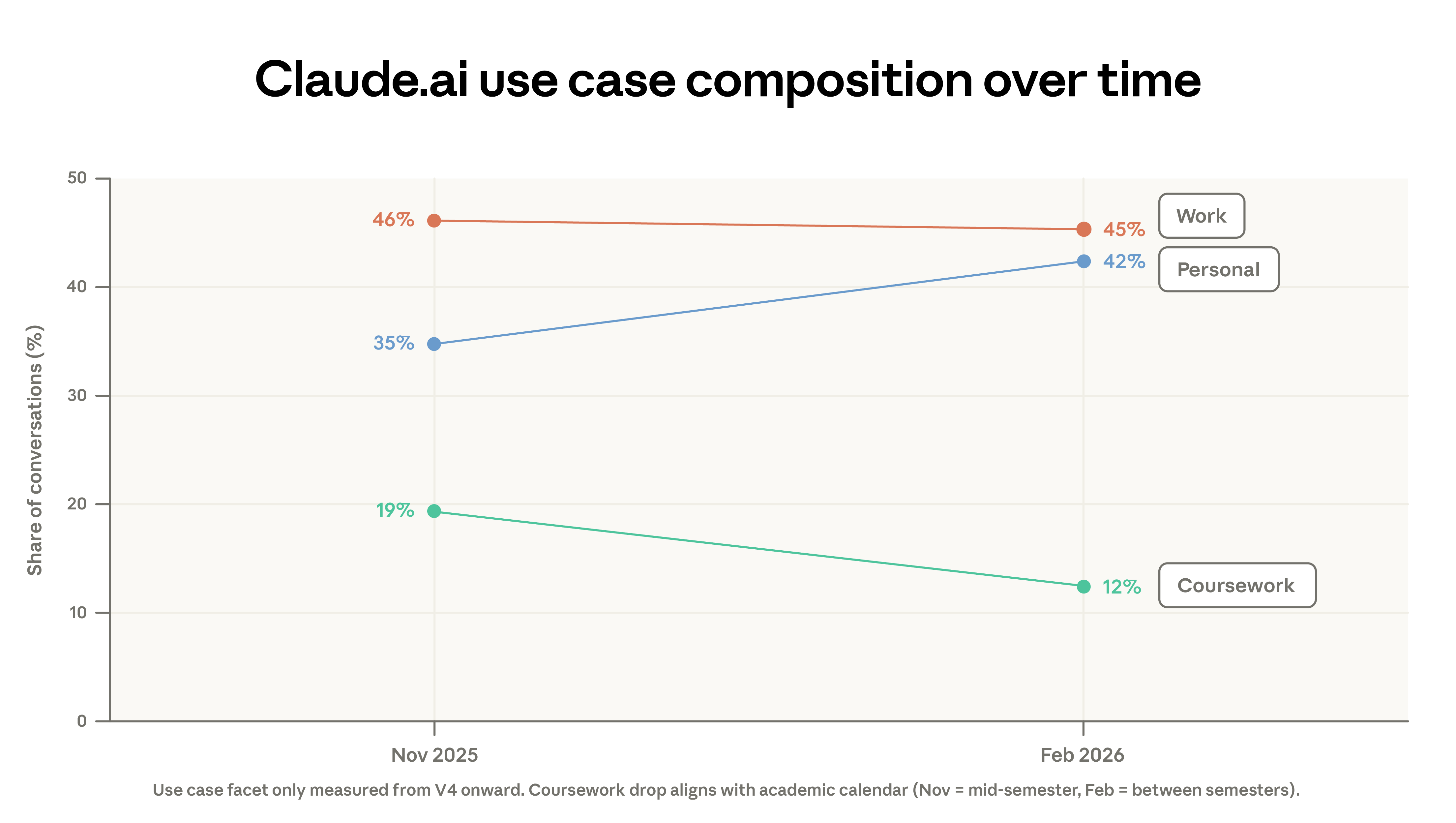
Diversification of use cases in Claude.ai
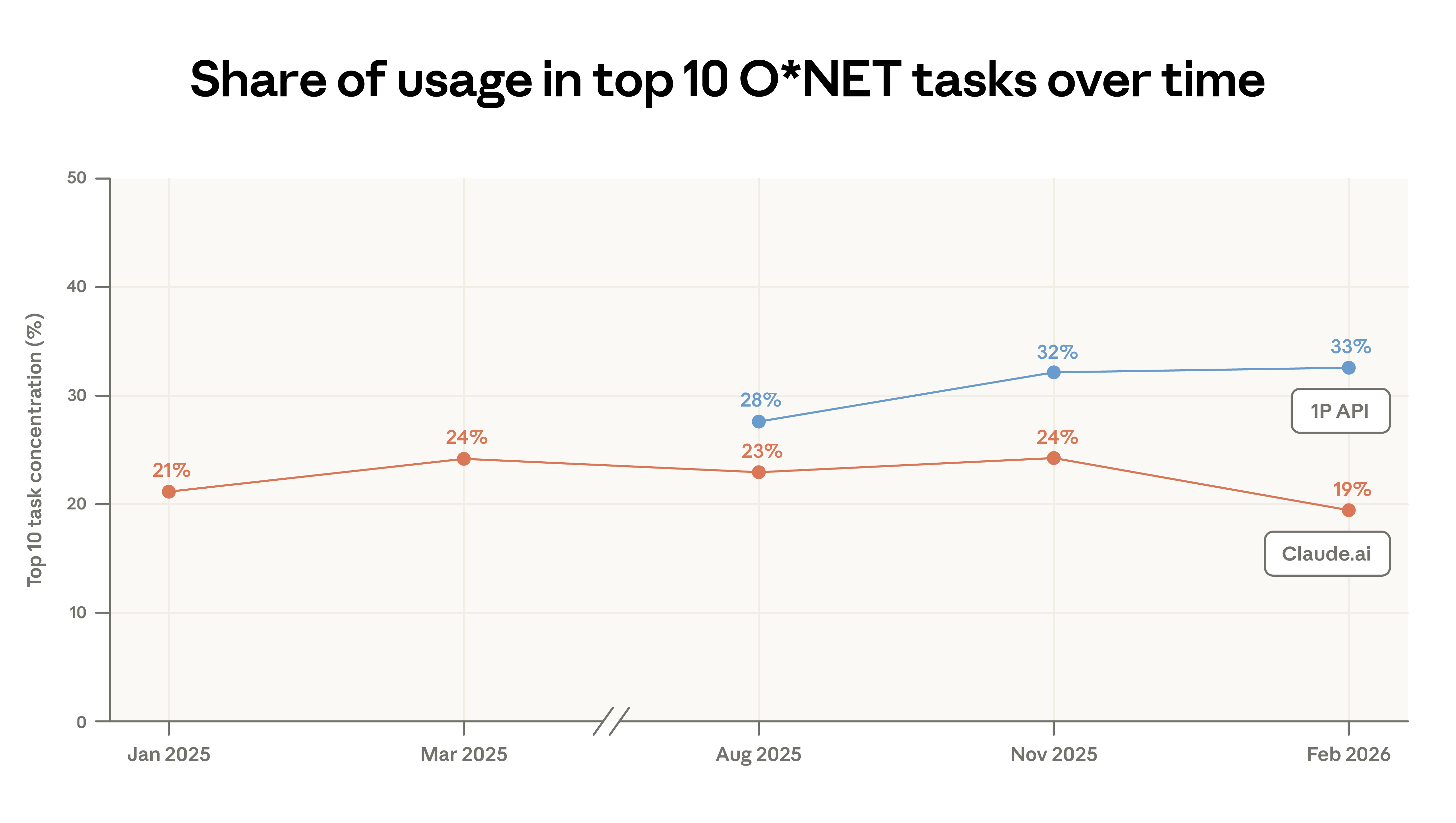
Coding tasks continue to migrate from augmentative usage in Claude.ai to more automated workflows via the API. In this report, Claude.ai usage was less concentrated: the top 10 tasks made up 19% of all traffic in February, down from 24% in November 2025.
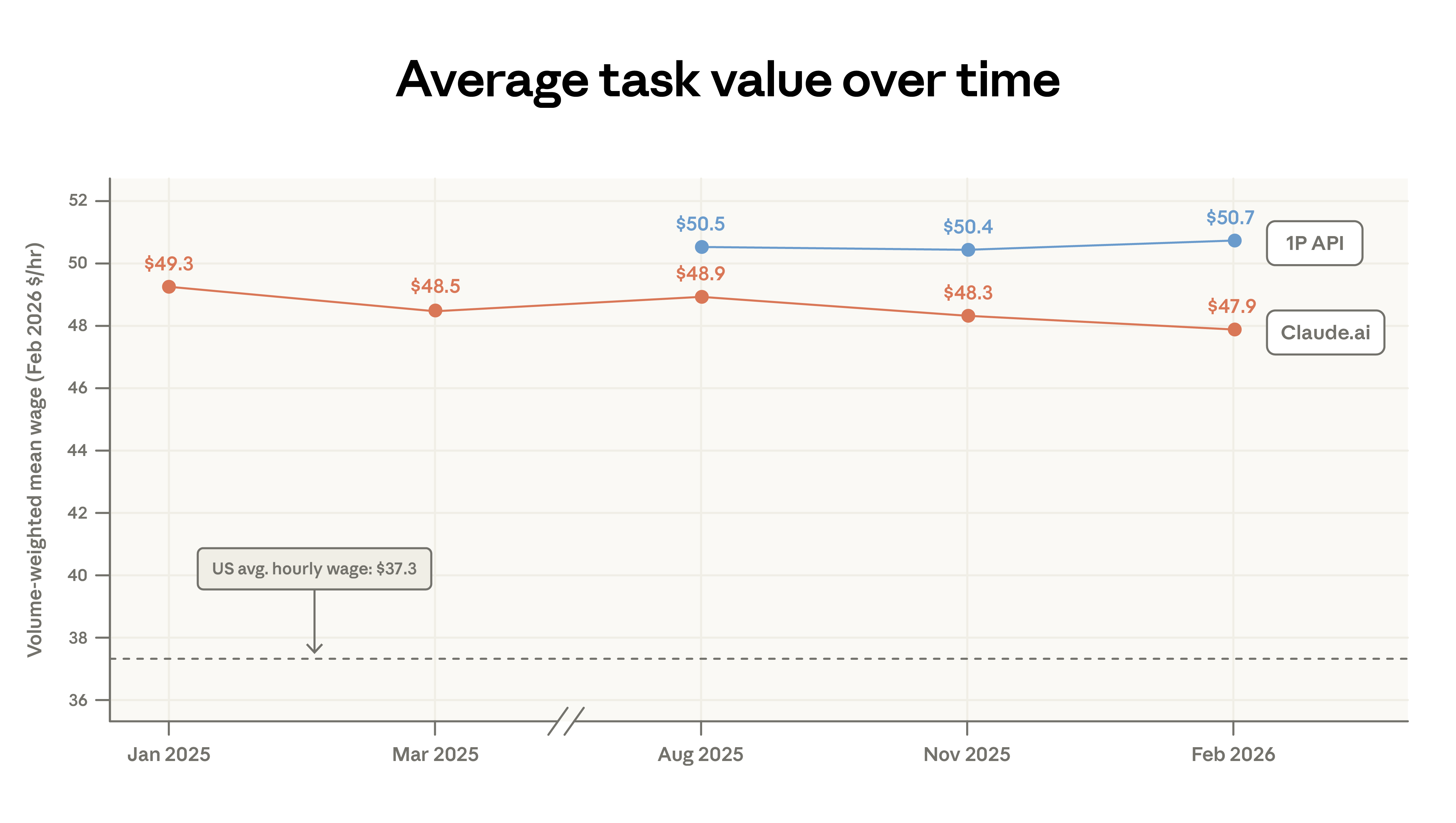
Claude adoption broadened to lower-wage tasks
As use cases have diversified, the average economic value of work done on Claude—as measured by US wages paid to workers in the associated occupations—has decreased slightly. This indicates a standard "adoption curve," where early adopters favor high-value uses like coding, while later adopters explore a wider range of personal and everyday tasks.
Learning Curves: High Tenure, Higher Success
A central finding is that effective AI use requires complementary skills acquired through use and experimentation. Experienced users (over 6 months of tenure) have better learned to extract value from AI. They have a 10% higher success rate in their conversations, an association not explained by task selection alone.
Higher-tenure users are more likely to use Claude to iterate on their work, and much less likely to delegate greater responsibility through simple directive use patterns. They use Claude for work more frequently, tackling tasks that require higher levels of education.
Model selection reflects task value
Users actively calibrate model choice to task complexity. The most capable model class, Opus, is heavily selected for tasks associated with higher-paid jobs (such as Computer and Mathematical domains) and programmatic API workflows, while faster models are used for everyday queries.
The MENA Verdict
This report underscores a critical insight for the MENA region's rapid AI evolution: the "skill gap" is compounding, not closing. As nations like the UAE and Saudi Arabia inject billions into sovereign AI infrastructure and enterprise adoption, realizing true ROI hinges on cultivating a workforce of "high-tenure" users.
The data from Anthropic highlights that users who consistently experiment over months handle more complex workflows, collaborate more effectively, and achieve significantly higher success rates. For GCC enterprises, this presents a clear mandate: simply buying seat licenses is insufficient. Organizations must actively foster systemic, long-term AI training to transform their teams into the sophisticated "power users" who will ultimately dictate the region's economic competitiveness.