AI Digital Twins Could Halve Nuclear Build Times and Cut Operating Costs by 50%
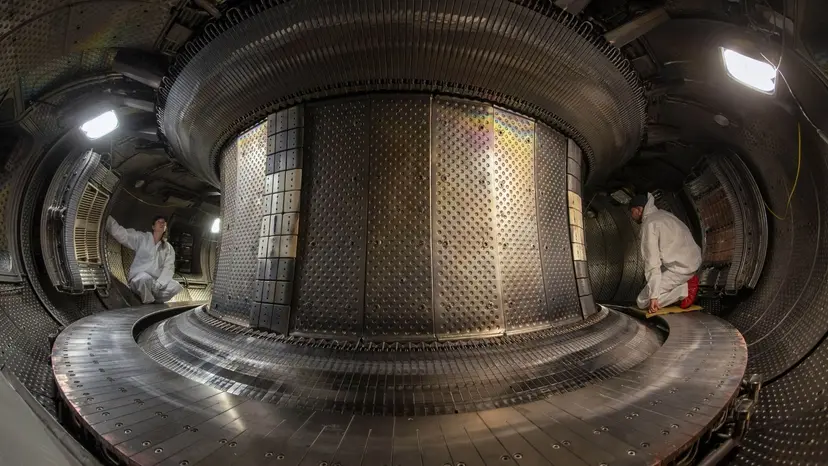
AI and nuclear power are converging in a partnership that could reshape how the world builds reactors — and the implications for the UAE and the broader Middle East are enormous.
The Idaho National Laboratory (INL) and NVIDIA have announced a landmark collaboration to use artificial intelligence — including generative AI models, digital twins, and agent-based workflows — to accelerate advanced nuclear reactor deployment across the United States. The goal: cut reactor development timelines in half and reduce operational costs by more than 50 percent.
For the Middle East and North Africa (MENA) region — where the UAE already operates the Arab world's first nuclear power plant and Saudi Arabia is actively pursuing its own programme — this partnership signals a paradigm shift in how nuclear energy could be delivered globally.
What Is Project Prometheus?
The collaboration falls under the US Department of Energy's Genesis Mission, a national computing initiative focused on accelerating scientific discovery and energy innovation. Within this mission, the nuclear energy effort is codenamed Prometheus.
Prometheus will leverage AI to automate and optimise every stage of the nuclear lifecycle — from design and licensing to manufacturing, construction, and operations. The approach embeds human-in-the-loop workflows while automating engineering-heavy processes that have traditionally taken years to complete.
"This partnership represents a transformative approach to one of our nation's greatest challenges for deploying abundant, reliable nuclear energy at the speed and scale required for our AI-driven future," said John Wagner, INL director.
How AI Digital Twins Reshape Reactor Timelines
At the heart of the initiative is the use of AI-powered digital twins — comprehensive virtual replicas of nuclear reactor systems. These digital models are trained using decades of legacy nuclear data, laboratory experiments, and real-world reactor operations at INL.
By simulating and validating reactor systems in a digital environment before any physical construction begins, engineers can identify design flaws, stress-test safety scenarios, and compress years of iterative prototyping into weeks.
Key Technologies Involved
- Generative AI models trained on decades of nuclear research data
- Digital twins for virtual reactor simulation and validation
- Agent-based AI workflows with human-in-the-loop governance
- GPU-accelerated nuclear simulation codes (MOOSE, BISON, Griffin, Pronghorn) running on NVIDIA architectures
- DOE leadership-class supercomputers for large-scale model training
NVIDIA will contribute its AI infrastructure and GPU-accelerated computing platforms. "Combining INL's decades of nuclear expertise with NVIDIA AI infrastructure will put AI to work to design, license, and operate reactors faster, safer, and at lower cost," said John Josephakis, NVIDIA's global Vice President of Sales for HPC/Supercomputing.
The Self-Reinforcing Loop: AI Powers Nuclear, Nuclear Powers AI
Perhaps the most strategic insight from this partnership is the symbiotic relationship between AI and nuclear energy. AI infrastructure — particularly the massive data centres required for training frontier models — demands enormous, reliable, carbon-free electricity. Nuclear power delivers exactly that.
The INL-NVIDIA partnership envisions a self-reinforcing cycle: AI-designed nuclear plants powering the AI data centres that designed them. As global electricity demand driven by AI infrastructure surges, nuclear energy becomes not just a climate solution but an AI-enabling technology.
Why the UAE and Middle East Should Pay Close Attention
The implications for the Gulf region are significant. The UAE's nuclear energy programme — anchored by the Barakah Nuclear Energy Plant in Al Dhafra, Abu Dhabi — is already the most advanced in the Arab world. All four units are now operational, generating approximately 25% of Abu Dhabi's electricity demand with zero carbon emissions.
Middle East Nuclear Energy Landscape
- UAE (Barakah): 4 operational APR1400 reactors, 5.6 GW total capacity — the Arab world's first nuclear power plant
- Saudi Arabia: Planning 17 GW of nuclear capacity under Vision 2030 with KACARE leading procurement
- Egypt (El Dabaa): 4 VVER-1200 reactors under construction with Rosatom, first unit expected 2028
- Turkey (Akkuyu): Russia-built nuclear plant with first unit approaching completion
- Jordan: Small modular reactor (SMR) feasibility studies underway
If AI-accelerated nuclear deployment can genuinely halve construction timelines and slash costs by 50%, the business case for expanding nuclear capacity across the Gulf and wider MENA region transforms dramatically. Saudi Arabia's ambitious nuclear programme, currently in the procurement phase, could benefit enormously from AI-optimised reactor design and digital twin validation — potentially compressing a decade-long timeline into five years.
For the UAE, which has already demonstrated its ability to deliver complex nuclear projects, AI-enabled optimisation could reduce the cost of future reactors and position the nation as a knowledge hub for AI-augmented nuclear engineering — a natural extension of its broader AI strategy.
Supercomputers Meet Nuclear Codes
The initiative will rely on DOE leadership-class supercomputers for large-scale AI model training and reactor simulations. INL's facilities — including the Neutron Radiography Reactor and the Microreactor Applications Research Validation and Evaluation (MARVEL) project — will provide real-world validation data for the digital twin models. MARVEL, though not yet operational, is designed to provide experimental validation at microreactor scale.
The nuclear simulation codes being accelerated on NVIDIA GPU architectures — MOOSE, BISON, Griffin, and Pronghorn — are open-source platforms developed at INL. Porting these to GPU-accelerated hardware could reduce computation times from days to hours, enabling rapid design iteration.
Regulatory and Industry Impact
Beyond construction speed, officials say the broader objective is to support regulatory modernization and industry adoption of AI-driven nuclear tools. The programme could expand to include reactor developers, utilities, investors, and additional national laboratories.
"This public-private partnership presents a targeted approach to AI-acceleration that goes beyond incremental improvements. It has the potential to transform the paradigm for how we deploy nuclear energy," said Rian Bahran, Deputy Assistant Secretary of Energy for Nuclear Reactors.
For Middle East regulators — including the UAE's Federal Authority for Nuclear Regulation (FANR) and Saudi Arabia's Nuclear and Radiological Regulatory Commission (NRRC) — the emergence of AI-validated reactor designs will demand new frameworks for assessing digitally engineered safety cases.
The Verdict: A Watershed Moment for Nuclear + AI
The INL-NVIDIA partnership is not an incremental improvement — it's a potential paradigm shift. If AI can compress nuclear development cycles the way it has compressed drug discovery and materials science workflows, the global energy landscape transforms.
For the UAE and the wider Gulf region, this development arrives at a critical juncture. With AI data centre demand surging, nuclear energy offers the only scalable, carbon-free baseload power capable of sustaining these workloads. AI-accelerated nuclear deployment could make the next wave of Middle East reactors faster, cheaper, and safer.
The question is no longer whether AI will reshape nuclear energy — but how quickly the Middle East will adopt these tools to secure its energy future.
Key Takeaways
- INL and NVIDIA partner to use AI digital twins to halve nuclear reactor build times and cut costs 50%
- Project Prometheus uses generative AI, digital twins, and GPU-accelerated simulation across the nuclear lifecycle
- A self-reinforcing AI-nuclear loop emerges: AI designs reactors, reactors power AI data centres
- The UAE (Barakah) and Saudi Arabia (Vision 2030) could benefit significantly from AI-optimised nuclear deployment
- Middle East regulators face new challenges in assessing AI-validated reactor safety cases
Frequently Asked Questions
How can AI digital twins reduce nuclear reactor build times?
AI digital twins simulate and validate reactor systems virtually before physical construction begins. By training generative AI models on decades of nuclear data and using GPU-accelerated computing, engineers can test designs, predict failures, and optimise manufacturing processes in weeks instead of years.
What is the INL-NVIDIA Prometheus project?
Project Prometheus is a collaboration between Idaho National Laboratory and NVIDIA under the US Department of Energy's Genesis Mission. It aims to use AI tools — including digital twins, generative models, and agent-based workflows — to design, license, manufacture, construct, and operate nuclear reactors at double the current deployment speed.
Why does this matter for the UAE and Middle East?
The UAE already operates the Arab world's first nuclear power plant (Barakah) and Saudi Arabia is planning its own programme under Vision 2030. AI-accelerated nuclear deployment could dramatically reduce timelines and costs for future reactors in the region, supporting both energy diversification and the massive power demands of emerging AI data centres across the Gulf.
What is the relationship between AI and nuclear energy?
AI requires enormous computing power, which needs reliable, carbon-free energy. Nuclear power provides this baseload capacity. In turn, AI can accelerate nuclear deployment through digital twins and simulation. The INL-NVIDIA partnership envisions a self-reinforcing cycle where AI-designed nuclear plants power the AI data centres that designed them.
Source: Interesting Engineering | Idaho National Laboratory | NVIDIA