AI for Education and EdTech in the GCC: What Every Enterprise and Institutional Leader Needs to Know
Saudi Arabia introduced a mandatory AI curriculum for over 6 million students in 2025. The UAE became the first country in the world to mandate AI education from kindergarten through Grade 12. The GCC EdTech market will reach USD 6.03 billion by 2035. For enterprise leaders, school operators, and government education authorities across the Gulf, AI in education is not an emerging trend. It is a national mandate and the defining infrastructure investment of the region's next decade.
In this article
- What is AI for education and EdTech and why does it matter for B2B enterprises?
- The GCC education AI landscape in 2026
- The AI services every GCC education and enterprise learning leader needs to know
- Deep dive: what is AI-powered adaptive learning?
- How education AI works from enrolment to outcomes
- Types of AI education services and when to use each
- What does an enterprise education AI platform actually deliver?
- How to evaluate an AI EdTech provider for GCC deployment
What is AI for education and EdTech and why does it matter for B2B enterprises?
AI for education and EdTech is the application of machine learning, adaptive learning algorithms, natural language processing, predictive analytics, and agentic AI to the design, delivery, management, and measurement of learning experiences across every education context: K-12 schools, higher education institutions, corporate training programmes, government workforce upskilling initiatives, and the lifelong learning infrastructure that GCC national strategies have placed at the centre of economic transformation.
For GCC B2B enterprises, the education AI landscape matters on two distinct levels that are often treated separately but are strategically inseparable.
The first is the enterprise learning and workforce development level. Every major GCC organisation operating in an environment of rapid technological change, Vision 2030 Saudisation requirements, national AI literacy mandates, and a talent market where AI capability has become a primary hiring and retention variable, is simultaneously a consumer of education technology. Corporate learning management systems, AI-powered skills assessment platforms, personalised professional development programmes, and workforce analytics tools that measure learning outcomes against business performance are the enterprise EdTech investments that determine whether an organisation's human capital keeps pace with the strategic demands placed on it.
The second is the institutional and government level. School operators, university networks, government education ministries, and the private sector partners that serve them are managing the largest education technology transformation in the GCC's history, driven by national mandates that have turned AI literacy from an optional curriculum enrichment into a legal requirement for every public school student in the UAE and Saudi Arabia.
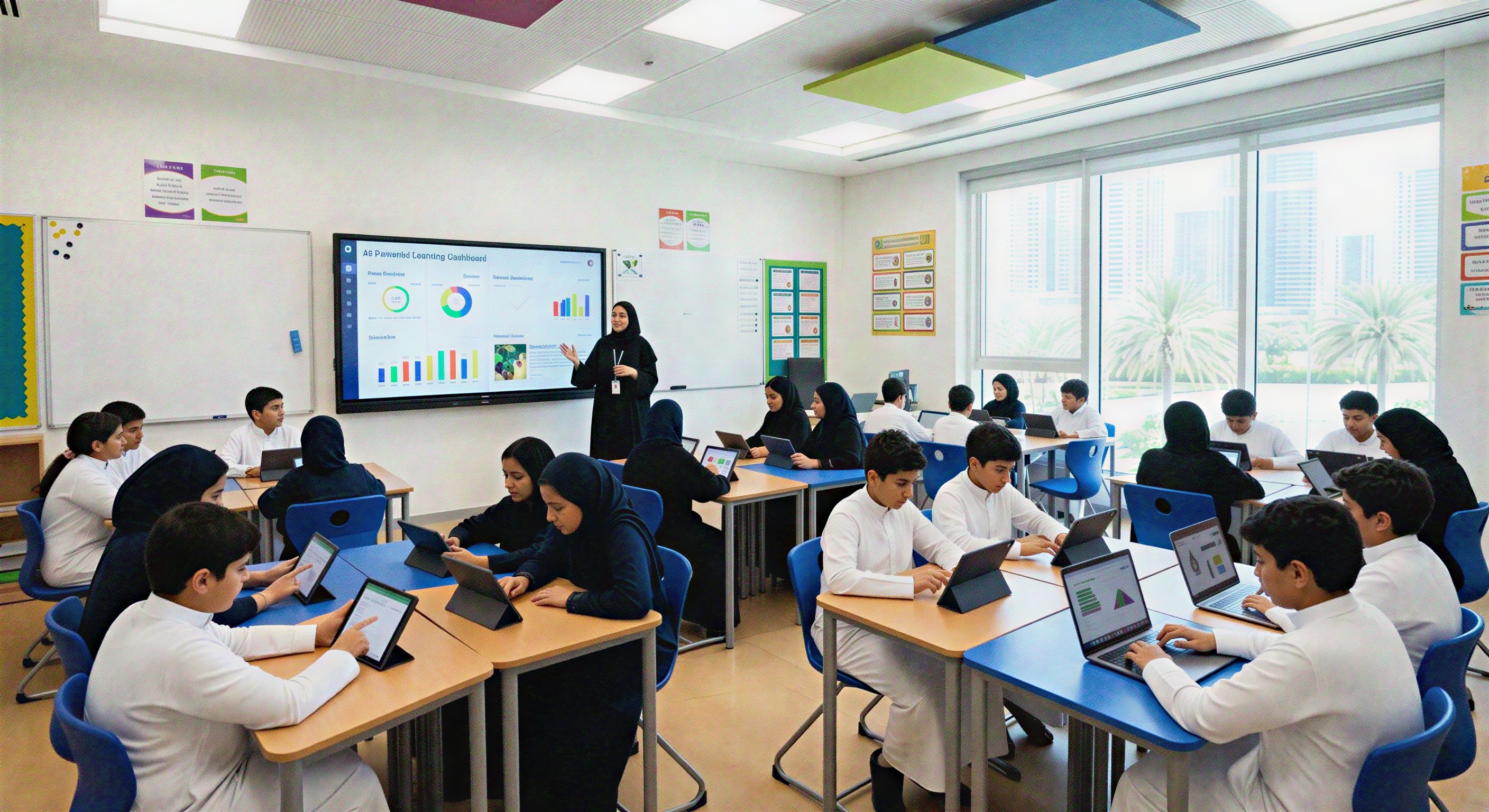
Starting in the 2025 to 2026 academic year, every public school in the UAE will integrate AI lessons into the core curriculum, making the UAE the first country globally to mandate AI education from kindergarten through Grade 12. Saudi Arabia introduced a mandatory AI curriculum for over 6 million students starting in the 2025 to 2026 academic year, making it one of the world's largest deployments of technology education.
For enterprise leaders, the implication is direct. The workforce entering GCC organisations over the next decade will be the first in history to have received structured AI education from their earliest years of schooling. The organisations that build the AI-powered corporate learning infrastructure to develop and retain that talent, and the technology partners that serve educational institutions navigating the national AI curriculum transformation, are operating in the most consequential education technology market the region has ever seen.
Info
USD 3.07 billion: GCC EdTech market size in 2026, projected to reach USD 6.03 billion by 2035
Info
6 million: Saudi Arabian students enrolled in mandatory AI curriculum from 2025 to 2026
Info
USD 52 billion: Saudi Arabia's national education budget allocation in 2024, approximately 16% of total government spending
The GCC education AI landscape in 2026
The GCC EdTech market was valued at USD 2.85 billion in 2025 and is estimated to reach USD 3.07 billion in 2026, projected to grow to approximately USD 6.03 billion by 2035 at a CAGR of 7.8%. These figures represent the conservative estimate. The GCC EdTech market is projected to grow from USD 3.86 billion in 2025 to USD 16.3 billion by 2035, exhibiting a CAGR of 15% during the forecast period. Across every analyst projection, the direction is the same: the GCC EdTech market is in the early stages of a decade-long expansion that government mandates, infrastructure investment, and demographic demand are making structurally inevitable.
Saudi Arabia's declaration of 2026 as the Year of Artificial Intelligence is the culmination of years of deliberate strategy, massive investment, and institutional commitment. The Saudi Arabia AI curriculum 2026 is a national programme co-developed by SDAIA, the Ministry of Education, MCIT, and the National Curriculum Center. It introduces AI literacy, ethics, and applied AI concepts across K-12 public schools, reaching over 6 million students.
The corporate learning dimension amplifies this picture significantly. The global executive education programme market is valued at USD 10.9 billion in 2026 and is projected to reach USD 31.5 billion by 2036, expanding at a robust 11.2% CAGR, as enterprises shift toward outcome-based learning and continuous workforce transformation. For GCC enterprises managing Saudisation compliance requirements, national AI literacy obligations, and the accelerating pace of workforce skill requirements across every sector, corporate AI-powered learning is not a training budget line. It is a strategic workforce management infrastructure.
AI personalisation has boosted course completion rates by 70% and improved exam scores by up to 10% in pilot university programmes. Platforms in 2026 predict a student's risk of dropping out weeks before the student decides to quit, reducing dropout rates by an average of 15% through behavioural analytics.
The enterprise implications compound further when the talent pipeline is considered. 210 or more EdTech startups are launching in Saudi Arabia every year, painting a picture of a market in full acceleration. GCC organisations competing for AI-literate talent in a market where supply remains significantly below demand are not simply consumers of EdTech. They are active participants in building the talent ecosystem that their own future workforce requirements depend on.
"The mandatory AI curriculum in UAE public schools from kindergarten through Grade 12 is not an education policy decision alone. It is a national workforce development strategy. The enterprises that align their talent pipelines with that strategy now are building structural hiring advantages that will compound for the next decade."
The AI services every GCC education and enterprise learning leader needs to know
The AI services landscape for GCC education and enterprise learning can be organised into five pillars, each addressing a different layer of the institutional and corporate learning requirement.
AI-powered adaptive learning platforms apply machine learning to individual learner data, including performance history, learning pace, knowledge gaps, engagement patterns, and assessment results, to continuously personalise the learning experience for each student or employee. Unlike static e-learning content that presents the same material in the same sequence to every learner regardless of what they already know or how they learn best, adaptive learning platforms adjust content difficulty, presentation format, and progression pace in real time, ensuring that every learner is always working at the level that maximises their learning efficiency. For GCC institutions managing large and diverse learner populations across multiple languages and educational backgrounds, adaptive AI learning is the technology that makes personalised education operationally feasible at scale.
AI-powered learning management systems and institutional platforms provide the foundational infrastructure for managing, delivering, and tracking learning programmes across educational institutions and enterprise organisations. Modern AI-powered LMS platforms go significantly beyond content delivery to include predictive analytics that identify at-risk learners before they disengage, automated assessment and feedback systems that provide instant, personalised responses to learner submissions, intelligent scheduling that optimises cohort composition and learning pathway sequencing, and regulatory compliance tracking that ensures institutional programmes meet the SDAIA, Ministry of Education, and NELC alignment requirements that GCC institutions navigate.
AI-driven corporate skills assessment and workforce analytics enables enterprises to continuously assess the AI and digital skill levels of their workforce, map capability gaps against strategic talent requirements, and design targeted learning interventions that address the specific development priorities of each employee cohort. For GCC organisations managing Saudisation compliance, national AI literacy requirements, and the rapid evolution of skill requirements across every function, AI workforce analytics that provide real-time visibility of organisational capability are the foundation of informed talent strategy. Without this visibility, learning investment is allocated against assumptions rather than data.
Conversational AI tutoring and Arabic-language learning support deploys AI-powered tutoring systems that can engage learners in natural conversation, answer subject-matter questions, explain concepts, provide worked examples, and guide learners through complex material in Arabic and English around the clock. For GCC institutions serving large Arabic-speaking learner populations, AI tutoring that performs accurately in Arabic, understands the specific Arabic educational terminology and curriculum structures of Saudi and UAE school systems, and engages with learners in the natural register of Gulf Arabic, delivers a learning support capability that is not constrained by teacher availability or tutoring affordability. The learner in Riyadh who can access an AI tutor that explains a calculus concept in Arabic at 11pm has access to a quality of support that was not available to any previous generation.
AI-powered content creation and curriculum development applies generative AI to the production of educational content, including adaptive assessments, interactive exercises, curriculum-aligned learning materials, and Arabic-language instructional content at a scale and speed that human content development teams cannot match. For GCC educational institutions managing the transition to AI-integrated curricula across thousands of classrooms, and for corporate learning teams building AI-powered training programmes across large organisations, AI content creation tools that can generate, localise, and adapt learning materials for specific curriculum requirements, cultural contexts, and accessibility needs compress development timelines from months to days.
Deep dive: what is AI-powered adaptive learning?
AI-powered adaptive learning is the application of machine learning to the continuous personalisation of the learning experience, creating a system that responds to every learner as an individual rather than delivering the same content in the same sequence to everyone.
Understanding what makes adaptive AI learning genuinely transformative in a GCC enterprise and institutional context requires examining three capabilities that define the current frontier.
Dynamic learner modelling is the foundational capability. An adaptive learning platform builds a continuously updated model of each learner, capturing what they know and do not know, how quickly they learn different types of content, which presentation formats they engage with most effectively, when they are most likely to disengage, and what the specific knowledge gaps are that are most likely to impede their progress. This learner model is not static. It updates with every interaction, every assessment response, every engagement signal, and every outcome, creating an increasingly accurate representation of the individual learner that the platform uses to optimise every subsequent learning decision.
For GCC institutions managing learner populations with highly diverse educational backgrounds, languages, and prior knowledge levels, dynamic learner modelling solves a structural challenge that uniform curriculum delivery cannot address: how to teach 30 students in the same classroom when their actual knowledge levels span three grade levels. Adaptive AI does not average the class. It teaches each student.
Predictive learning analytics is the capability that moves AI education from reactive to proactive. Traditional educational analytics identify that a student has failed an assessment after the fact. Predictive analytics identify the behavioural and performance signals that predict failure weeks before it occurs, giving educators the lead time to intervene before a student disengages, falls behind, or drops out.
Platforms in 2026 predict a student's risk of dropping out weeks before the student decides to quit, by analysing behavioural patterns including response latency and login consistency, reducing dropout rates by an average of 15%. For GCC enterprises managing corporate learning programmes where completion rates are a direct measure of training investment return, and for educational institutions where retention metrics are tied to funding and accreditation, this predictive capability changes the economics of learning outcomes fundamentally.
Arabic-first adaptive intelligence is the capability that distinguishes AI education platforms built for the GCC from those adapted to it. The Arabic language presents specific challenges for educational AI that affect every layer of the learning stack. Assessment systems must be capable of evaluating Arabic written responses with the morphological complexity that Arabic grammar requires. Content delivery systems must handle the right-to-left text rendering, Tashkeel diacritical marks, and the specific Arabic educational typography conventions of GCC curricula. Conversational tutoring AI must engage in the formal Arabic of academic instruction and the dialectal Arabic of natural learner conversation. Learning analytics platforms must process Arabic-language learner behavioural data without the systematic bias that occurs when Arabic is processed through AI models trained primarily on English.
Platforms that ignore RTL-native UX, Tashkeel-ready content systems, AI-powered learning flows, and Saudi-compliant infrastructure are no longer optional features for EdTech operating in the GCC market. The gap between adaptive learning AI that was built for Arabic-speaking learners and AI that was not is not a nuance. It is a systematic performance difference that affects every learner interaction the platform delivers.
How education AI works from enrolment to outcomes
Understanding how AI-powered education operates in a production GCC institutional or enterprise environment requires following a learner through the complete educational journey the platform supports.
Enrolment, onboarding, and initial assessment is the entry point. AI-powered onboarding systems assess incoming learners against the knowledge and skill baseline relevant to their programme, generating an individual learning profile that establishes the starting point for personalised pathway design. For corporate learning programmes onboarding large employee cohorts, AI initial assessment compresses the diagnostic process from days to minutes, providing the data foundation for personalised learning pathway assignment without the manual assessment overhead that conventional skills mapping requires.
Adaptive pathway design and content delivery is where the learning experience diverges from the uniform curriculum model. Based on the initial learner model, the adaptive platform designs a personalised learning pathway: sequencing content modules in the order that maximises learning efficiency for this specific learner, selecting the content format that aligns with their demonstrated learning preferences, setting the difficulty progression that keeps them in the optimal challenge zone, and scheduling reinforcement activities at the spacing intervals that maximise long-term retention. This pathway is not fixed. It updates continuously as new performance data refines the learner model.
Formative assessment and AI feedback replaces the delayed assessment cycle of conventional education with continuous, real-time evaluation and feedback. AI assessment systems evaluate learner responses at every step of the learning journey, providing immediate, personalised feedback that explains not just whether an answer is correct but why, what the underlying concept is that the error reveals, and what the recommended next step is to address the gap. For GCC learners studying in Arabic, this feedback must be delivered in the language and register of instruction, with the cultural sensitivity that educational feedback in Arabic-speaking contexts requires.
AI tutoring and support access provides the on-demand learning support layer that gives every learner access to assistance whenever they need it, regardless of teacher availability. AI tutors that can explain concepts, answer questions, provide worked examples, and guide learners through difficulties in Arabic and English, available around the clock, at the moment of learning rather than in a scheduled support session, deliver a quality of learning support access that no institution can replicate through human staffing alone. For enterprise corporate learning programmes where employees are learning alongside their work responsibilities, the ability to access AI tutoring support during evening study hours is not a convenience. It is the enabler of effective learning for a workforce that cannot attend daytime classroom sessions.
Learning analytics and outcome measurement closes the loop by translating individual learner activity data into the institutional and enterprise intelligence that leaders need to manage learning programmes strategically. For school operators, AI analytics platforms provide real-time visibility of learner progress against curriculum standards, early warning of at-risk learners across the full population, teacher performance insights that guide professional development investment, and institutional benchmark data that informs curriculum design and resource allocation. For enterprise learning leaders, AI workforce analytics provide the skills coverage map, training completion metrics, and learning ROI data that connect learning investment to business performance outcomes.
Types of AI education services and when to use each
Adaptive learning platforms personalise the learning experience for individual learners based on continuous performance assessment and learner modelling. Essential for any GCC educational institution or corporate learning programme where learner diversity, scale, or the pace of curriculum change makes uniform delivery ineffective. Most impactful in K-12 mathematics and sciences, higher education STEM programmes, and corporate technical skills development where the knowledge hierarchy is well-defined and the personalisation benefit is most directly measurable.
AI-powered LMS and institutional management platforms provide the foundational infrastructure for learning programme management, content delivery, learner tracking, and regulatory compliance across educational institutions and enterprise organisations. Essential for any GCC institution managing learning at scale across multiple programmes, cohorts, and locations. The return on investment is highest where administrative overhead reduction, compliance reporting automation, and learner engagement improvement are the primary performance drivers.
Corporate AI skills assessment and workforce analytics enables enterprises to continuously map organisational AI and digital capability against strategic talent requirements and design targeted learning interventions. Essential for GCC enterprises managing Saudisation compliance, national AI literacy requirements, and the rapid evolution of role-specific skill requirements. Most impactful for large organisations where the visibility gap between existing capability and required capability is the primary barrier to effective talent development investment.
Conversational AI tutoring and Arabic-language support deploys AI tutors that engage learners in natural Arabic and English dialogue, providing on-demand academic support around the clock. Most relevant for GCC educational institutions with large Arabic-speaking learner populations where access to qualified human tutoring is constrained by availability or affordability, and for enterprise learning programmes where employees need support access outside of standard working hours. The learning outcome impact is highest in language learning, mathematics, and technical skills programmes where immediate corrective feedback accelerates mastery.
AI content creation and curriculum development tools applies generative AI to the production of adaptive assessments, interactive learning materials, and Arabic-language curriculum content. Most valuable for GCC educational institutions managing the transition to AI-integrated national curricula, and for enterprise learning teams building AI-powered training programmes at scale. The productivity gain from AI content creation is most significant where content volume requirements exceed the capacity of human development teams to produce and localise manually.
AI-powered assessment and credentialing platforms automates the design, delivery, and evaluation of assessments across educational programmes, providing instant, personalised feedback and generating the credential verification infrastructure that increasingly governs workforce access in GCC regulated sectors. Most relevant for higher education institutions, professional certification bodies, and enterprise organisations where assessment accuracy, anti-fraud capability, and credential portability are operational requirements.
What does an enterprise education AI platform actually deliver?
The output of a well-implemented AI education deployment is measurable across four dimensions that connect learning investment to institutional and enterprise outcomes.
First, it delivers learning outcome improvement that is directly measurable in assessment performance, completion rates, and skill acquisition speed. AI personalisation has boosted course completion rates by 70% and improved exam scores by up to 10% in pilot university programmes. For GCC enterprises where the return on corporate learning investment is measured in skill acquisition speed and knowledge retention, and for educational institutions where learner outcomes determine accreditation status and competitive positioning, these improvements are not marginal. They are the difference between learning programmes that achieve their objectives and those that consume budget without measurable effect.
Second, it delivers the Arabic-first, culturally aligned learning experience that GCC learners engage with at the depth that produces durable knowledge. Learning in one's primary language is not a preference. It is a cognitive reality that determines how deeply new knowledge is encoded and how durably it is retained. For GCC institutions serving predominantly Arabic-speaking learner populations, education AI that was built for Arabic-speaking learners, with the linguistic depth and cultural intelligence that Gulf educational contexts require, delivers learning outcomes that are not achievable through multilingual platforms treating Arabic as a secondary interface.
Third, it delivers regulatory compliance with national AI curriculum mandates and institutional accreditation requirements. For GCC educational institutions navigating the SDAIA and Ministry of Education AI curriculum requirements, the NELC alignment standards for Saudi EdTech platforms, and the UAE's national AI education framework, AI-powered learning platforms that are designed for regulatory compliance from the outset reduce the institutional risk of non-alignment and the operational overhead of manual compliance reporting. For enterprise organisations managing Saudisation and national AI literacy requirements, AI workforce analytics that produce the documentation and reporting evidence regulators require transform compliance from a manual administrative burden into an automated operational output.
Fourth, it delivers the workforce capability foundation that GCC national transformation programmes depend on. The ambitions of Vision 2030, the UAE National Education Strategy, and the GCC's broader AI-era economic diversification programmes are ultimately human capital programmes. They require a workforce that can operate in, build, and govern AI-powered organisations across every sector of the economy. The educational institutions and enterprises that invest now in AI-powered learning infrastructure are not simply improving their internal performance metrics. They are building the human capital foundation on which the GCC's most important national programmes will either succeed or fall short.
How to evaluate an AI EdTech provider for GCC deployment
The GCC EdTech market encompasses global learning platform vendors, specialist adaptive learning providers, and regional education technology companies with deep GCC curriculum, language, and regulatory expertise. When evaluating an AI EdTech provider, enterprise and institutional leaders should examine five dimensions.
Arabic-first learning content and platform capability. Evaluate providers specifically on the depth of their Arabic language and Arabic curriculum capability, not their general multilingual claims. Ask for documented evidence of Arabic learning content quality: right-to-left interface implementation, Tashkeel-ready content systems, Arabic assessment accuracy, and the cultural appropriateness of Arabic-language instructional content for GCC educational contexts. Providers who have built their platforms for Arabic-speaking learners from the outset will produce this evidence without hesitation. Providers who have adapted global English-language platforms to Arabic will demonstrate the performance limitations of that approach in any substantive Arabic content review.
GCC regulatory alignment and national curriculum compatibility. Evaluate providers on their alignment with the specific regulatory and curriculum requirements of the GCC markets you are deploying in. For Saudi Arabia, this means SDAIA and MOE AI curriculum alignment, NELC accreditation standards, and PDPL data compliance. For UAE institutions, this means alignment with the Ministry of Education's AI curriculum framework and KHDA requirements for private schools. Providers with documented deployments in GCC institutional contexts, including evidence of successful regulatory review and curriculum alignment certification, carry a compliance credential that first-time regional deployers cannot offer.
Adaptive learning depth and personalisation evidence. Evaluate providers on the genuine depth of their adaptive learning capability, specifically the sophistication of their learner modelling, the granularity of their assessment analytics, the quality of their predictive at-risk identification, and the evidence they can produce of learning outcome improvement from comparable GCC deployments. Providers with genuine adaptive AI will be able to demonstrate, with production data, the relationship between platform personalisation and learner outcome improvement. Those offering adaptive learning as a marketing description of content branching will not be able to produce this evidence.
Enterprise integration and corporate learning capability. For enterprise deployments, evaluate providers on the depth of their HR system integration architecture, their corporate skills assessment capability, their Saudisation compliance reporting functionality, and their track record of successful corporate learning deployments in GCC organisations. The enterprise learning use case has specific requirements around workforce analytics, management reporting, and integration with talent management systems that K-12 focused platforms do not address. Providers with dedicated corporate learning capability built for GCC enterprise contexts will deliver materially better outcomes than those adapting school-focused platforms to corporate environments.
Data sovereignty and student data governance. For educational institutions managing the personal data of minors and for enterprises managing sensitive employee learning data, the data sovereignty and student data governance architecture of the EdTech platform is a legal compliance requirement, not an evaluation preference. Evaluate providers on their data residency architecture for GCC deployment, their compliance with UAE PDPL and Saudi Arabia's PDPL for learner data, and the specific controls they provide over how learner data is used for model training and platform improvement. Providers with sovereign GCC deployment options and transparent data governance policies for learner data give institutions the compliance assurance that national data protection requirements demand.
For GCC enterprises and institutions operating at the intersection of the region's most ambitious national transformation programmes and the most consequential education technology mandate in the Gulf's history, AI-powered learning is not an optional upgrade. It is the infrastructure investment that determines whether the GCC's human capital transformation delivers on its extraordinary ambitions.
Saudi Arabia and the UAE will continue to lead. AI-powered personalisation will become the default standard. And schools and enterprises that invest in purpose-built EdTech platforms will outperform those that do not.
The students entering GCC schools today will graduate into an AI-powered economy. The workforce transforming GCC organisations today needs AI-powered skills to remain effective. The investment that bridges both realities is the same: AI-powered education infrastructure built for the language, the culture, and the regulatory environment of the Gulf.
The mandate is set. The market is growing. The competitive advantage belongs to the institutions and enterprises that build this capability now.
Related Articles
DEWA Showcases AI-Powered Asset Management Strengthening Dubai's Power Network
DEWA CEO Saeed Mohammed Al Tayer toured the authority's Al Ruwayyah complex to review a cluster of AI-driven initiatives, including an Asset Health Centre that predicts equipment failures before they happen, as Dubai's power network shifts from reactive to predictive maintenance.
Sep 4, 2026
IntelligenceJordan's Public Sector AI Programme: What 92% Completion Rate and Five Active AI Agent Use Cases Tell Us About MENA Government Technology
Jordan completed 78 of 85 public sector modernisation axes in H1 2026. Five AI agent use cases are now in active development across five government entities. 23 data teams assessed for maturity. This is what structured government AI adoption looks like in MENA.
Aug 17, 2026
IntelligenceAI Agents Move Into UAE Retail as Shadow AI and Governance Gaps Raise Concern
UAE retailers are moving from AI-driven insight to fully autonomous AI agents for pricing and inventory, but experts warn that fragmented systems and unmonitored "shadow AI" could expose businesses to serious governance risk.
Jul 28, 2026
IntelligenceBirchford Technologies Launches First MENA AI Translator to Fix Cross-Border Payment Compliance Gap
Birchford Technologies has launched ProLink AI Translator, the first MENA platform combining SWIFT's AI model with proprietary reference data to convert unstructured postal addresses into ISO 20022 compliant payment data ahead of a November 2026 deadline.
Jul 27, 2026
IntelligenceAnthropic Launches Claude Opus 5, Delivering Near-Frontier Performance at Half the Price
Anthropic has launched Claude Opus 5, a new frontier model delivering performance close to its top-tier Fable 5 model at half the cost, alongside what the company describes as its most aligned and safest model to date.
Jul 27, 2026