Automated Silicon Synthesis: Evaluating Autonomous Agent Performance in Spec-to-GDSII CPU Design
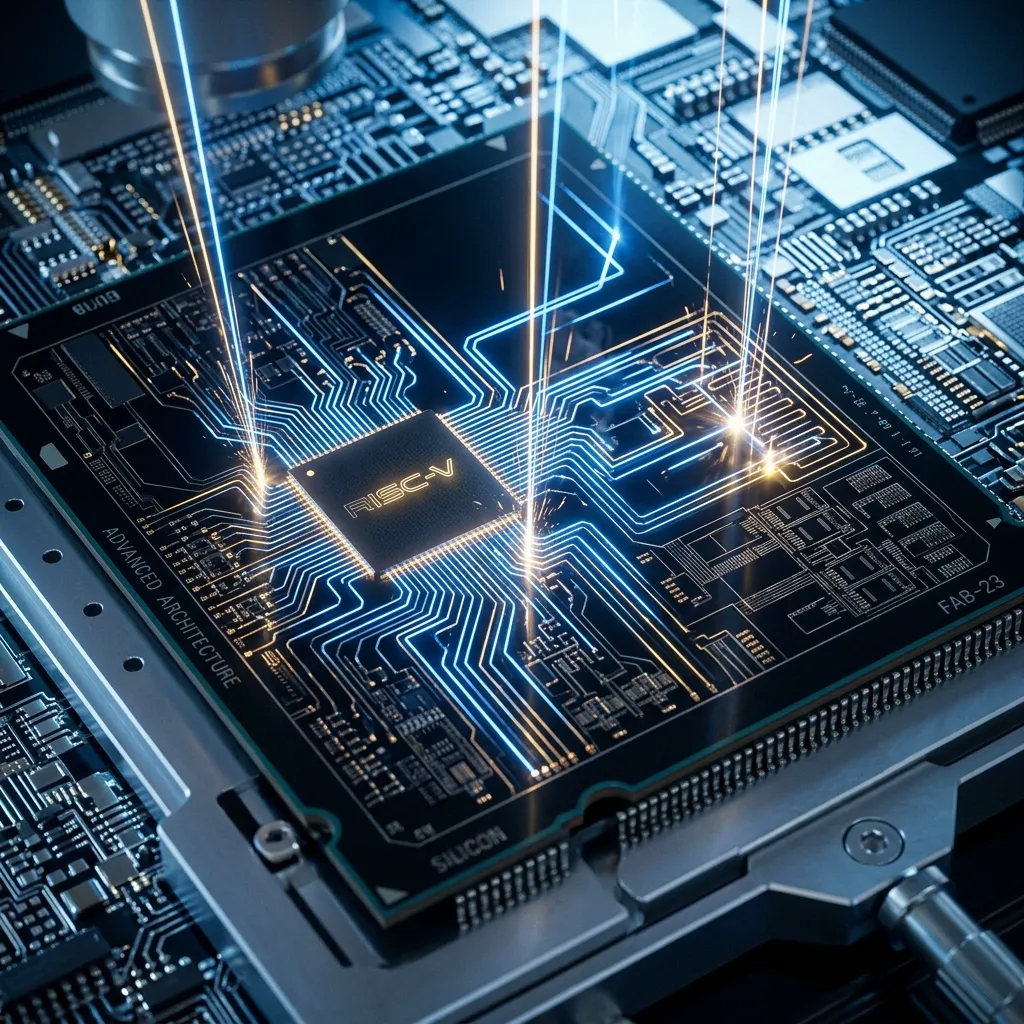
The traditional integrated circuit (IC) design cycle is characterized by high capital expenditure and multi-year development timelines. A significant shift in this paradigm has just occurred.
Researchers at Verkor.io demonstrated a milestone in Electronic Design Automation (EDA) with Design Conductor (DC), an agentic AI system that autonomously synthesized a RISC-V CPU core (VerCore) in approximately 12 hours. This achievement is particularly relevant to the UAE's sovereign hardware initiatives like Khalifa University's RF-GPT.
1. Architectural Overview of VerCore
The VerCore processor is a five-stage in-order pipeline (Fetch, Decode, Execute, Memory, Writeback). While architecturally simple, its performance is notable:
- Frequency: 1.48 GHz on the ASAP7 7nm PDK.
- Benchmark: 3,261 CoreMark score.
- Autonomy: The agent independently selected a fast Booth-Wallace multiplier and optimized branch penalties.
2. The Token-Complexity Paradox
A critical finding is the massive compute overhead. Synthesis required "many tens of billions of tokens." This highlights a non-linear compute scaling issue: as design complexity increases, the token count for debugging and timing closure is expected to grow exponentially.
3. Cognitive Friction in Hardware Modeling
The study identifies "hallucination-adjacent" behaviors in LLMs when applied to hardware description languages (HDLs). The agent frequently reasoned about Verilog—a concurrent language—as if it were sequential software code, hampering its ability to debug complex timing violations.
Technical Insight
The AI tended to underestimate the effort required for physical closure, occasionally attempting to re-architect the entire pipeline to fix simple timing errors that a human expert would resolve via local logic optimization.
4. Verification and Simulation
VerCore remains a "digital twin" without physical silicon. Verification was conducted using Spike (the industry-standard RISC-V simulator) and the design successfully booted a variant of the uCLinux kernel in simulation.
5. Conclusion: The Human-in-the-Loop Necessity
While a 12-hour synthesis is a breakthrough, autonomous does not mean unsupervised. A production-ready chip would still require a core team of experts to correct architectural "blind spots." As Claude Opus 4.7 sets new benchmarks in coding, the path toward fully autonomous silicon design is becoming clearer, albeit with human oversight.