RPA matters, but AI changes how automation works
The Evolution of Automation: Why RPA Still Matters in an AI-Driven World
For years, Robotic Process Automation (RPA) has been the workhorse of the digital enterprise. By deploying software bots to execute repetitive, rule-based tasks—think data entry, invoice processing, and basic report generation—companies successfully slashed manual workloads in finance, operations, and customer support.
However, the automation landscape is undergoing a tectonic shift. As business processes grow more complex and data becomes increasingly unstructured, the "fixed-rule" philosophy of traditional RPA is reaching its limits.
The Limits of Rigid Rules
Traditional RPA thrives in stable environments where inputs are predictable and structured. But today’s business world is messy. Companies are inundated with unstructured data, such as conversational messages, handwritten documents, and varying invoice formats.
When conditions shift or inputs vary, standard bots often "break," leading to high maintenance overhead and diminishing returns. This has prompted a move toward more adaptive automation systems—tools designed to handle uncertainty by blending execution with intelligence.
From "Follow the Steps" to "Understand the Context"
The integration of Machine Learning (ML) and Large Language Models (LLMs) is transforming automation from a series of rigid chains into a flexible web of capabilities.
- Interpretation over Execution: Leading vendors are now enabling bots to interpret context. Instead of just moving a file, the system can understand the sentiment of an email or extract specific nuances from a legal document.
- Beyond Routine Data: Research suggests that Generative AI is shifting the automation frontier toward decision-making and communication—areas previously considered too "human" for software to manage.
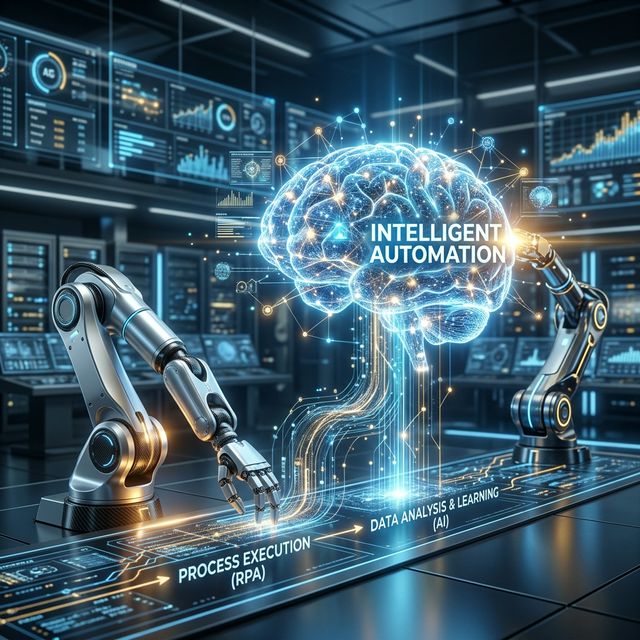
- The Hybrid Approach: Because AI can be unpredictable and produce inconsistent outputs, the most effective strategy is Intelligent Automation. This involves using AI to handle the "fuzzy" inputs and then passing the structured results to RPA for rock-solid, predictable execution.
Why RPA Isn't Going Anywhere
Despite the hype surrounding AI, rule-based automation remains a critical component of the enterprise stack. In highly regulated sectors like banking and healthcare, the predictability and traceability of RPA are its greatest strengths.
Key Use Cases for Standalone RPA:
- Payroll Processing: Where accuracy is non-negotiable.
- Compliance Checks: Where a clear audit trail of fixed rules is required.
- System Integrations: Bridging legacy software that lacks modern APIs.
Rather than a "rip and replace" scenario, we are seeing a gradual transition. RPA provides the "hands" that do the work, while AI provides the "eyes and brain" to understand what needs to be done.
The Path Forward: Intelligent Automation
The future of work isn't a choice between RPA and AI; it’s an orchestration of both. Platforms are evolving into unified ecosystems where data sources, AI-driven decision points, and automated execution steps coexist in a single workflow.
For most organizations, the transformation will be incremental. By layering AI capabilities onto existing RPA frameworks, businesses can tackle more complex problems without discarding the stable, cost-effective systems they already have in place. The rule-based bot isn't retiring—it’s just getting a much smarter supervisor.