How to Check If Your Brand Appears in AI Search Results

Most Gulf businesses have no idea whether they appear in AI-generated answers. They check their Google rankings regularly. They monitor their social mentions. But they have never once opened ChatGPT or Perplexity and asked whether their brand gets cited when a potential buyer asks a relevant question.
This is a significant blind spot. AI search is not a future channel — it is active right now, and buyers across the UAE and Saudi Arabia are using it to discover vendors, compare services, and shortlist suppliers. If your brand does not appear in those answers, you are invisible to that buyer at the most important moment in their decision process.
This guide walks you through exactly how to check your brand's AI visibility — platform by platform — and what to do with what you find.
Why AI Visibility Is Different From Google Rankings
Before running any checks, it is important to understand that AI visibility and Google rankings are separate things. A brand can rank on page one of Google for its target keywords and still be completely absent from ChatGPT or Perplexity answers on the same topic.
This happens because AI models do not run live searches when generating answers. They draw on what they learned during training — the publications that covered your space, the sources that mentioned your brand, the structured content that clearly explained what you do. A brand with strong SEO but weak editorial presence, sparse structured content, and low citation density will rank on Google but disappear in AI answers.
The reverse is also possible — and increasingly common in the GCC. Brands with strong regional editorial coverage and well-structured content are getting cited in AI answers even before their SEO rankings have fully matured.
Want to understand the underlying framework first?
Read our explainer on what GEO is and how it works — covering how AI models select content, what makes a brand citable, and why GEO differs from traditional SEO for Gulf businesses.
Step 1 — Test ChatGPT
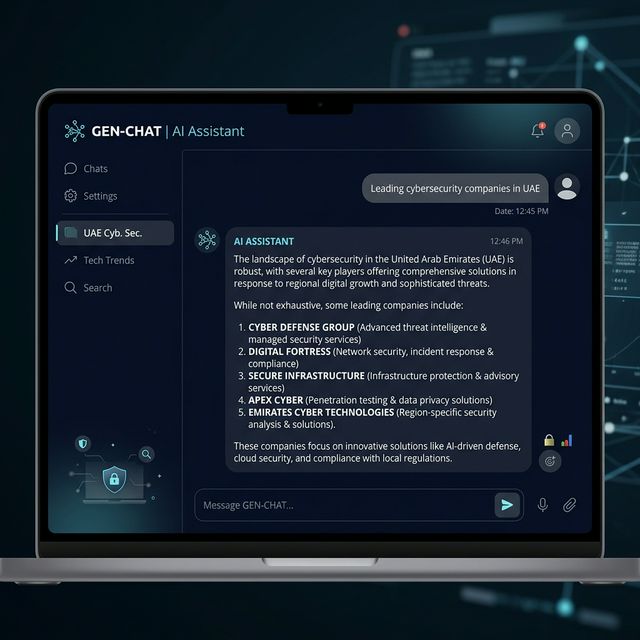
ChatGPT is the most widely used AI assistant globally and the most important platform to test first. Here is how to run a structured brand visibility check:
Open a fresh ChatGPT conversation — do not test in a conversation where you have previously discussed your brand, as context from earlier messages can influence responses.
Run these four query types:
1. Category Query
Ask about your product or service category without mentioning your brand.
- "What are the leading cybersecurity companies operating in the UAE?"
- "Which AI marketing agencies work with Gulf businesses?"
- "What real estate technology platforms are used in Dubai?"
Does your brand appear? If yes, note the position — are you first, third, mentioned in passing? If no, your brand has no citation presence for that query on ChatGPT.
2. Problem Query
Ask about the problem your product solves.
- "How do UAE companies improve their AI search visibility?"
- "What should a Saudi business do to protect against ransomware?"
This tests whether your content is being used as a source for solution-led queries — typically higher buying intent than category queries.
3. Comparison Query
Ask ChatGPT to compare vendors in your space.
- "Compare GEO agencies in the GCC"
- "What are the differences between cyber risk assessment providers in the UAE?"
Comparison queries reveal whether your brand is considered a legitimate peer to your competitors. If competitors appear and you do not, that is your most urgent GEO gap.
4. Direct Brand Query
Ask about your brand by name.
- "What is [your company name] and what do they do?"
- "Tell me about [your company name] in Dubai"
If ChatGPT cannot answer this or gives inaccurate information, your brand entity is not well established in its training data. This is fixable but requires a deliberate entity-building strategy.
Step 2 — Test Perplexity
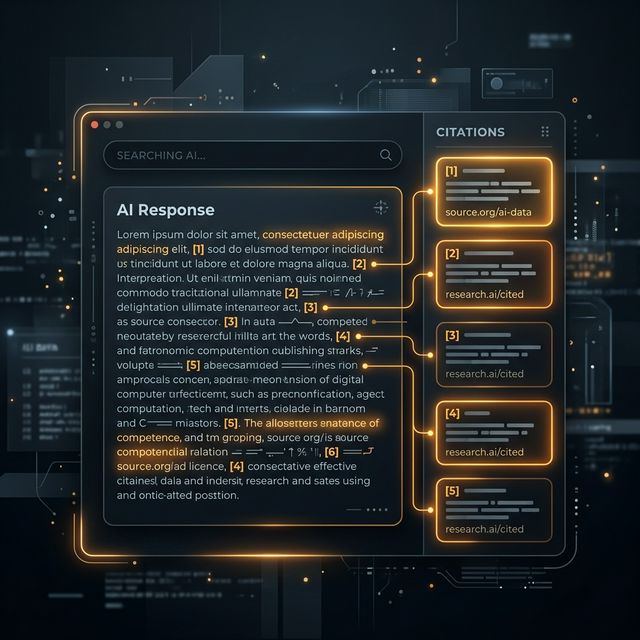
Perplexity is the fastest-growing AI search engine globally and is particularly popular among professional and research-oriented users — exactly the demographic making B2B purchasing decisions in the Gulf.
Unlike ChatGPT, Perplexity runs live web searches and cites its sources directly in the answer. This makes it especially valuable for brand visibility testing because you can see exactly which sources are being cited.
Go to perplexity.ai and run the same four query types you used for ChatGPT.
Pay particular attention to two things:
- Which sources are being cited? Perplexity shows the source URLs it drew from to generate its answer. If your competitors are being cited through Gulf News, Zawya, or industry publications and you are not, you know exactly what kind of editorial coverage you need to build.
- Is your brand mentioned in the answer text? Even if your own website is not cited as a source, your brand may still appear in the answer if you have been mentioned by publications that are being cited. This is a weaker form of visibility but still meaningful.
Step 3 — Test Google AI Overviews
Google AI Overviews appear at the top of search results for an increasing proportion of queries — particularly informational and research-oriented queries that align with B2B buyer behaviour.
Open Google in a browser and search for your target category and problem queries. If an AI Overview appears at the top of the results, note whether your brand is mentioned or cited within it.
Google AI Overviews draw heavily from sources that Google already considers authoritative for the topic — meaning strong traditional SEO and strong GEO tend to reinforce each other here more than on other platforms. If you are ranking well on Google but not appearing in AI Overviews for the same queries, your content likely lacks the structured, answer-led format that AI Overview generation favours.
Step 4 — Test Arabic Queries

This step is skipped by almost every Gulf business running AI visibility checks — and it is the most consequential omission.
Arabic-speaking buyers represent a majority of the Gulf population and a large proportion of B2B decision-makers in Saudi Arabia, Kuwait, Bahrain, Oman, and Qatar. Their AI queries are in Arabic. The answers they receive are drawn from Arabic-language content — a substantially different content pool from the English-language web.
Run your category, problem, and comparison queries in Arabic on ChatGPT and Perplexity. If you do not have Arabic speakers on your team, use a translation tool to generate the Arabic versions of your test queries — but make sure the translation is natural, not literal.
What you will almost certainly find
Your English-language GEO efforts have not translated into Arabic AI visibility at all. This is the core finding that most Gulf businesses need to act on — and it is why GEO agencies operating in the GCC increasingly offer Arabic GEO as a distinct service line.
Step 5 — Test Regional AI Models
For businesses targeting Saudi Arabia specifically, testing visibility on Arabic-first regional models is increasingly important.
Jais Chat
The consumer interface for the Jais 2 model developed by MBZUAI in Abu Dhabi. Jais 2 is trained heavily on Arabic-language Gulf content and is used by Arabic-speaking users across the GCC. Run your standard query set here.
Fanar
Qatar's national AI assistant, built on Arabic-language training data. Relevant for businesses targeting the Qatari market specifically.
Visibility on these platforms requires Arabic-language content that has been published on sources these models were trained on — regional Arabic publications, government-adjacent content, and Arabic-language industry media.
How to Track AI Visibility Over Time
Running a one-time check tells you where you stand today. Tracking visibility over time tells you whether your GEO efforts are working.
Manual Tracking
Run your core query set across all platforms once a month. Log whether your brand appears, the position of the mention, and which sources are being cited. A simple spreadsheet with dates, queries, platforms, and presence/absence is sufficient to start.
GA4 Referral Traffic
Check your Google Analytics 4 referral traffic sources for visits from chatgpt.com, perplexity.ai, and claude.ai. These are direct signals that AI users are clicking through to your site from AI-generated answers. Even small volumes of this traffic indicate growing AI citation presence.
Dedicated GEO Tracking Tools
Platforms including Profound, Otterly.AI, and Scrunch AI offer automated AI citation monitoring across multiple platforms. These are worth investing in once your GEO programme is established and you need systematic tracking at scale.
What to Do With What You Find
Once you have run your visibility checks, you will typically find one of three situations:
Your brand does not appear at all
Your GEO foundation needs to be built from scratch. Focus on structured content creation, entity building across the web, and earning editorial mentions in regional publications. Understand what GEO is and how it works before prioritising tactics.
Your brand appears inconsistently
You have some GEO presence but it is fragile and dependent on a small number of sources. Focus on diversifying your citation sources and improving the structure and depth of your content.
Your brand appears in English but not in Arabic
This is the most common finding for Gulf businesses that have invested in content marketing. Your English GEO is working. Your Arabic GEO does not exist. Prioritise Arabic content creation and citations from Arabic-language regional publications immediately.
Frequently Asked Questions
How often should I check my brand's AI visibility?
Monthly manual checks are sufficient for most organisations. If you are running an active GEO programme with regular content publishing, check every two weeks to track progress. Major content initiatives — a new research report, significant press coverage, a product launch — warrant an immediate check to see if visibility has shifted.
Does appearing in AI results drive measurable traffic?
Yes, though volumes are still relatively small compared to organic search for most brands. Check your GA4 referral report for chatgpt.com and perplexity.ai. Even a handful of monthly visits from these sources indicates AI citation presence — and those visitors are disproportionately high-intent, research-oriented buyers.
Can I request that an AI model include my brand?
No — AI models cannot be directly instructed to cite specific brands. Visibility is earned through the quality, structure, and reach of your content and the breadth of your editorial coverage. The only exception is paid placement programmes that some AI platforms are beginning to test, but these are distinct from organic citation and are clearly labelled as sponsored.
My competitor appears in AI results but I do not. What should I do first?
Analyse the sources that are citing your competitor. Perplexity makes this easy — it shows source URLs directly. Identify the publications, directories, and content formats driving their citations and build a targeted strategy to appear in those same sources with content that demonstrates equivalent or superior expertise.
Conclusion
AI visibility is not something that will matter eventually — it matters now, for Gulf businesses operating in markets where AI tool adoption is among the highest globally. The brands that run these checks today, find their gaps, and act on them will be the brands that own AI citation presence in their categories six months from now.
The brands that wait will find themselves competing against deeply entrenched citation profiles that take years to displace.
Run the checks. Find the gaps. Then build — systematically, in both English and Arabic, with the regional publications and structured content formats that AI models in the GCC are actually drawing from.
For a ranked guide to agencies that can help build your GEO presence in the region, see our coverage of GEO agencies operating in the GCC.